
MiniMax M3 adds OpenCode, Hermes Agent, Atomic Chat, and Vercel AI Gateway support
A day after MiniMax M3 launched, OpenCode, Hermes Agent, Flowith, Atomic Chat, Kilo Code, Cloudflare AI Gateway, and Vercel AI Gateway shipped support. That breadth shows M3 plugged into agent harnesses and routing layers immediately, not just its own API.
TL;DR
- MiniMax shipped M3 on May 31 with three headline claims in one package, according to MiniMax's launch post: frontier coding and agent performance, 1M-token context via MiniMax Sparse Attention, and native multimodality. WesRoth's benchmark summary and haider1's launch recap echoed the same positioning from the first wave of posts.
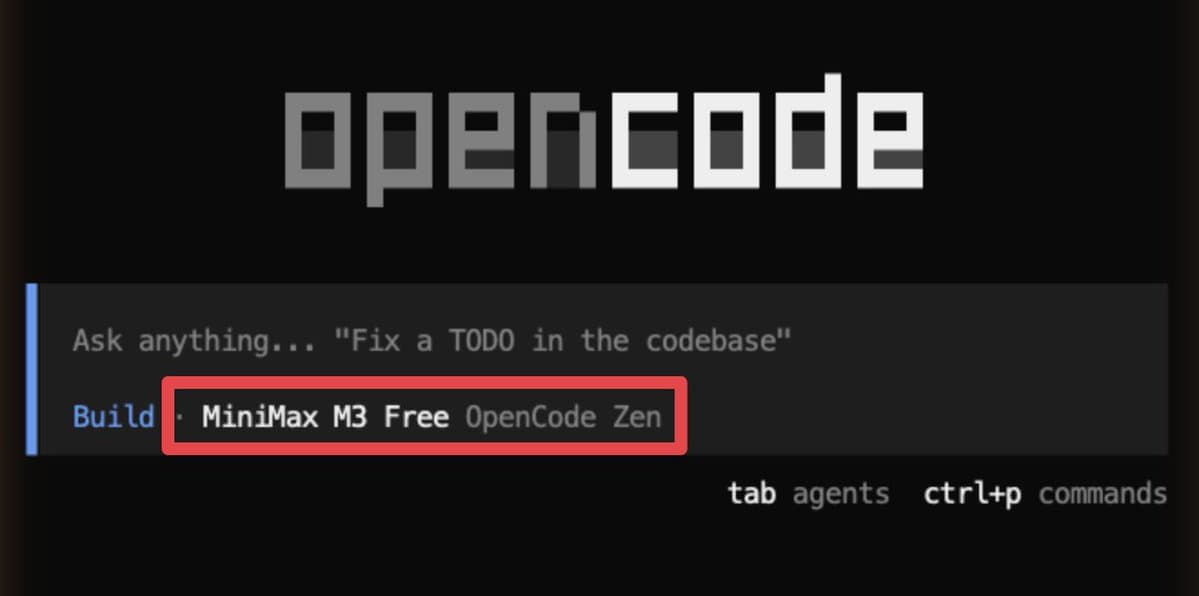
- The interesting part was the rollout shape: opencode's early access post put M3 in OpenCode before the formal launch window finished, while Teknium's Hermes Agent post and MiniMax_AI's Hermes repost showed agent harness support landing immediately.
- By the end of day one, M3 had also landed in consumer and comparison surfaces, with flowith's support post advertising side by side runs and testingcatalog's Atomic Chat demo showing a multimodal one-shot game build from a hand-drawn sketch.
- The routing layer lit up fast too: vercel_dev's AI Gateway post published the model slug as
minimax/minimax-m3, while MiniMax_AI's Cloudflare AI Gateway post and MiniMax_AI's Novita post pushed discount-driven day-one access through gateways and providers. - One caveat surfaced just as quickly: DillonUzar's Context Arena note said OpenRouter was exposing only about 524k context, and DillonUzar's follow-up repost added that the MiniMax API itself was not yet serving the full 1M window.
You can read MiniMax's official announcement, inspect Vercel's AI Gateway changelog, and check the live Vercel model page. The weirder reveal is that the launch story was not just "new model, new API": OpenCode had free access first, Hermes auto-added it to model pickers, and Context Arena immediately found that the advertised 1M window was not fully exposed in practice.
OpenCode and Hermes Agent
OpenCode and Hermes made the quickest point about M3's launch: this model showed up inside existing agent harnesses, not just on MiniMax's own surface.
OpenCode's post went up on May 31 and said users could try M3 "right now" for free. Hermes followed by wiring M3 into Nous Portal, OpenRouter, and direct MiniMax providers, with Teknium's Hermes Agent post noting that it appeared in the model picker automatically.
That matches the product framing in MiniMax's launch post, which pushes M3 as a coding and agent model first, then pairs it with MiniMax Code as the preferred agent product. The external integrations made that claim feel real faster than a benchmark chart would.
Atomic Chat and Flowith
Atomic Chat and Flowith turned the launch into something you could poke at from two different angles: a multimodal build demo and a side by side comparison UI.
According to testingcatalog's Atomic Chat demo, Atomic tested M3 on a task that started with a hand-drawn napkin sketch and ended with game logic, UI, and a playable HTML platformer in one pass for $0.028. That is promotional material, but it is still a concrete demo of the multimodal coding pitch.
Testingcatalog's companion post described M3 as MiniMax's latest model with 1M-token context, native multimodality, agentic reasoning, and Sparse Attention, while flowith's support post stressed 1M context and compare mode. Together they show where M3 was being positioned on day one: not as a chatbot replacement, but as a model for agent runs and multimodal coding workflows.
AI Gateway and routing layers
The gateway rollout was unusually broad for day one, and it matters because gateways decide where a model becomes one fetch away instead of one vendor integration away.
Vercel's changelog says M3 is available through AI Gateway with the slug minimax/minimax-m3, and describes support for image input, software engineering tasks, terminal tool use, and agentic web browsing in the official announcement. The Vercel model page also lists 1M context and pricing that resolves to $0.60 per million input tokens and $2.40 per million output tokens before the launch discount.
The surrounding posts fill in the distribution map quickly:
- MiniMax_AI's Cloudflare AI Gateway post said M3 was on Cloudflare AI Gateway day one.
- vercel_dev's AI Gateway post and MiniMax_AI's Vercel follow-up both advertised a one-week 50 percent discount.
- MiniMax_AI's Novita post offered the same first-week 50 percent cut through Novita.
- MiniMax_AI's Qubrid post pushed an early-adopter discount through Qubrid.
- MiniMax_AI's TokenRouter repost added PBD TokenRouter to the list.
This is Christmas-come-early behavior for agent infrastructure people. M3 did not wait for one canonical endpoint to win distribution. It hit harnesses, gateways, and comparison tools all at once.
Benchmarks and early hands-on reports
MiniMax's official blog anchored the launch around coding and agent benchmarks, and the ecosystem repeated those numbers almost verbatim.
The official benchmark set from MiniMax's launch post and WesRoth's benchmark summary breaks down like this:
- SWE-Bench Pro: 59.0%
- Terminal-Bench 2.1: 66.0%
- SWE-fficiency: 34.8%
- KernelBench Hard: 28.8%
- MCP Atlas: 74.2%
Vercel added a different kind of eval signal. According to vercel_dev's Next.js evals post, M3 ranked as the highest open-source model on Next.js evals at #6 overall, with a 75% base score and 96% with AGENTS.md.
The early user tone was more skeptical than celebratory. bridgemindai's hands-on post said benchmarks get "benchmaxed" and started a live test on a real codebase with real TODOs and no cherry-picking. That reaction matters because it is exactly how coding model launches get stress-tested now: not by asking whether the chart is high, but by dropping the model into an existing harness and seeing whether it survives real repo work.
The 1M context caveat
The sharpest new finding on day one was not another integration. It was that the advertised 1M context window was not fully reachable everywhere M3 was already being routed.
Context Arena tested M3 on 8-needle GDM-MRCRv2 and reported a big jump over M2.7 through the 8k to 64k range, with AUC at 128k rising from 25.2% to 39.2%. The same post said OpenRouter was exposing only about 524k max context, which blocked 512k and 1M runs in that setup.
The follow-up was blunter. According to DillonUzar's follow-up repost, pingToven said the MiniMax API itself did not currently serve the full 1M context and would be updated once available. That leaves an awkward but useful split in the launch record: MiniMax's official announcement sells 1M context as a defining property, while the first public eval thread found that the full window was not yet exposed end to end.
That does not erase the rollout story. It sharpens it. M3 arrived everywhere at once, but one of its flagship specs was still catching up to the distribution footprint.