
OpenAI says Astra produced 10 Lean 4-certified math results
OpenAI says an internal Astra model generated arguments for ten long-standing math and theoretical CS problems, with Lean 4 certificates in openai/ten-proofs. Posts focused on the reported sub-$2,000 inference cost.
TL;DR
- OpenAI says an internal Astra model generated arguments for ten long-stalled math and TCS results, with humans preparing manuscripts and the model later producing Lean certificates; polynoamial framed it as a major step for scientific reasoning.
- The cleanest technical artifact is
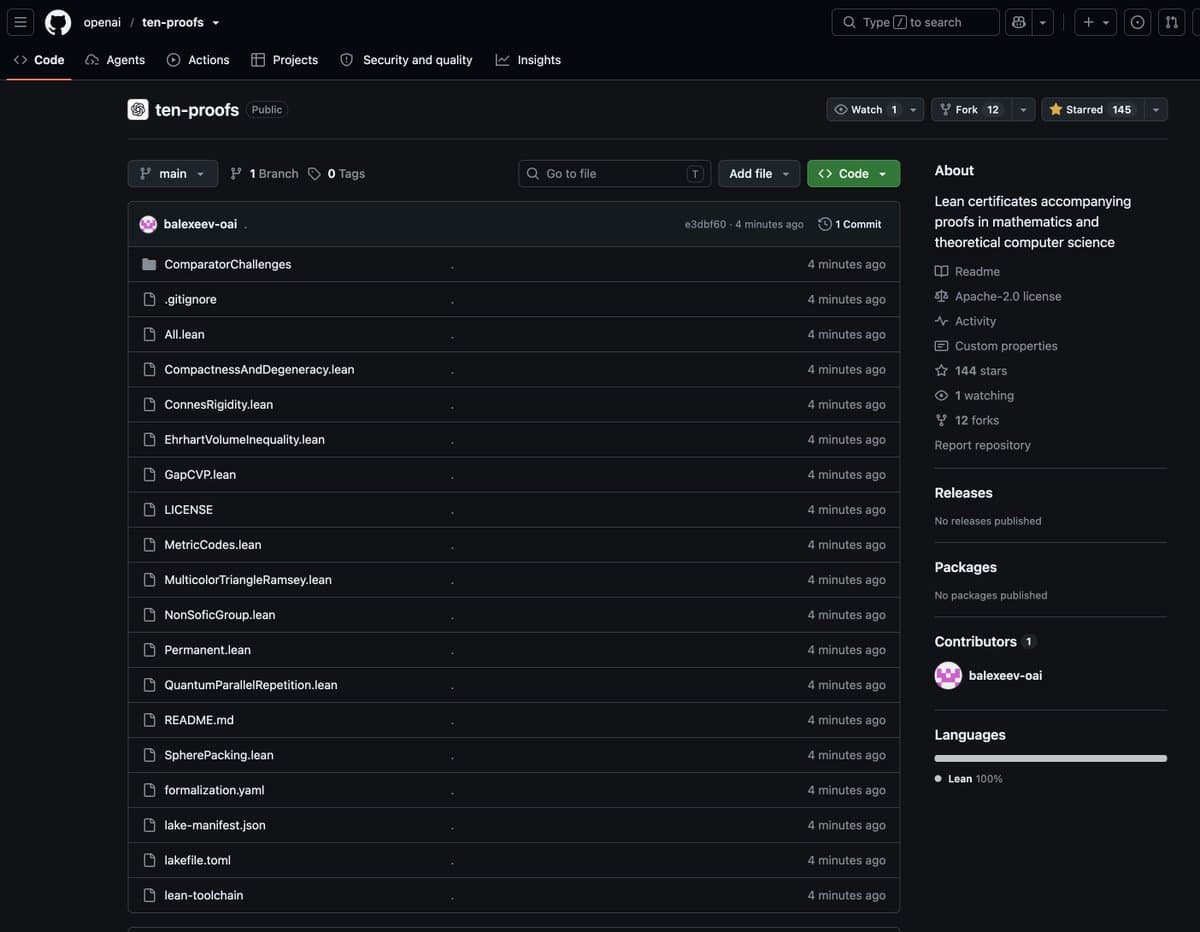
openai/ten-proofs, because paoloanzn counted roughly 522K lines of Lean 4 for sphere packing, Connes rigidity, non-sofic groups, GapCVP, and the rest. - The cost claim is narrow: successful solution-search tokens for all ten were under $2,000 at Sol API rates, according to polynoamial's cost post, while polynoamial's follow-up says other major problems failed.
- Astra is still unreleased, and chetaslua's screenshot says OpenAI had not decided whether to label it GPT-6 or GPT-5.7.
- OpenAI drew a hard authorship line, with the attribution screenshot saying humans prepared and formalized the work but the mathematical arguments came from the system.
The official post has the full ten-result list, the GitHub repo builds with lake build All, and the Comparator challenge README gives an independent checker path. The strange number is the roughly $2,000 combined search cost, not a benchmark score. Simon Willison's Weblog caught the missing piece: the papers and walkthroughs are public, but the prompts and full failed-experiment ledger are not.
The Astra proof drop
OpenAI published the results on August 1, saying they came from “an internal version of Astra, our next major model.” According to OpenAI's announcement, the targets had seen no progress on the main result for at least a decade, often longer.
The workflow matters more than the launch theater:
- Astra generated the mathematical arguments.
- Humans prepared manuscripts with the same model.
- The proofs were formalized as Lean certificates.
- OpenAI released model-written reasoning walkthroughs for each solution.
The OpenAI post also ties the release to its ChatGPT for Academic Researchers program, which is starting with 10,000 researchers this summer and expanding toward 100,000 through 2027.
The ten results
OpenAI's list spans eight areas: high-dimensional geometry, coding theory, arithmetic circuit complexity, group theory, operator algebras, quantum complexity, lattice cryptography, and extremal combinatorics.
- High-dimensional sphere packing: new upper bounds down to the Cohn-Elkies threshold.
- Binary and spherical codes: exponential-factor improvements for fixed-distance codes.
- Non-sofic groups: a construction establishing that non-sofic groups exist.
- Connes's rigidity conjecture: a disproof via nonisomorphic property-(T) groups with the same group von Neumann algebra.
- Arithmetic circuit complexity: lower bounds for the permanent, including an
n^4 / log nformula lower bound. - Quantum parallel repetition: exponential parallel repetition for finite two-player entangled games.
- Closest vector problem: polynomial-factor hardness of approximation, with lattice and decoding consequences.
- Ehrhart's volume conjecture: the sharp maximum volume in every dimension for a convex body whose centroid is its only interior lattice point.
- Multicolor Ramsey numbers:
R_k(3) = k^Θ(k), resolving Erdős problem 183. - Compactness and degeneracy: separate graph constructions resolving Erdős problems 146 and 180.
The list is wild because it is not one math trick repeated ten ways. It crosses proof styles and verification surfaces.
Lean 4 certificates
The openai/ten-proofs repository says it contains Lean 4 formalizations for all ten results, using Lean 4.32.0, mathlib, and Lake.
The build path is short:
Individual modules can be built directly, for example:
The Comparator challenge README adds a second checking path using landrun, lean4export, and nanoda_bin:
Lean checks the formal statement inside the proof assistant. The separate review question is whether each formal statement captures the intended mathematical claim, a point also raised in The Colony's analysis.
The 2000 dollar search bill
The number that blew up the timeline was not a training budget. It was OpenAI's estimate for the tokens needed to find the ten successful solutions, priced at Sol API rates.
A few numbers and caveats sit together:
- Successful search runs: under $2,000 combined, according to polynoamial's cost post.
- Implied average: roughly $200 per announced problem, as rohanpaul_ai put it.
- Failed attempts: polynoamial's follow-up says OpenAI tried other major problems and got no Millennium Prize result.
- Spend depth: the same follow-up says OpenAI “didn't spend a lot on each problem,” leaving more test-time compute on the table.
polynoamial added that OpenAI believes the fastest route to a Millennium Prize problem is building the next generation of general-purpose models, not throwing a large human team directly at the prize.
Astra as a long-horizon model
The math release landed after screenshots of The Information's Astra report circulated. The screenshot says Sam Altman demoed Astra to policymakers and regulators in Washington, D.C., with OpenAI touting multiple agents working together over a long period on hard projects and advanced math.
That report framed Astra as:
- a new model family for long-running tasks;
- a new class alongside Sol, Terra, and Luna;
- a multi-agent system for hard projects;
- an unreleased model with no public launch date;
- a model whose final label could be GPT-6 or a GPT-5 series release such as GPT-5.7.
The proof drop is the first public artifact that gives the “long-running tasks” pitch teeth.
The limits OpenAI stated
polynoamial said Astra is not “building new branches of mathematics” or “posing interesting new conjectures.” That is the research-taste boundary people kept circling.
The same thread says no Millennium Prize problem fell, and other major targets failed. The reported capability is targeted proof discovery on human-posed problems with strong verification, not autonomous field selection.
Ethan Mollick also noted that for most people the results are hard to feel directly because the problems sit beyond ordinary intuition; emollick said the public has to rely on expert mathematicians to judge how impressive they are.
Attribution and the math community
OpenAI's responsibility section says claiming human authorship for a proof generated entirely by an AI system would misrepresent both the system's contribution and human intellectual work. It also says OpenAI helped prepare the manuscripts and formalize the proofs in Lean, and takes responsibility for correctness.
The human reaction was already loaded. The Dark Night of Mathematics, a pre-release essay by mathematician Kirwin Hampshire, described a “profound spiritual crisis” around AI-produced mathematics, and Ryan Lowe pointed back to it after the Astra announcement.
Ethan Mollick placed the result in the same category as coding, math, and other formal domains where verifiable answers can make capability jumps more visible; emollick argued that limits in less-verifiable fields do not stop models from improving there too.
The reproducibility gap
Ten advances in mathematics and theoretical computer science
Ten advances in mathematics and theoretical computer science A few days ago it was Anthropic discovering cryptographic weaknesses with Claude using Mythos Preview, spending $100,000 on tokens and with prompts that included "again we are not looking for low hanging fruit, we want proper research to find genuinly hard findings." Now it's OpenAI's turn to flex. They set "an internal version of Astra, our next major model" on finding solutions to ten mathematical problems that "have seen no progress on the main result for at least a decade". They claim to have spent less than $2,000 at GPT-5.6 Sol token prices on each one. (No news on how many problems they spent $2,000 on without reaching a solution though.) The openai/ten-proofs repository has Lean 4 formalizations of their results, and there's also a paper describing the solutions and an additional LLM-generated PDF where the model "reconstructs how the proof came together" based on the unpublished reasoning traces. That's a decent level of transparency, but I want to see the prompts they used! A lot of mathematicians online are experiencing a collective burst of Deep Blue. Mathematician Kirwin Hampshire published an impassioned essay last week, The Dark Night of Mathematics, describing "a profound spiritual crisis" brought on by previous (and less significant) results. OpenAI's results reminds me of what Terence Tao described as "big mathematics" in IEEE Spectrum in June: Unlike some of his peers, Tao is neither dismissive of
Willison called the Lean repo, paper, and LLM-generated reasoning PDF “a decent level of transparency,” then named the missing artifact: prompts. He also noted that OpenAI did not disclose how many unsuccessful problems consumed comparable search budgets.
A Hacker News discussion pushed the same reproducibility frame: AI-powered math may need publication formats closer to experimental science, with model type, inference settings, seeds, and full prompt history disclosed.
That is the unresolved engineering gap in the release. The proofs are checkable; the discovery process is only partially inspectable.