
OpenAI releases GPT-5.4, GPT-5.5, and Codex on Amazon Bedrock
OpenAI made GPT-5.4, GPT-5.5, and Codex generally available through Amazon Bedrock. AWS shops can now use OpenAI models inside existing IAM, compliance, and procurement workflows instead of adopting a separate vendor stack.
TL;DR
- OpenAI made GPT-5.4, GPT-5.5, and Codex generally available on Amazon Bedrock, and OpenAI's launch post framed the pitch around existing AWS security, compliance, and governance workflows.
- AWS's launch note says GPT-5.5 and GPT-5.4 run on Bedrock for production workloads, while TheRealAdamG's repost of AWS adds AWS's automatic-scaling framing.
- Codex can now point at Bedrock by setting
model_provider = "amazon-bedrock", and reach_vb's setup post says the same path works for local CLI, desktop, and IDE workflows with AWS IAM. - The OpenAI and AWS docs bury the real caveat: Bedrock gives you a mostly compatible Responses API path, but the Codex Bedrock guide says Fast Mode, hosted plugins, cloud agents, image generation, and voice transcription are unavailable there.
- OpenAI also used testingcatalog's quote of the announcement and the official post to tee up a broader AWS expansion, including future availability for Daybreak and Codex Security.
You can read OpenAI's own announcement, the AWS-side what shipped note, and the practical Codex on Bedrock guide. The weirdly important detail lives in Amazon Bedrock Mantle, which is AWS's OpenAI-compatible Responses API endpoint. OpenAI also published a separate Bedrock guide that is unusually direct about when Bedrock differs from the first-party OpenAI API.
Amazon Bedrock path
The launch is less about a new model than a new control plane. In OpenAI's announcement, the company says enterprises can buy and deploy OpenAI through existing AWS procurement, billing, security, and governance flows instead of standing up a separate vendor path.
AWS describes the same move in more infrastructure terms. Its what's new post says GPT-5.5, GPT-5.4, and Codex are now production-ready on Bedrock's next-generation inference engine, while the machine learning blog says GPT-5.5 pricing matches OpenAI's first-party rates and Codex usage counts toward existing AWS commitments.
That commit-spend angle is exactly what embirico's reaction picked up on, and levie's post argued the partnership should expand OpenAI distribution inside AWS-heavy enterprise accounts.
Codex setup
The configuration change is tiny. reach_vb's post says setting model_provider = "amazon-bedrock" is enough to run Codex against OpenAI models on Bedrock, and the Codex Bedrock doc confirms that local CLI, desktop app, and IDE extension flows are supported.
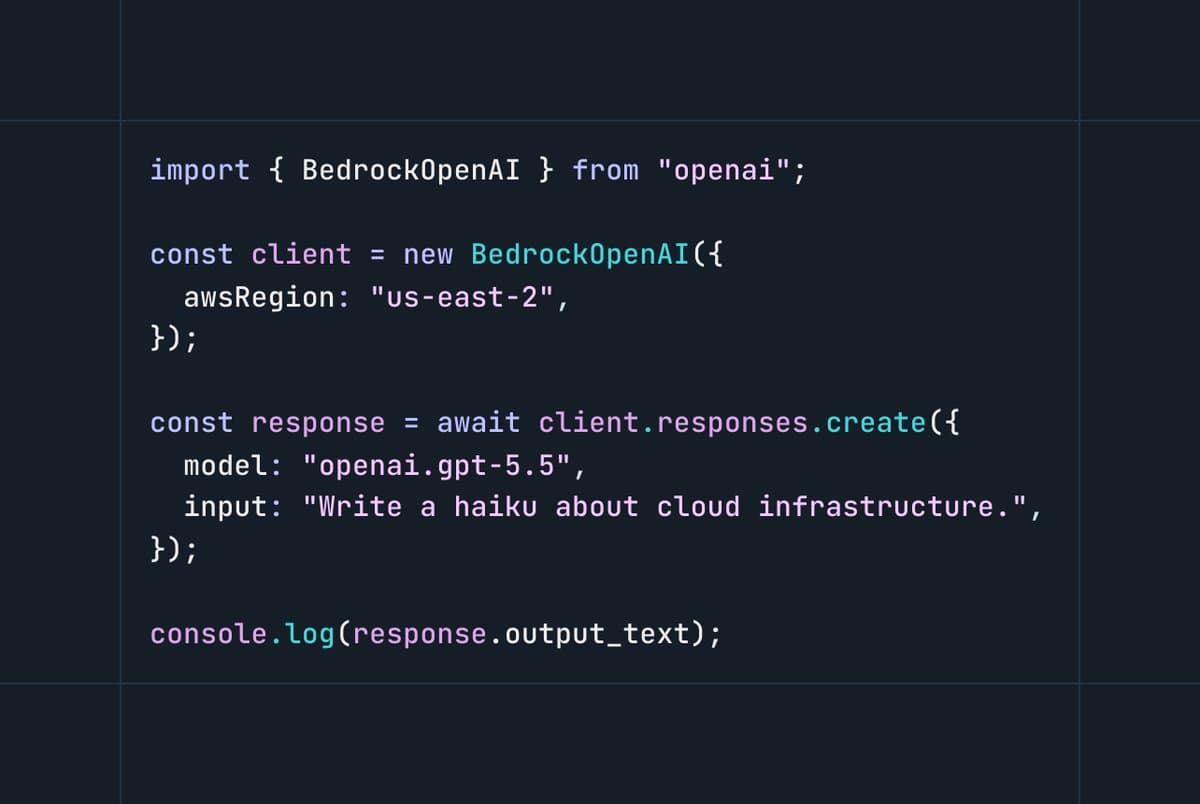
The integration works because Bedrock exposes an OpenAI-compatible Responses API. In AWS's Mantle docs, Amazon says developers can keep familiar OpenAI SDKs and tools, then swap the base URL to bedrock-mantle.<region>.api.aws/v1 and authenticate with a Bedrock API key or standard AWS credentials.
The auth story changes more than the SDK story. The OpenAI Bedrock guide says AWS owns account access, regional availability, and billing around the model path, which is the whole reason this ship matters to teams already standardized on IAM and AWS-native controls.
Feature gaps
The Bedrock route is not the same product surface as calling OpenAI directly. The Codex guide says Bedrock-backed Codex supports local workflows only, with these limits:
- Fast Mode is unavailable.
- GovCloud regions are unsupported.
- Hosted plugins are unavailable.
- Cloud agents are unavailable.
- Image generation is unavailable.
- Voice transcription is unavailable.
There are model-surface caveats too. AWS's OpenAI model docs say the Bedrock OpenAI path supports text input and text output, plus InvokeModel, Converse, Chat Completions compatibility, batch inference, and guardrails headers.
That makes this a clean fit for a lot of existing app and coding-agent workloads, but not a mirror of the full first-party OpenAI platform. The OpenAI Bedrock guide explicitly tells developers to stay on the direct OpenAI API when they need the broadest feature coverage or the latest first-party capabilities.
Daybreak
OpenAI used the Bedrock launch to preview the next item in the pipeline. In OpenAI's announcement, the company says this is the start of a broader AWS expansion and calls out future availability for Daybreak, which testingcatalog's quote post describes as OpenAI's cybersecurity package, including cyber models and Codex Security.
That future-looking note is absent from most of the reaction posts, but it matters because it extends the partnership beyond model hosting. If Daybreak lands on the same Bedrock path, AWS becomes a distribution channel not just for OpenAI inference, but for the company's security tooling too.