
Reuters, WSJ: OpenAI reportedly lines up PE-backed B2B distribution partners
Reuters and The Wall Street Journal separately reported that OpenAI is lining up private-equity-backed distribution partners while narrowing its strategy around coding and business productivity. Watch the channel strategy if you sell into enterprises, where distribution may matter as much as model quality.
TL;DR
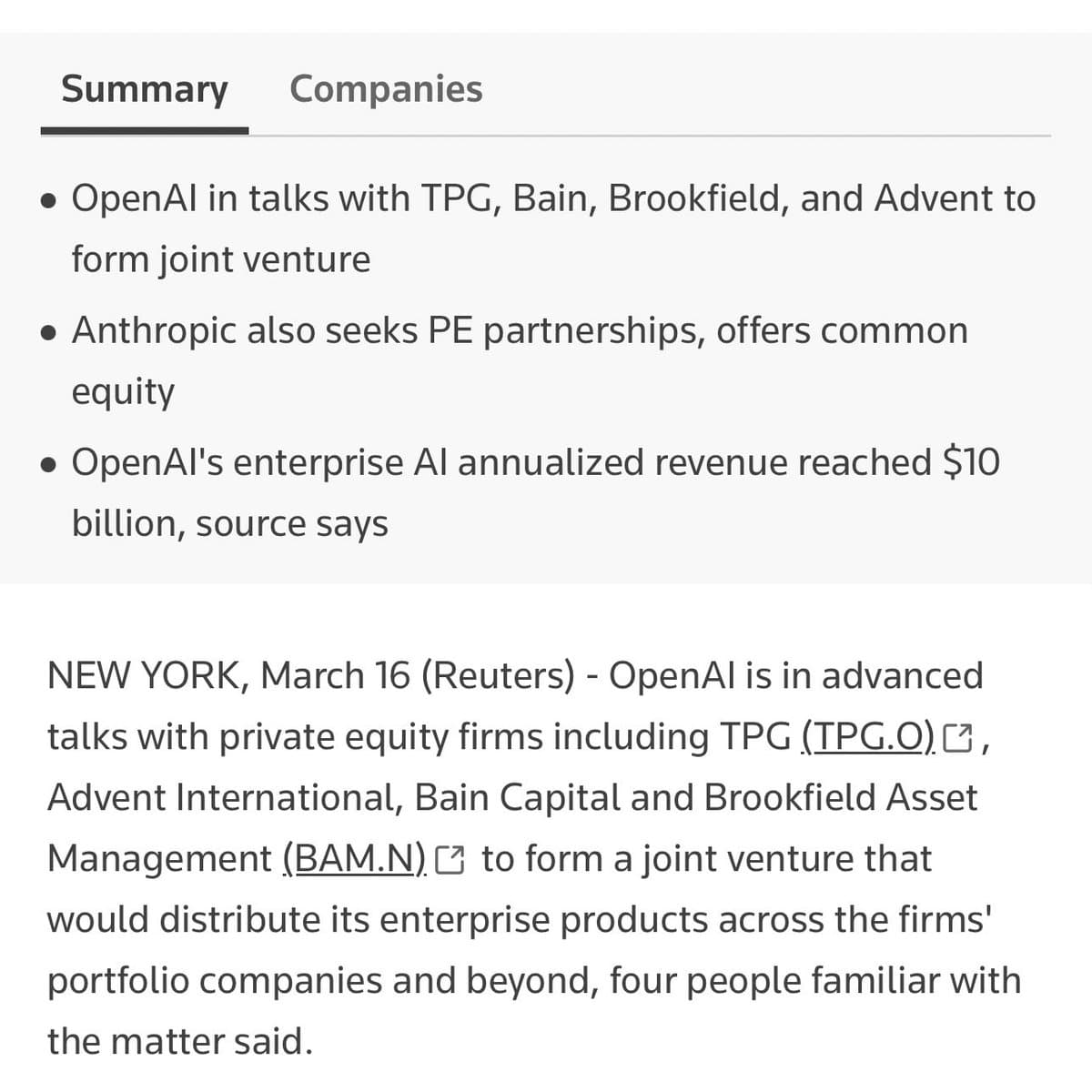
- Reuters, via the reported talks, says OpenAI is in advanced discussions with TPG, Bain, Brookfield, and Advent on a joint venture to distribute its enterprise AI products across portfolio companies and beyond.
- The same Reuters reporting, as summarized in a second source post, pegs the vehicle at about a $10 billion pre-money valuation with roughly $4 billion in investor commitments, though the talks are still private and not final.
- OpenAI's channel move is arriving as Anthropic reportedly pursues similar PE partnerships, with the Reuters summary describing a broader race to lock up enterprise distribution rather than just compete on model quality.
- Separately, The Wall Street Journal excerpt shared in the WSJ screenshot says OpenAI leadership is narrowing focus toward coding and business productivity, with Fidji Simo telling staff the company cannot be “distracted by side quests.”
What is OpenAI reportedly building?
Reuters' reported structure is not a new model launch or API tier. It is a distribution JV aimed at getting OpenAI's enterprise products sold into the companies already controlled by large private-equity firms, with the Reuters summary saying those firms would help distribute OpenAI's tools “across their portfolio companies and beyond.”
The more detailed Reuters summary in the deal post says TPG would be the anchor investor, with Advent, Bain, and Brookfield as co-founding investors, and that all four would get board seats. That same post says the arrangement could give those firms early access to OpenAI's enterprise tools. For engineers, the practical signal is that enterprise adoption may be shaped increasingly by procurement channels and rollout partners, not only by direct product demand.
Why does this matter for engineering teams?
The WSJ excerpt in the WSJ screenshot frames this as part of a broader strategy reset: OpenAI is refocusing around “coding and business users,” and Simo's line about avoiding “side quests” suggests internal prioritization behind enterprise productivity workloads. That makes the PE push look less like a one-off financing story and more like a go-to-market layer for coding, workflow, and agent deployments inside large companies.
Anthropic is reportedly pursuing a similar path, according to the Reuters-based post, which cited discussions with Blackstone, Permira, and Hellman & Friedman. A practitioner summary in one reaction thread captures the shift cleanly: frontier model companies are building “distribution alliances” around the groups that already “control enterprise decision-making.” If that pattern holds, engineers evaluating vendors may increasingly see model access, services, and internal rollout packaged through PE- and consultancy-shaped channels rather than bought as standalone software.