
OpenHands adds Agent Client Protocol support to Agent Canvas, SDK, and Cloud
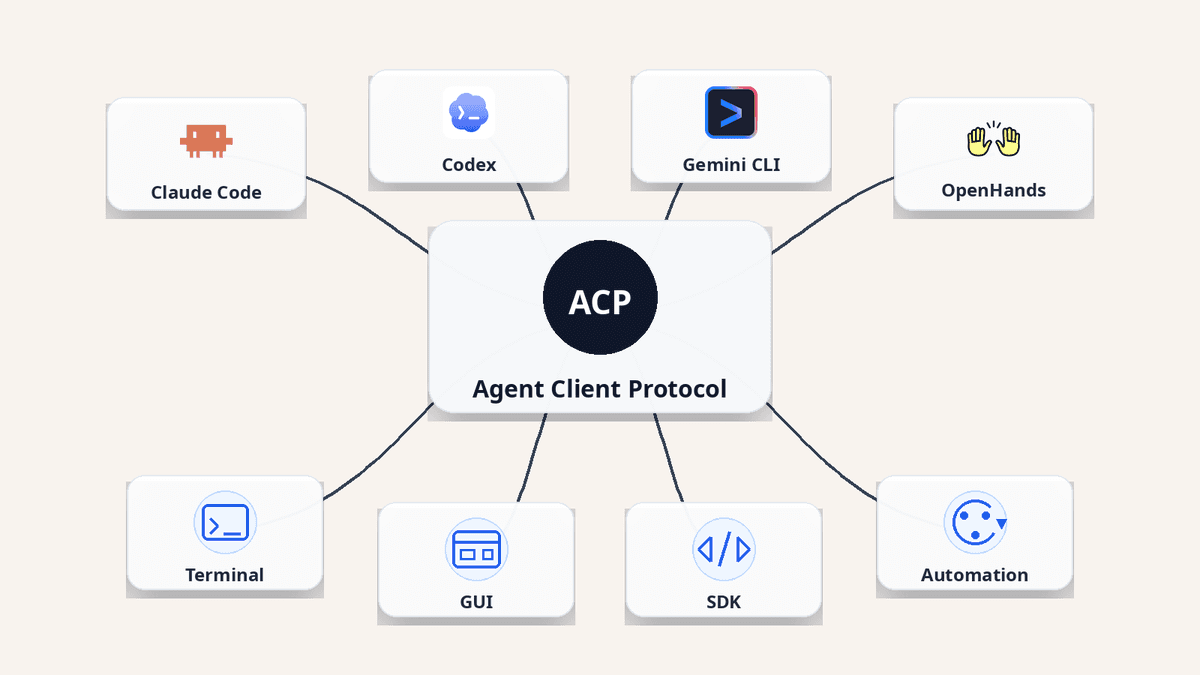
OpenHands added Agent Client Protocol support to its Agent Canvas, SDK, and Cloud, letting teams run different coding agents through one interface across local, remote, and cloud backends. The release also underpins new OpenHands Index results, so teams can compare harness-plus-model combinations instead of model-only runs.
TL;DR
- OpenHands added Agent Client Protocol support across Agent Canvas, the SDK, and Cloud, so one client can talk to multiple downstream coding agents through a single interface, according to OpenHandsDev's launch post and OpenHandsDev's ACP thread.
- OpenHandsDev's Agent Canvas post and gneubig's earlier canvas demo both frame the UI around three execution backends: local, remote VMs, and OpenHands Cloud or Enterprise.
- The release is explicitly about swapping agent harnesses, with OpenHandsDev's comparison post contrasting provider-tied tools like Claude Code and Codex with more customizable setups such as OpenHands and Pi.
- gneubig's benchmark thread says the same ACP plumbing now powers OpenHands Index runs that score harness-plus-model combinations, while gneubig's results summary claims OpenHands beats Claude Code on accuracy and cost with Claude Opus, but trails Gemini-CLI when both use Gemini.
You can browse the ACP support docs through OpenHandsDev's linked page, jump to the SDK example links from OpenHandsDev's SDK post, and inspect the full benchmark trajectories from gneubig's follow-up. The odd but useful bit is that the launch doubles as a benchmarking story: OpenHands is not just adding a protocol adapter, it is using that adapter to compare whole agent stacks instead of just underlying models.
Agent Canvas
Agent Canvas is the operator surface in this release. gneubig's launch thread describes it as agent-agnostic, able to run OpenHands, Claude Code, or Codex, while OpenHandsDev's feature thread adds multi-backend support across local machines, remote VMs, and OpenHands Cloud or Enterprise.
The concrete workflow pieces are already visible in the launch posts:
- Run different coding agents from one GUI, per OpenHandsDev's Agent Canvas post.
- Point those agents at local, remote, or cloud execution backends, per the same thread.
- Schedule automations, which OpenHandsDev's automation post pitches for PR review, issue triage, and repo summaries.
- Connect external systems such as Slack and GitHub, according to OpenHandsDev's get-started post.
A small but practical detail came in replies: gneubig's automation reply says scheduled automations are part of the open source version, and gneubig's mobile reply says the UI already works on mobile, with ngrok or Tailscale as a secure access path.
ACP
OpenHands describes ACP as the protocol layer between agent clients, like IDEs or canvases, and downstream agents. In OpenHandsDev's explainer, the company says ACP already has wide support across popular coding agents, which is the reason this launch can promise agent swapping instead of a single built-in agent.
The release makes more sense as decoupling than as a UI refresh. OpenHandsDev's comparison post says today's coding agents are usually tied to their own terminals, subscriptions, or model stacks; ACP is the piece meant to break that coupling.
The SDK side matters because it pushes ACP beyond the GUI. OpenHandsDev's SDK post says arbitrary agents can now slot into more structured workflows, and OpenHandsDev's open source follow-up points readers to the project links and contribution path.
OpenHands Index
The benchmark angle is more interesting than the launch copy. gneubig's thread argues that most coding-agent benchmarks isolate either the model with a fixed harness or the harness with a fixed model, while the real unit of performance is the combination.
The OpenHands Index composite covers five task buckets, according to gneubig's benchmark scope thread:
- Issue resolution, via SWE-Bench.
- Frontend development, via SWE-Bench Multimodal.
- Greenfield development, via commit0.
- Software testing, via SWT-Bench.
- Information gathering, via GAIA.
The early topline results in gneubig's results summary are directional rather than fully tabulated in the tweet thread:
- OpenHands generally beats Claude Code on both accuracy and cost when both use Claude Opus.
- OpenHands beats Codex on accuracy, but not on cost, when both use GPT.
- Gemini-CLI beats OpenHands when both use Gemini.
That same follow-up adds one more new detail: gneubig's trajectories follow-up says the full per-benchmark results and agent trajectories are already published, and that ACP support in the OpenHands SDK is what made those cross-agent benchmark runs possible in the first place.