
OpenRouter raises $113M Series B as weekly volume hits 25T tokens
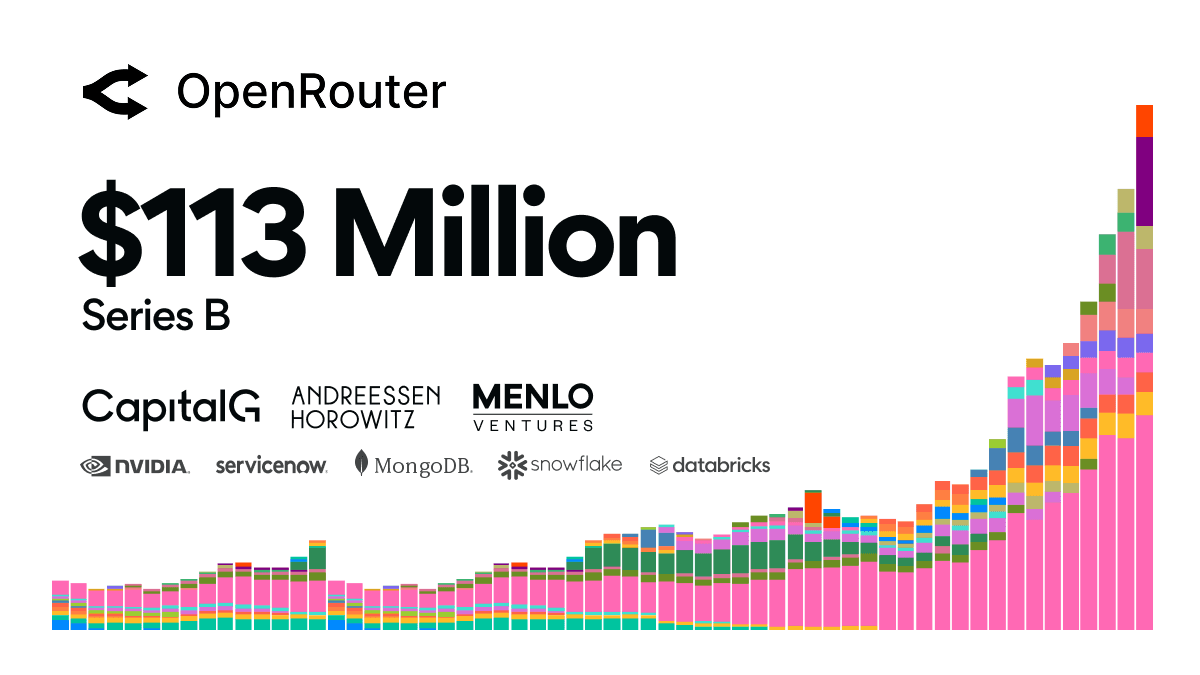
OpenRouter announced a $113M Series B led by CapitalG and said weekly routed volume grew from 5T to 25T tokens in six months. The funding matters because the company is pitching itself as production infrastructure for multi-model deployments, not just an API convenience layer.
TL;DR
- OpenRouter said it raised a $113 million Series B led by OpenRouter's funding announcement, with a follow-up investor list naming a16z, Menlo Ventures, NVentures, ServiceNow Ventures, MongoDB Ventures, Snowflake Ventures, and Databricks Ventures.
- In the same announcement, OpenRouter said weekly routed volume grew from 5 trillion to 25 trillion tokens in six months, framing the jump as evidence that AI traffic is moving from experimentation into production.
- OpenRouter's New York Times link shows the company pushing the round beyond X, while Menlo partner Deedy Das amplified a larger annualized figure of 1.5 quadrillion tokens.
- The annualized comparison is squishier than the headline number: Deedy Das's methodology thread says OpenAI and Google publish per-minute peaks, OpenRouter reports per-week volume, and OpenRouter also double-counts traffic for models it brokers from those same vendors.
You can jump from the New York Times coverage to Menlo's own OpenRouter run-rate post, and the interesting bit is how quickly the framing shifts from fundraising to infrastructure metrics. OpenRouter is selling the round as proof that the multi-model layer is becoming production plumbing, while Menlo is already benchmarking that layer against Google, OpenAI, and Azure.
Funding round
OpenRouter's public announcement was short: $113 million, led by CapitalG, plus a claim that usage scaled 5x in six months. The linked New York Times coverage is the company's signal that this is a financing event for infrastructure, not a product launch thread.
That distinction matters because OpenRouter is not pitching a new model. In OpenRouter's investor follow-up, the company described itself as infrastructure for the "multi-model AI era," which is a cleaner description of the business than "one more AI API."
Weekly volume
The operating metric in the announcement was weekly token volume, not customers or ARR. According to OpenRouter's post, the platform went from 5 trillion to 25 trillion tokens per week over the last six months.
That is the strongest fact in the story because it says something concrete about where routing layers sit in the stack. OpenRouter is arguing that model selection and traffic brokering are no longer edge conveniences, they are absorbing production-scale demand.
Run-rate comparisons
Menlo Ventures partner Deedy Das, who said the business was 15x larger than when Menlo invested a year ago, translated the weekly figure into a 1.5 quadrillion token annual run rate and compared that to Google APIs, OpenAI, and Microsoft Azure Foundry in his post.
His own follow-up immediately narrowed the claim. According to Das's methodology thread, Google and OpenAI disclose per-minute figures that may represent peaks, OpenRouter reports per-week volume, Azure Foundry's public numbers are incomplete, and OpenRouter's totals inherently include traffic destined for GPT and Gemini models.
In other words, the comparison is directionally useful and structurally messy. The clean number is still the one OpenRouter gave first: 25 trillion tokens per week in the company announcement.
Investor stack
The participating list is unusually stacked with strategic infrastructure names. OpenRouter named a16z and Menlo alongside NVentures, ServiceNow Ventures, MongoDB Ventures, Snowflake Ventures, and Databricks Ventures.
That mix says as much about distribution as capital. The round pulls in model-adjacent compute, enterprise software, databases, data platforms, and developer tooling, all around a company whose core job is routing between models rather than training one of its own.