
Score Centering targets RL gradient bias from training-inference mismatch
Score Centering addresses RL gradient bias caused by differences between training and inference distributions. It subtracts a distillation-like drift term using a stop-gradient estimate.
TL;DR
- Trainer-inference mismatch can move a policy even without reward differences, according to nrehiew_'s explanation.
- Score Centering subtracts that drift using an additive correction, approximated with top-128 sampler probabilities in nrehiew_'s implementation notes.
- Score Centering alone still collapsed in Modal's mixed-hardware coding run, highlighted by SemiAnalysis_; combining it with masked importance sampling finished stably.
The paper makes the failure beautifully blunt: give every rollout +1 and the model can still drift. The reference code includes PyTorch and JAX losses, and reports that saving just 32 sampler probabilities matched full-vocabulary centering in the authors' experiments.
Policy-gradient drift
Together AI's Martin Marek and Max Ryabinin analyze two distributions in their September paper: the rollout sampler q and the trainer p. Different kernels or numerical precision can make them disagree even with identical weights.
At a fixed prefix, the “score” means the gradient of a token's log-probability: s = ∇θ log p(token | prefix). The expected policy-gradient update splits into:
- Drift:
E_q[R] × E_q[s], which depends on reward only through its mean. - Signal:
Cov_q(R, s), which captures the relationship between token choice and reward.
On-policy, E_p[s] = 0, so the drift vanishes. With positive expected reward under mismatch, drift fits the trainer toward the sampler, creating the moving-teacher effect described by nrehiew_.
Refreshing the sampler from the trainer feeds that bias into subsequent updates. Centering advantages across a prompt's rollouts does not eliminate it: the expected advantage at an individual prefix can remain positive or negative, according to the paper's prefix-level analysis.
Top-128 correction
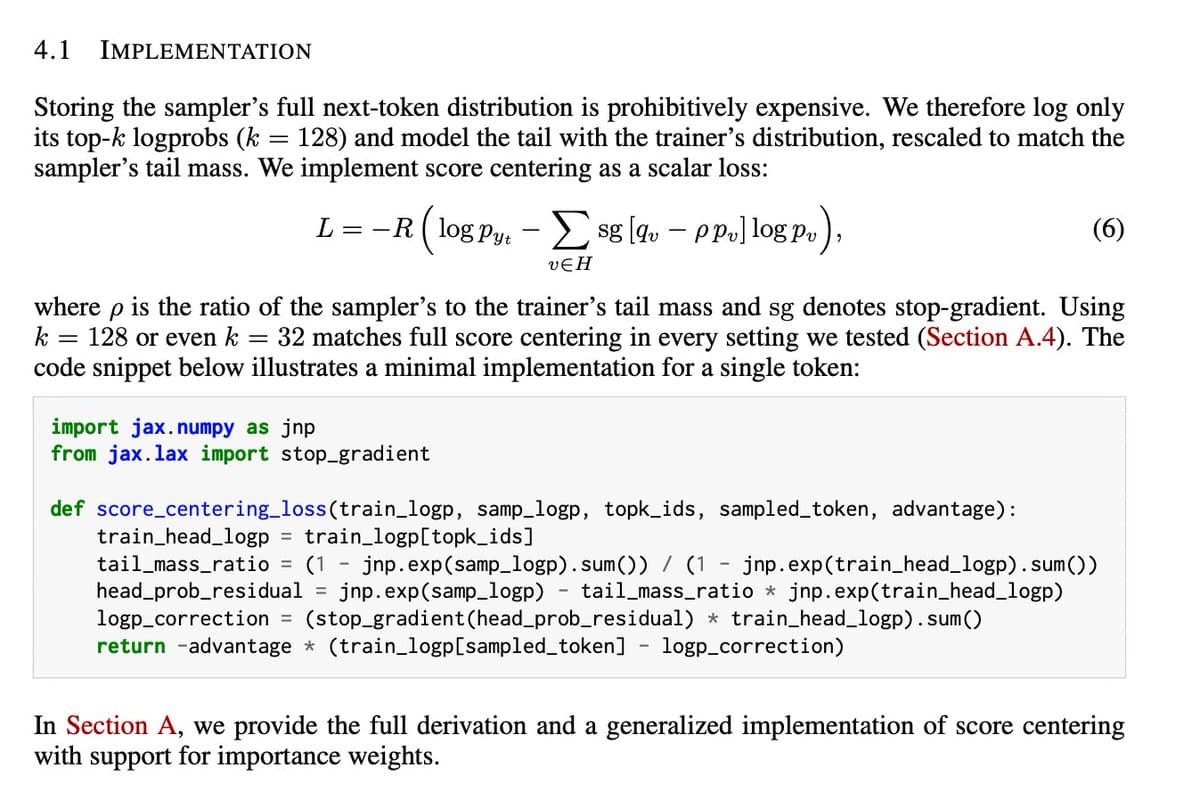
Score Centering replaces each token score with s - E_q[s], restoring zero mean under the sampler. The practical implementation approximates that expectation without logging the sampler's entire vocabulary.
The released implementation has three mechanics:
- Sampler logging: retain the top-128 token IDs and log-probabilities at each position, plus the sampled token's log-probability even when it falls outside that head.
- Tail-mass ratio: for saved token set
K, computerho = (1 - Σ_K q_v) / (1 - Σ_K p_v), with small numerical floors in the code. - Tail approximation: model unrecorded sampler probabilities as
q̂_v = rho × p_v, preserving the sampler's remaining probability mass.
For pure centering, the PyTorch loss reduces to the following, where head_logp and token_logp are trainer log-probabilities, and p_head and q_head are probabilities over the saved token IDs:
The stop-gradient freezes the correction's coefficients while leaving the trainer log-probabilities differentiable. The implementation uses float32 log-probabilities and leaves the saved top-k head unnormalized.
Importance sampling
Exact score centering leaves Cov_q(R, s), while the on-policy update uses Cov_p(R, s), as the derivation makes explicit. Removing drift therefore leaves a difference in how tokens are weighted.
Importance sampling reweights updates toward p, but large probability ratios increase variance. Clipping or masking those ratios, the alternatives discussed in nrehiew_'s thread, bounds their contribution while reintroducing drift.
Centering can also operate on the weighted score, including the drift introduced by clipping or masking. The paper reports different results by mismatch source:
- Sampler quantization: standalone centering matched or outperformed importance-sampling baselines on Qwen3-0.6B Countdown and Qwen3-30B-A3B-Base INTELLECT-2 math experiments.
- Stale rollouts: centering combined with importance sampling outperformed pure importance-sampling baselines.
Six-accelerator coding run
On October 13, Modal reported fully asynchronous coding-agent training of Qwen3.6-35B-A3B, with contexts up to 256K tokens. A Megatron-LM trainer ran in BF16 on B200 GPUs, while SGLang samplers used six accelerator types:
- B200 and B300: NVFP4 weights.
- H100 and H200: FP8 and BF16 weights.
- A100 and RTX PRO 6000: BF16 weights.
Every sampler used an FP8 KV cache, and training imposed no staleness limit. Only Score Centering plus masked importance sampling, with or without top-p sampling, trained stably to the end; each correction used alone ultimately finished at or below the base model.
With the full combination, SWE-bench Pro V2 pass@4 rose from 89% to about 94%. The top-p variant replayed the sampler's candidate mask in the trainer, giving both policies the same token support.
Mixed samplers matched the homogeneous B200/BF16 run's performance despite an average sampler-trainer KL 4.7 times larger. Their sampling cost per update was about 15% lower for most of training.