
TrueFoundry releases TrueForge agent harness under MIT license
TrueFoundry released the self-hostable TrueForge agent runtime under the MIT license. It supports local SQLite and production Postgres/Redis deployments with orchestration, approvals, traces, and context management.
TL;DR
- TrueForge is an MIT-licensed agent harness that can be forked and shipped commercially, according to kimmonismus's launch thread.
- The runtime has a local SQLite mode and a hosted Docker Compose or Helm mode backed by Postgres and Redis, as the launch thread describes.
- The core loop handles tool calls, context, subagents, approval checkpoints, sandboxed execution, and traces, which kimmonismus's overview lists as the harness layer.
- Model routing spans OpenAI, Anthropic, Google, Kimi, GLM, and DeepSeek providers, according to kimmonismus's provider list.
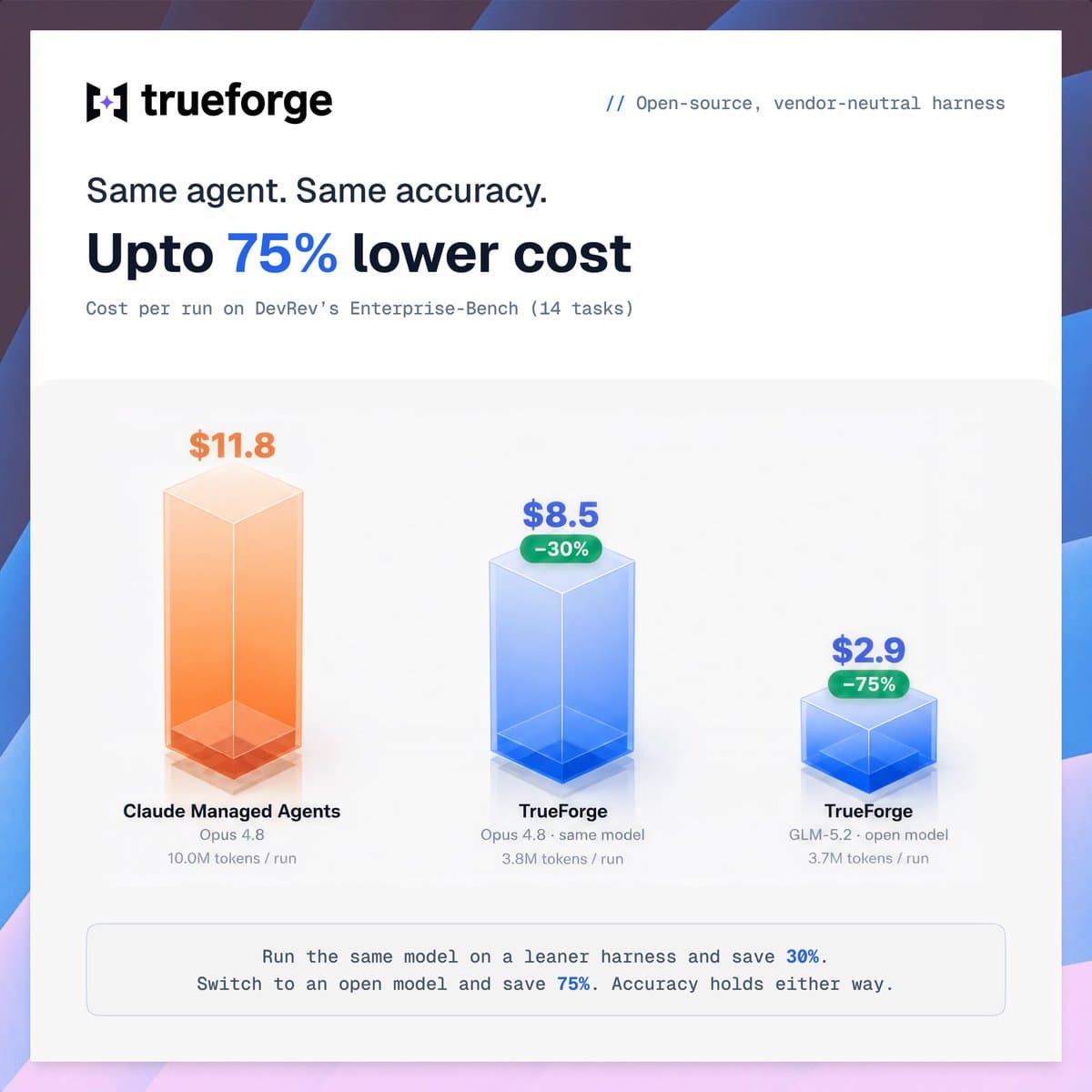
- TrueFoundry reported roughly 11 solved tasks out of 14 for GLM-5.2 on TrueForge and Opus 4.8 on Claude Managed Agents in a comparison that kimmonismus's launch thread summarized, at $2.9 rather than $11.8 per run.
The launch post exposes a core server, TypeScript SDK, and embeddable chat UI rather than a single black-box agent endpoint. Its benchmark post used three MCP servers and a blind LLM judge; sandboxed code execution remains a Daytona dependency in kimmonismus's deployment note.
Core server, API, and UI
TrueForge separates its runtime into three surfaces in the launch post:
- Core server: Runs the agent loop, streams steps, pauses sensitive actions for approval, compacts context, uses subagents, and persists sessions across reconnects.
- HTTP API and TypeScript SDK: Exposes the agent from application code through
@truefoundry/trueforge-sdk. - Chat UI and UI SDK: Supplies a complete UI that can be used as-is, themed, or embedded.
The project is published in the public GitHub repository under the MIT License.
SQLite and Postgres/Redis
Local mode is a single process with SQLite and no additional infrastructure. The hosted configuration uses Docker Compose or Helm, plus Postgres and Redis; the official post adds replicas behind a load balancer and OIDC login for team deployments.
TrueFoundry says the agent features are the same in both modes, with the deployment infrastructure as the difference.
Models, MCP, and skills
TrueForge takes user-supplied model keys, MCP servers, and SKILL.md files. Its documented provider path covers direct OpenAI, Anthropic, and Google integrations alongside open-weight options such as Kimi, GLM, and DeepSeek; the benchmark post says any OpenAI-compatible API can be used.
The launch partners named by TrueFoundry include Together AI, Fireworks AI, Alibaba, and web providers Exa, Tavily, Parallel Web, and Bright Data. MiniMax_AI's announcement said MiniMax joined the ecosystem on day one.
Daytona sandbox provisioning
TrueForge provisions a sandbox only when an agent needs to execute code. The launch post says that leaves non-code turns outside the sandbox path, while allowing a server to support concurrent agents.
The sandbox is the exception to the self-hosted story at launch: kimmonismus's deployment note says it currently runs through Daytona, with a self-hosted option planned.
Enterprise-Bench results
TrueFoundry evaluated its harness against Claude Managed Agents and deepagents on DevRev's Enterprise-Bench: 14 cross-system tasks using the same Salesforce-style CRM, Jira-style tracker, Drive-style document store, three MCP servers, and a fresh session per task. The benchmark methodology says an LLM judge scored answers blind against task criteria, with no partial credit.
Its reported mean results were:
- Claude Managed Agents, Opus 4.8: about 11/14 solved, $11.8 per run, 10M tokens, and 63 minutes.
- TrueForge, Opus 4.8: about 11/14 solved, $8.5 per run, 3.8M tokens, and 40 minutes.
- TrueForge, GLM-5.2: about 11/14 solved, $2.9 per run, and 3.7M tokens.
- deepagents, Opus 4.8: about 10/14 solved, $21 per run, 16.5M tokens, and 64 minutes.
The cost calculation used actual token usage at stated list prices and accounted for cache hits. TrueFoundry attributes the same-model gap to a smaller prompt payload, fewer tool calls, and compaction of history and large tool responses.
Gateway controls
The self-hosted mode leaves model and MCP credentials with the operator. TrueFoundry's AI Gateway tier adds RBAC, budgets, PII guardrails, credential rotation, and unified traces; kimmonismus's sandbox note identifies the first three controls as enterprise features.
The project launched as an open-source beta, with general availability described as a few weeks away by . The direct repository link is in kimmonismus's repository post.