
White House releases national AI framework with permitting and copyright guidance
The White House published a national AI legislative framework covering minors, infrastructure permitting, copyright, and federal preemption. Engineers building for regulated or public-sector environments should watch how these proposals shape deployment constraints.
TL;DR
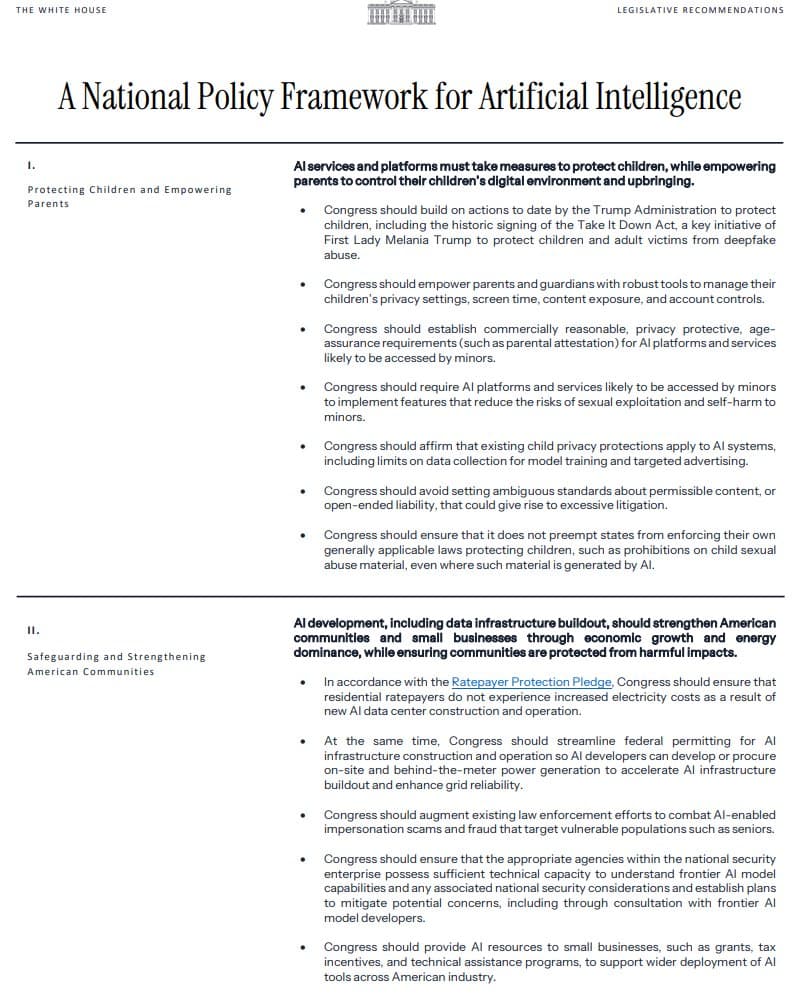
- The White House published a national AI legislative framework that pushes for one federal approach instead of a patchwork of state rules, according to the policy thread and the linked White House document.
- The proposal pairs child-safety requirements for AI platforms with age verification, parental controls, and safety features for minors, as summarized in the thread and the document post.
- It also calls for faster permitting for AI infrastructure while trying to shield households from higher electricity costs, a detail highlighted in the framework summary.
- On IP and governance, the framework would leave AI-training copyright fights to courts, create federal protections against unauthorized voice and face copies, and avoid creating a new AI regulator, per the White House summary.
What the framework proposes
The White House's legislative recommendations frame AI policy around federal preemption: one national ruleset for AI, with states still retaining control over zoning, police powers, and their own procurement decisions. For engineers shipping across multiple jurisdictions, that is the biggest structural signal in the thread summary: the administration is arguing against a state-by-state compliance model.
The same package bundles several deployment-facing requirements. According to the document post, Congress is being urged to require parental control tools, age checks, and minor-safety features on AI platforms; speed federal approval for AI infrastructure; and establish federal rules against unauthorized AI replicas of a person's voice or face. The copyright piece is narrower than a new statute on training data: the summary thread says the framework would let courts continue deciding whether training on copyrighted works is legal.
Why engineers should pay attention
This is still a legislative framework, not an enacted rulebook, but it points to where future implementation constraints may land. Teams building consumer AI products should watch the child-safety and identity-replica provisions, because those map directly to account flows, content safeguards, and model outputs. The infrastructure language also matters for operators: the policy thread says the White House wants faster approval for data-center and power buildouts while ensuring ordinary ratepayers do not absorb the cost.
The governance approach is also notable. Rather than proposing a new federal AI agency, the document post says the framework would rely on existing expert agencies and create "safe testing zones" for new technology. That combination suggests a compliance environment shaped less by one new AI-specific regulator and more by sector regulators, procurement rules, and court decisions.