
Deadfall reports 100+ Reddit upvotes and SNES hardware confirmation
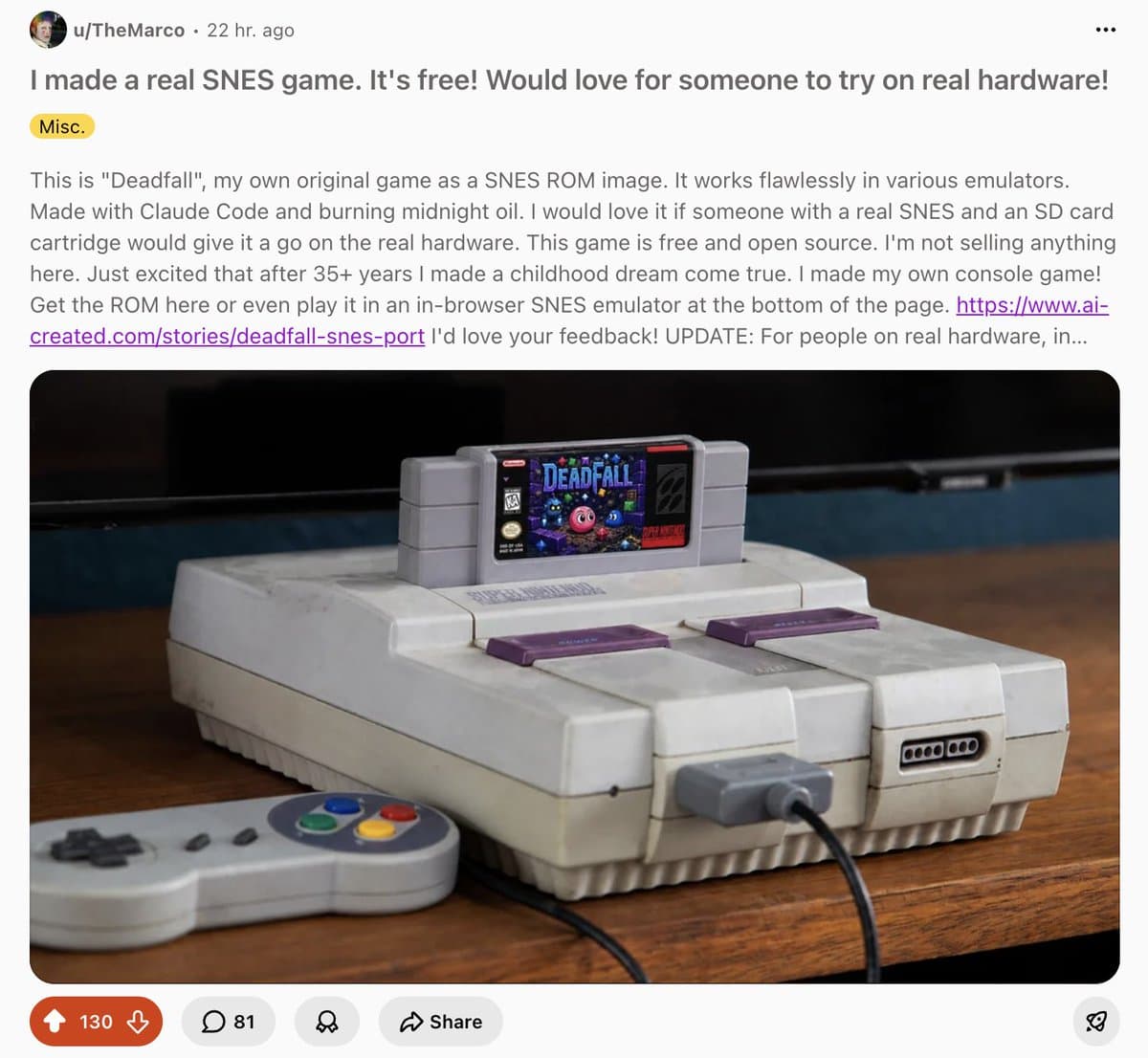
The creator said Deadfall's /r/snes post turned mostly positive, passed 100 upvotes, and drew confirmation that the ROM runs on real SNES hardware. Follow-up replies said the characters and levels were hand-made, while Claude generated music and Midjourney backdrops were heavily edited, so watch the breakdown as more details emerge.
TL;DR
- In the creator's Reddit update, AIandDesign said the /r/snes post for Deadfall flipped from early backlash to mostly positive replies, passed 100 upvotes, and included a report that the ROM runs on real SNES hardware.
- AIandDesign's workflow breakdown said the characters and level layouts were hand-made, Midjourney backdrops were heavily edited, and Claude handled the music.
- In the full write-up, AIandDesign said the browser version was ported from Phaser and JavaScript to C with PVSnesLib in three days, with Claude Code helping map the path.
- According to the write-up's asset section, SNES limits changed the art and audio pipeline: backgrounds were rebuilt as 256×256 tiles, cut to roughly 24 colors, and the music moved from MP3-style tracks to SPC700-friendly looping MIDI.
- a later follow-up added one more retro twist: after the Reddit thread took off, someone DM'd about a possible physical cartridge run.
You can read the full postmortem, try the browser build, and grab the beta ROM from AIandDesign's post. The most interesting detail in the write-up is that Claude did not just help with code, it also produced looping MIDI that could survive SNES channel limits. The most useful public proof point came later, when a hardware follow-up asked for longer footage from a real console build.
Reddit reception
The first public story here was not the port itself, it was the reaction to it. In an early Reddit reaction post, AIandDesign said many commenters fixated on Claude instead of the free game.
Hours later, a follow-up on the same thread said the sentiment had turned mostly positive and the post had crossed 100 upvotes. A later estimate put the mix at roughly 80 percent enthusiasm and 20 percent haters.
Human-AI breakdown
The clearest attribution came in AIandDesign's breakdown reply. Characters and level design were hand-made, the game concept was the creator's own, Midjourney backdrops were heavily edited, and Claude made the music.
That lines up with another reply on authorship, where AIandDesign said the creations were "designed and envisioned" by the human and AI helped realize them. In a process reply, the creator also pushed back on the idea that this was a pure prompt-to-app workflow.
Three-day port
the main port announcement framed the technical leap in the bluntest possible way: a JavaScript game was turned into a real SNES ROM in three days. The linked write-up says the original ran in Phaser on modern hardware, while the new version runs in C on top of PVSnesLib, an open source SNES homebrew library.
The toolchain in the write-up breaks down cleanly:
- Original game: Phaser and JavaScript.
- SNES port: C plus PVSnesLib.
- Code assistant: Claude Code.
- Testing: SNES emulators during development.
- Public builds: a browser-playable SNES version and a downloadable ROM.
That same postmortem says Claude Code identified the SNES path, then the work settled into a loop of building, testing, converting assets, and tightening what felt wrong.
SNES constraints
The useful part of the postmortem is not the victory lap, it is the constraint list. The write-up says the original large backgrounds had to be replaced with 256×256 seamless tile backgrounds, then resized, cleaned up, and palette-reduced in Photoshop.
The write-up gives three concrete limits that changed the final game:
- Backgrounds were reduced to roughly 24 colors to leave room for sprites.
- Music had to fit 6 channels, with 2 more reserved for sound effects.
- MP3-style browser audio was replaced by Claude-generated looping MIDI converted for SPC700 playback.
That helps explain why the main announcement claimed the SNES version ended up better. The creator said the hardware limits improved backgrounds, timing, transitions, music, and polish.
Hardware confirmation
The last turn in the story is that the ROM appears to have escaped the emulator-only phase quickly. In the Reddit turnaround update, AIandDesign said someone had already confirmed it runs on real SNES hardware.
By a later reply asking for footage, the creator was actively requesting a longer gameplay video from a real SNES and even shared an alternate build if performance was slow. Another follow-up said the response had already reached the point where someone was discussing a possible physical cartridge run.