
DIT AI launches API routing across 50+ models by price
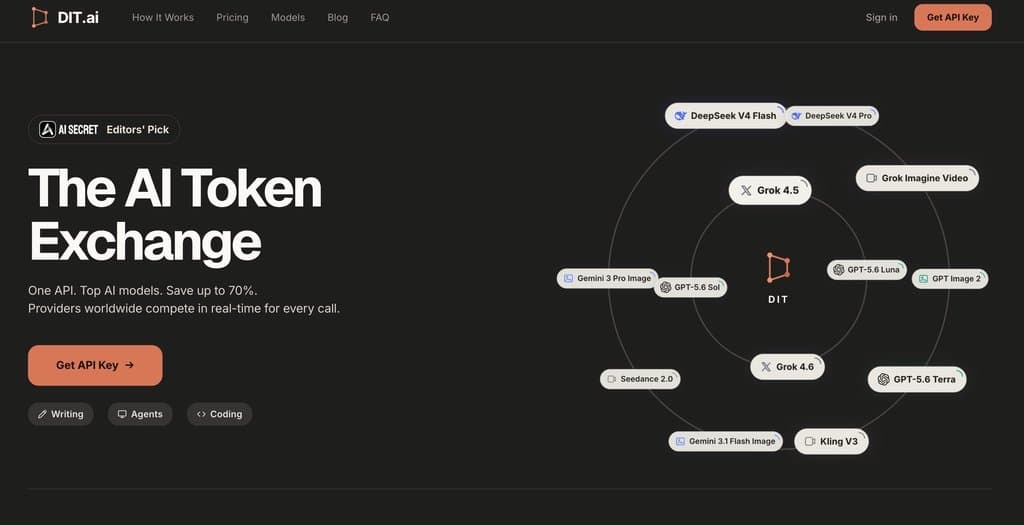
DIT AI says its OpenAI-compatible API routes text, image, and video calls among more than 50 models and 160 providers. The company claims typical costs 30–70% below official API pricing; that savings figure is vendor-reported.
TL;DR
- DIT AI puts 50-plus text, image, and video models behind one OpenAI-compatible endpoint, according to hasantoxr's setup post.
- The company’s cost pitch is vendor-reported: hasantoxr's launch post says qualified providers can make calls 30 to 70 percent cheaper than official APIs.
- Each call is matched among more than 160 providers on price, quality, and availability, hasantoxr's routing breakdown says.
- Existing OpenAI SDK, LangChain, LlamaIndex, and Vercel AI SDK users only swap the base URL and API key, per hasantoxr's integration list.
The official DIT site puts its routing overhead below 100 ms. Its terms also reserve the right to replace a provider connection for legal, security, operational, or compliance reasons.
The token exchange
DIT describes the product as an exchange rather than a price list. Providers compete for every request, while the router selects the lowest-cost option that clears its quality and availability criteria.
The company’s marketplace page shows indicative reductions of roughly 40 to 50 percent for several listed models, while its broader launch claim is 30 to 70 percent. The precise bill changes with the provider selected for that request.
The base URL swap
The migration described in DIT’s launch material has two steps:
- Change the API base URL.
- Replace the API key.
The company says existing code can remain in place across the OpenAI SDK, LangChain, LlamaIndex, and Vercel AI SDK, as hasantoxr's integration list lays out. DIT also presents one key and one bill for the model catalogue.
Prompt handling
DIT’s privacy policy says it processes request metadata, performance metrics, and billing signals, and may retain request data, including prompts and outputs, for a limited period for operations, security, debugging, and abuse prevention.
The policy says DIT does not train its own models on prompts or outputs unless a product-specific agreement says otherwise. The selected provider receives the request, and its own data-handling terms apply.