
Runway previews real-time video interfaces in Project Continuum
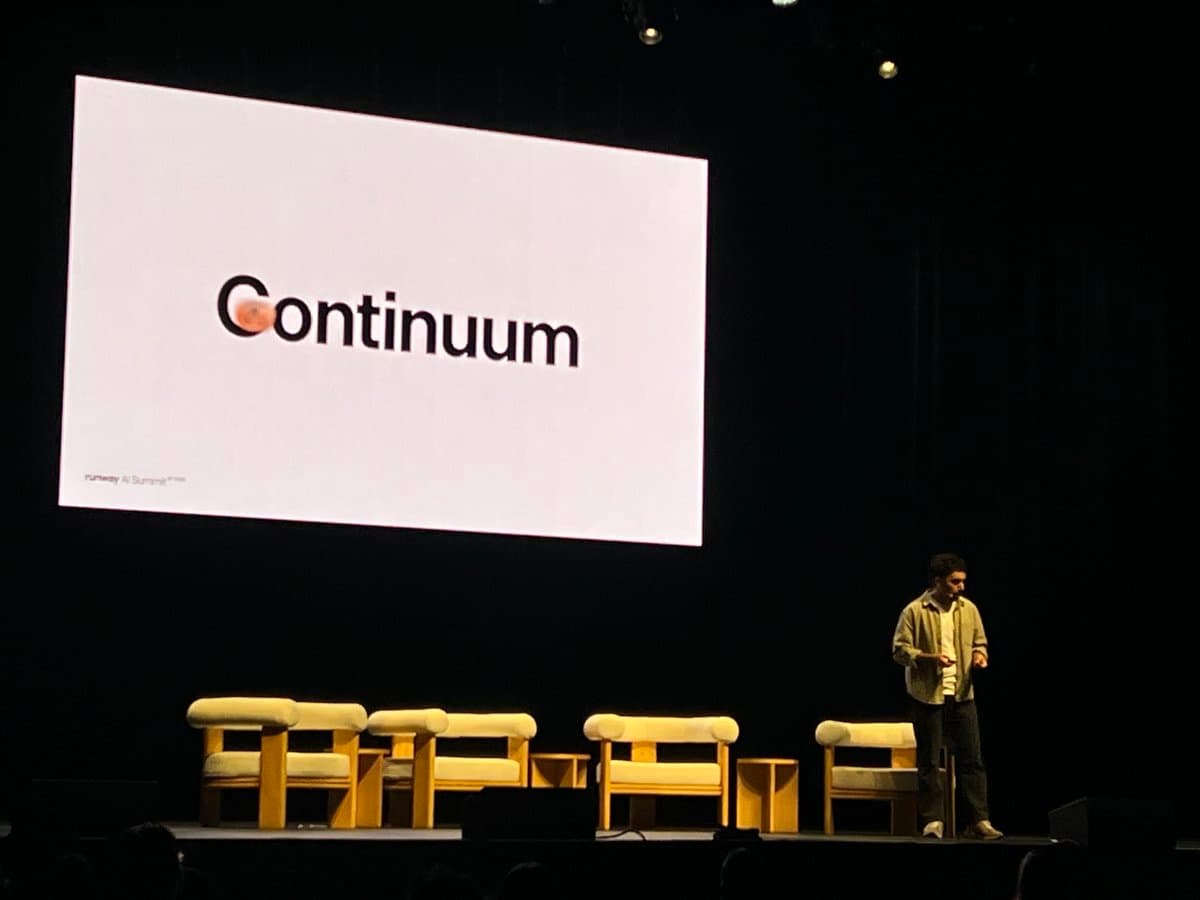
Runway Labs previews Project Continuum, a research app built around real-time video interfaces. Demos show animated browser overlays and scenes that recompose when resized.
TL;DR
- Project Continuum is a Runway Labs research preview built around real-time video interfaces, with four interaction modes in Runway's announcement.
- Responsive Video Interfaces recompose scenes when resized and respond to clicks, according to Runway's demo.
- Visual Thinking visualizes coding-agent steps and tool calls as they happen, as Runway demonstrates.
- Existing media becomes an interactive simulation for people and agents in the Interactive Worlds preview.
A cat can become a texture brush in one interaction proposed in Runway's Solaris description. Continuum comes from Runway's application-prototyping incubator, and its soft-edged portals mark where generated content begins. The company's instant-video research focuses on time-to-first-frame and streaming video as users prompt.
Portals
Portals generate animated, interactive illustrations of concepts, places or simulations while someone browses. Dragging one onto a page places it alongside the original content.
Responsive Video Interfaces
Resizing a video interface causes the model to recompose the scene with spatial awareness. Clicking inside it steers the environment in real time.
The resize handle is the standout design trick.
Visual Thinking
Runway calls Visual Thinking a new harness for coding agents. A real-time video model visualizes each step and tool call during complex autonomous workflows.
Interactive Worlds
Runway's fourth mode expands existing media into interactive, multimodal world simulations. The company describes these environments as usable by both people and agents.
Solaris
Runway CTO Kamil Sindi presented Solaris at the AI Summit as a model that generates interface frames in real time in response to user intent.
Runway introduced Solaris on August 31, before the Continuum preview. It builds on Gen-4.5: clicks and drags condition the next generated frame, while a language model interprets requests, decides scene changes and supplies rendering prompts.
Runway's technical description identifies three stages that make generation fast enough for interaction:
- Train the model to generate frames sequentially, with each frame depending only on what came before.
- Distill the many-step denoising process into a few steps.
- Train the fast model on its own outputs to stabilize visual quality over long interactions.
Generated interfaces could bring task-specific information, controls and context into view as agents work, iamneubert wrote in a separate preview.
Early access and UI limits
AI Summit attendees received an early Continuum preview before the public demo. Runway still describes Continuum as a research application and an early look.
The Solaris announcement offers an early-access request form and says Runway is working with partners toward a public launch. That form is for Solaris; the Continuum announcement gives no pricing or download date.
Runway also names four unfinished areas in its Solaris limitations:
- Text: Stable, legible text generated fully in real time remains an open challenge. Runway proposes hybrid interfaces with image-generated text-heavy views.
- Trust: Real product imagery and reference material can anchor the starting frame. Grounding ongoing generation in verified product data and documents remains a research focus.
- Long sessions: Maintaining visual and semantic coherence through extended, open-ended interactions is still under development.
- Accessibility: Generated interfaces still need integration with screen readers, accessibility APIs and the surrounding software stack.