
Fable makes The Narrow Thread documentary in JavaScript for under $10
Fable produced The Narrow Thread through a JavaScript workflow covering research, scripting, visuals, editing, and sound. The reported production cost was under $10.
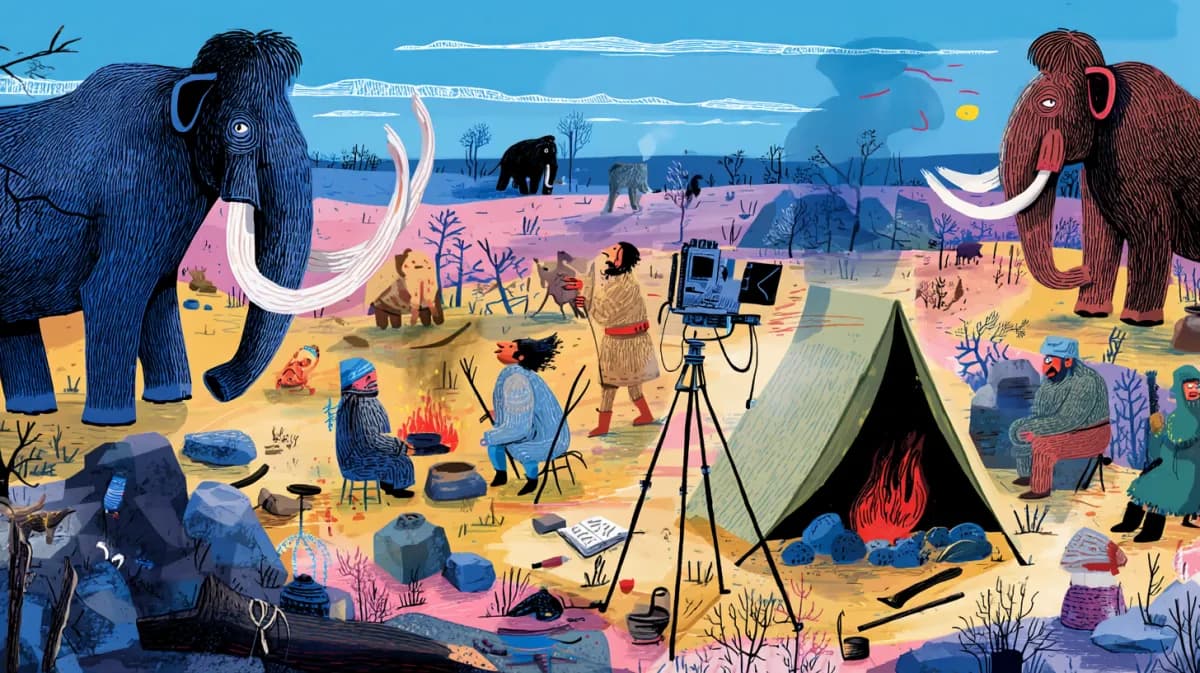
TL;DR
- Fable produced The Narrow Thread, a documentary about a disputed 900,000-year human population bottleneck, with the creator reporting under $10 in API costs: LLMJunky says research, script, visuals, edit, and sound came through the workflow.
- The pipeline combined JavaScript with GPT Image 2 for photographic plates, Gemini 3.8 TTS for narration, and Lyria 3.5 for the score, according to LLMJunky.
- The film's motion came from layered still images animated in JavaScript, after the creator rejected procedurally rendered humans: LLMJunky's clarification says there was no generated video asset.
- The production brief targeted a 20-minute, 1080p documentary with a deterministic timeline, local browser player, captions, and 28,800 frames, as laid out in LLMJunky's production prompt.
- The model label remains uncertain: LLMJunky called it “Fable 5.1/5.5” and said 5.5 was speculation.
The official Claude Fable page currently lists Fable 5.1, while a contemporaneous report describes Fable 5.5 as an unannounced user nickname. The brief's 28,800-frame target LLMJunky's production prompt sits alongside a contemporaneous plain-JavaScript video workflow that renders frames in a browser and assembles them with FFmpeg.
The documentary
The film follows a scientific question with a built-in argument: did an ancestral human population collapse to roughly 1,280 breeding individuals for more than 100,000 years? LLMJunky framed the premise around a 2023 study, while noting that other geneticists dispute it LLMJunky.
The original Science paper used more than 3,000 present-day genomes to infer ancient population sizes. Later work challenged the interpretation: Deng, Nielsen, and Song called the signal likely a statistical artifact, and Cousins and Durvasula found the severe-bottleneck model fit the data worse than a model without one.
The subject gave the production a research problem rather than a simple historical narration. Its brief required the film to distinguish evidence from illustrative reconstruction, cover fossils, tools, climate proxies, dating, and genomes, and explain why population structure and model assumptions change the conclusion LLMJunky's production prompt.
The production brief
The prompt treated Fable as a single production team covering direction, science research, screenwriting, cinematography, animation engineering, sound design, rendering, and quality review LLMJunky's production prompt. It specified two connected journeys: an intimate reconstruction of ancestral life and an investigation into how researchers infer events from incomplete evidence.
The brief broke the work into concrete production requirements:
- Visual language: cinematic landscapes, expressive hominin movement, readable scientific diagrams, restrained typography, and meaningful transitions between stones, water, climate, and genetic branching, according to the production prompt.
- Code architecture: a shared master timeline, seeded randomness, reliable seeking, deterministic frame rendering, cached assets, resumable renders, and an inspectable manifest for narration, music, captions, and scenes the production prompt.
- Delivery: approximately 20 minutes, 1920×1080 at 24 fps, H.264 MP4, stereo sound, a local browser player, captions, and editable JavaScript source the production prompt.
- Budget: a hard ceiling of $10 for paid asset generation across OpenAI and $20 for Google the production prompt.
Stills, layers, and JavaScript
The finished piece did not come from a text-to-video generation pass. After rejecting procedurally rendered humans, the creator had Fable generate photographic scenes and then split those images into layers, moving the camera through miniature-set compositions with water rings, fire, and dust LLMJunky's account.
LLMJunky clarified that image models rendered the hominids and some backgrounds, while JavaScript supplied the layering and animation LLMJunky's clarification. A contemporaneous plain-JavaScript production guide describes the underlying pattern as a deterministic frame(t) function, a headless browser rendering each frame, and FFmpeg stitching the sequence into an MP4. That guide describes a separate workflow, but its architecture matches the production brief's emphasis on deterministic seeking and frame rendering.
Narration and score
The audio plan was treated as part of the edit rather than a finishing pass. The brief called for Gemini's gemini-3.8-flash-tts with the Algieba voice, narration generated in manageable segments, pronunciation checks, and timing measured before the edit was locked the production prompt.
It paired that narration with an original instrumental score made with Google Lyria, organized into related cues for curiosity, daily life, instability, vulnerability, discovery, uncertainty, and a restrained ending the production prompt. The creator's post credits Gemini 3.8 TTS for narration and Lyria 3.5 for music LLMJunky.
The mix requirements included environmental sound, deliberate silence, music ducking under narration, smooth edits, captions, and clipping checks the production prompt.
Under $10, with notes
LLMJunky reported total API costs below $10 and described the project as roughly 15% of a week of usage LLMJunky. The post also says the creator added notes between cuts, so the workflow included human direction alongside Fable's research, writing, generation, editing, and review.
That intervention changed the visual method. The creator's rejection of procedural humans triggered a switch to photographic plates and layered animation, a concrete example of iteration changing the production technique rather than merely correcting a line of text LLMJunky.
Fable 5.5
The version attribution is tentative. LLMJunky labeled the result “Fable 5.1/5.5,” then added that the newer knowledge could mean a preview rather than a confirmed Fable 5.5 model LLMJunky.
Anthropic's official Fable page identifies Fable 5.1 as available to Pro, Max, Team, and Enterprise users. BitsMinds reported that users had coined “Fable 5.5” for an allegedly quietly served model and that Anthropic had not announced it. The documentary is therefore evidence of the workflow and output, while the exact model slug remains unconfirmed.
Timelines and interactive websites
The surrounding examples extend the code-first format beyond documentary filmmaking. DavidmComfort posted [a timeline of the American Revolution](src:5|DavidmComfort's timeline post), while youraipulse wrote that “interactive websites are getting crazy” youraipulse's post.
Those posts point to adjacent creative outputs, a historical timeline and an interactive website, rather than additional claims about The Narrow Thread itself.