
HappyHorse-1.0 ranks #1 in video arenas
HappyHorse-1.0 moved to the top of arena-style text-to-video and image-to-video leaderboards, and creators posted early tests showing strong multi-shot adherence and motion. Its vendor, pricing, and rumored ties to Veo or Hailuo remain unconfirmed, so watch for verification.
TL;DR
- venturetwins' early test thread says HappyHorse-1.0 jumped to the top of Artificial Analysis' video arena and looked unusually strong at multi-shot prompt following.
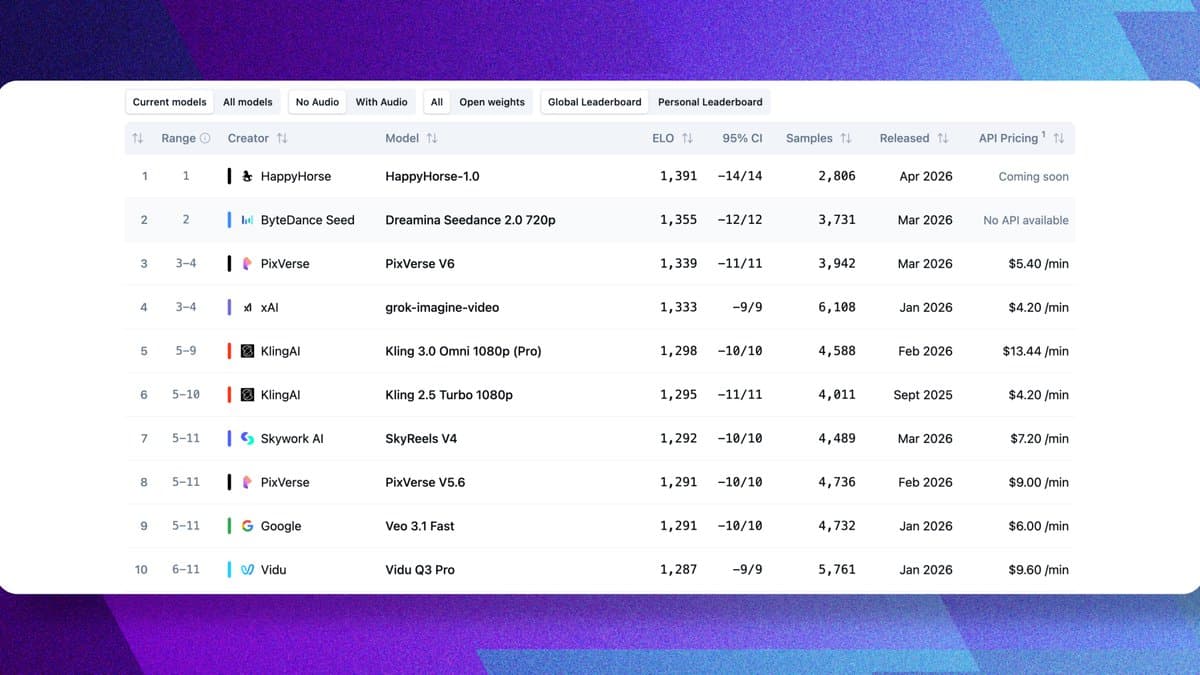
- On Artificial Analysis' Text to Video leaderboard, HappyHorse-1.0 is listed at No. 1 with a 1,355 Elo score, 3,975 samples, an April 2026 release date, and API pricing marked "Coming soon."
- The strongest creator clips in the evidence set come from venturetwins' home assistant sequence and their image-to-video follow-up, which both stress cross-shot consistency and harder motion.
- The identity story is still mushy: one rumor post floated Google Veo 4 or Hailuo 3.0, while another reaction just said it "smells" like Veo 4.
- The public paper trail is thin. Artificial Analysis has a live Video Arena, but the only obvious standalone web page Exa surfaced was a same-day HappyHorseAI terms page describing browser-based text-to-video and image-to-video workflows.
You can check the text-to-video leaderboard, the image-to-video leaderboard, and the live Video Arena yourself. The odd bit surfaced fast: the text leaderboard already shows HappyHorse-1.0 at No. 1, while the image-to-video page still lists Dreamina Seedance 2.0 720p on top, even as creator posts were calling HappyHorse the leader in both.
Text leaderboard
Artificial Analysis gives the cleanest hard datapoint in this story. On its Text to Video leaderboard, HappyHorse-1.0 sits above Dreamina Seedance 2.0 720p, SkyReels V4, and Kling 3.0 1080p.
The site says its rankings come from blind, crowdsourced preferences in the Video Arena, where users submit prompts, watch paired generations, and unlock a personal leaderboard after 30 submissions. Christmas came early for leaderboard obsessives.
Multi-shot consistency
The interesting part is not the codename. It is the kind of footage people immediately used to stress it.
Across the first test thread, three patterns keep recurring:
- Multi-scene continuity, especially the home assistant clip in venturetwins' example
- Detailed prompt adherence, which the opening post called out directly
- Fast, aggressive motion in image-to-video, which the bat and horse clips used as a stress test
That lines up with what creative users usually notice first in video tools: whether characters, products, and camera logic survive the cut.
Identity and access
The attribution layer is still mostly rumor. Ozan Sihay's post framed HappyHorse as a codename that might point to Google Veo 4, while also mentioning talk around Hailuo 3.0, and another X reply echoed the Veo guess without adding evidence.
The official web evidence is weirder than the rumor mill. Artificial Analysis' image-to-video leaderboard still says Dreamina Seedance 2.0 720p leads that arena, not HappyHorse, so the "No. 1 in both" claim from creator testing has not fully lined up with the public leaderboard page Exa could read.
The only standalone HappyHorse site Exa found was a same-day Terms of Service page. It describes HappyHorseAI as a browser-based service for text-to-video, image-to-video, reference-guided creation, downloads, and credit-based usage, but it does not answer the big question, namely who actually built the model.