
Midjourney supports SREF codes for comic, doodle, and model-sheet styles
Prompt libraries kept surfacing high-utility Midjourney SREF looks for comic realism, minimalist doodles, holographic sci-fi, and animation model sheets. Save the codes that match your job type, because they are faster than rebuilding a style from scratch.
TL;DR
- Creators are surfacing a small set of Midjourney SREF codes that map cleanly to different production jobs: comic-real illustration with
--sref 224194394, minimalist editorial doodles with--sref 1214430553, and character-sheet concept art with--sref 3092087225comic realism doodle style model sheets. - The strongest pattern is utility over novelty: the comic-real code is framed for covers, posters, game art, and ad visuals, while the doodle code is tuned for memeable editorial ideas rather than polished rendering comic realism doodle style.
- Style libraries are also pushing more niche looks, including a holographic sci-fi palette with
--sref 3874879308for album covers and futuristic brand work, plus a grainy retro-dreamcore look that mimics 80s airbrush and VHS noise holographic sci-fi dreamcore trend. - For animation-minded users, creators are sharing SREFs that behave more like preproduction tools than finishers: one aimed at Western-animation model sheets and another at painterly European cartoon characters model sheets european animation.
Which codes are solving real creative briefs
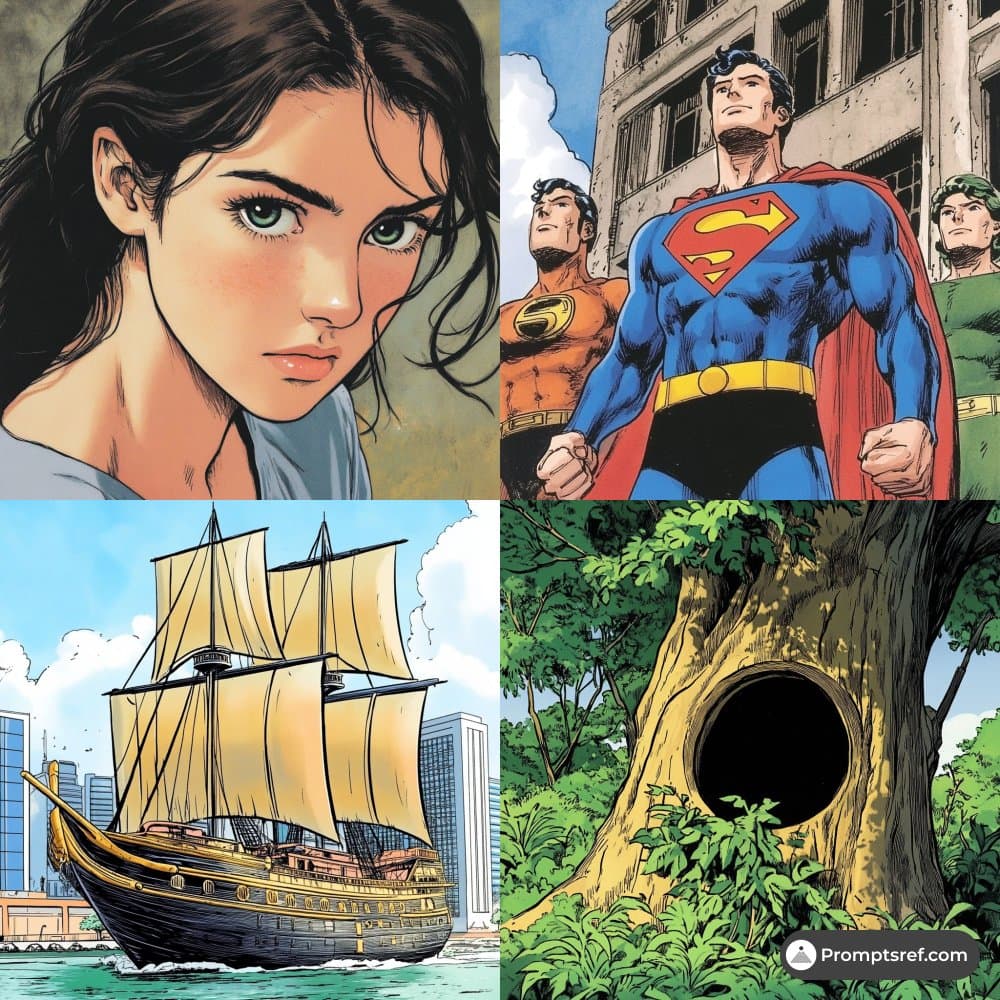
--sref 224194394 is being shared as a commercially usable middle ground between superhero linework and softer manga-like emotion. The examples attached to the post show it holding up across portraits, ensemble scenes, environment art, and poster-like compositions, which is why it reads less like a one-off aesthetic and more like a reusable house style.
At the other end, --sref 1214430553 strips the image down to shaky ink lines, sparse detail, and deadpan humor. In the writeup, the creator explicitly positions it for editorial cartoons, decks, merch, and social content where the joke or concept needs to land faster than the rendering.
Where the bigger opportunity is for concept artists
The most production-specific share is --sref 3092087225, which outputs character turnarounds and head studies in a Western-animation style with European comic influence. The attached examples in the model-sheet post look like development art rather than finished key art, which makes the code useful for character exploration, pitch decks, and game or animation prepro.
A related code, --sref 1922429581, pushes toward painterly European animation with looser linework and more emotive caricature. Separately, another shared code targets holographic sci-fi for UI, album-cover, and campaign work, while a trending-library post points to a retro dreamcore look built from film grain, muted color, and 80s airbrush cues. Taken together, the emerging pattern is less "best style" and more a lookup table: one code for polished narrative illustration, one for jokes, one for model sheets, and one for mood-heavy sci-fi.