
Seedance 2.0 supports Midjourney V8.2 storyboards for music-video and short-film runs
Creators are turning Midjourney V8.2 stills, character sheets, and storyboard frames into animated sequences in Seedance 2.0, with prompts and shot plans now shared across multiple threads. It matters because Midjourney is being used as the look-dev and planning layer while Seedance handles motion, giving small teams a repeatable image-to-sequence pipeline.
TL;DR
- Creators are using Midjourney V8.2 as the look dev layer, then handing those stills to Seedance 2.0 for motion, as Artedeingenio's storyboard workflow, starks_arq's music video thread, and koldo2k's Blender handoff each show in different ways.
- The prompt pattern is getting standardized: a reference image or storyboard first, then a second by second or beat by beat Seedance prompt, according to Artedeingenio's 15 second prompt, starks_arq's shot timeline, and MayorKingAI's Seedance prompt.
- Motion control is the other half of the recipe. koldo2k's camera control demo keeps the same tracked move across different worlds, while techhalla's lip sync workflow splits performance capture in Kling from cinematic camera variation in Seedance.
- The output is already spreading past short experiments into music videos, spec ads, fantasy scenes, and game mockups, as CuriousRefuge's Porsche spec film note, techhalla's 4K test, minchoi's roundup, and AIwithSynthia's GTA storyboard make clear.
You can watch koldo2k keep one camera move and swap the whole world, browse MayorKingAI's full storyboard to video prompt, and steal techhalla's split workflow for lip sync plus camera changes. There is also a neat distribution tell in the threads: people are running Seedance through Leonardo, Dreamina, TopviewAIhq, SocialSight, and CapCut.
Storyboards
The cleanest pattern in the evidence is that Midjourney or GPT Image 2 generates the planning frames, then Seedance turns those frames into a shot sequence.
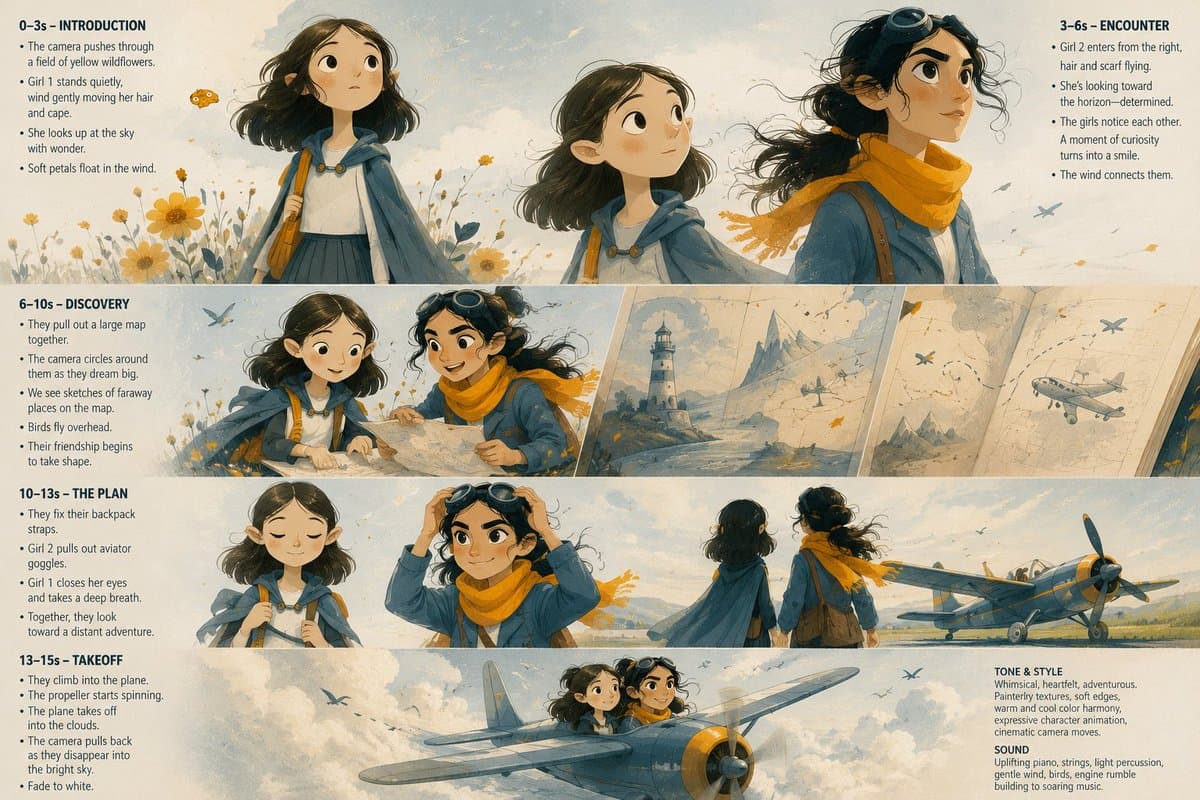
Artedeingenio says the piece started with a Midjourney illustration style, moved into a GPT Image 2 storyboard, and only then went into Seedance 2.0 inside TopviewAIhq. The follow up prompt post breaks the resulting 15 second clip into 0 to 3, 3 to 6, 6 to 10, 10 to 13, and 13 to 15 second beats.
MayorKingAI uses the same split more explicitly. The GPT Image 2 storyboard sheet lays out 12 panels, from establishing shot to final close up, and the Seedance prompt maps those panels into five timed blocks with camera moves, sound cues, and a quality anchor.
That is the useful shift. The still image is no longer just a mood board. In these threads it is functioning like previs.
Timelines
The Seedance prompts getting shared are less like text to video one liners and more like miniature shot lists.
starks_arq pairs a Midjourney V8.2 frame with a seven second Seedance prompt written as four beats: wide crowd setup, upward reveal, scramble in the crowd, then an overhead push. The clip only works because the shot order is specified before the model starts inventing motion.
Across the threads, the recurring ingredients are:
- camera instruction first: push in, orbit, whip pan, tracking shot, overhead
- locked visual references: exact character design, costume, lighting, or environment
- a timed sequence: usually every 2 to 5 seconds
- physics and stability anchors: no morphing, coherent motion, stable characters, no artifacts
Even the simpler examples follow that structure. techhalla's CapCut tested 4K prompt opens with style and camera, then specifies timeline blocks, then adds quality constraints.
Motion control
Some of the strongest results come from splitting motion from rendering instead of asking Seedance to invent both.
koldo2k uses a Blender reference video, a still image for world context, and a prompt that starts with "100% exact camera reference." The posted prompt tells Seedance not to change timing, angles, or orbit distance, then swaps the environment and actors around that locked move.
techhalla does the same division for music performance. The first pass uses Kling Motion Control to capture the acting and lip sync, then the second pass feeds that clip into Seedance as motion reference and asks for new camera perspectives while preserving the exact rhythm and mouth movement.
One reply adds a small but practical detail: in techhalla's interface note, the image should lead the final result when you want tighter control over the character look.
Formats
The creators sharing working examples are not converging on one genre. They are converging on one pipeline.
Curious Refuge says one student built a Porsche 911 GT3 RS spec film by developing 242 images in Flora, generating 512 Seedance 2.0 shots in Dreamina AI, then upscaling through Topaz Labs tools. That is already a multi shot production workflow, not a single clip demo.
minchoi's roundup clusters the visible use cases into a readable list:
- Blender action choreography to Seedance render
- 3D previs to anime
- K pop dance break from one character image
- 4K product ad
- luxury real estate commercial
- 4DX cinema tutorial
- Blender curiosity formats
- J horror in 4K 60fps
- story sequences in CapCut
- Midjourney plus GPT Image 2 plus Seedance shorts
The music video examples are especially repetitive in a good way. starks_arq, techhalla, and Artedeingenio all mix one image model for style, one audio or performance tool, and Seedance for the camera driven sequence.
Surfaces
The final useful clue is where people are actually accessing the model.
The evidence pool places Seedance across several wrappers and editing surfaces:
- TopviewAIhq, per Artedeingenio's workflow
- Dreamina, per Anima_Labs' character test and CuriousRefuge's spec film note
- Leonardo, per MayorKingAI's availability note
- CapCut, per techhalla's 4K test
- SocialSight, per AIwithSynthia's GTA storyboard
- Magnific, as the workflow shell in techhalla's lip sync tutorial and techhalla's ongoing story thread
- PixVerse, via AllaAisling's Prompt Studio example
That spread matters because the workflow is showing up as a layer inside other creator tools, not as a single destination app. The common unit across those posts is the same: reference images in, timed shot plan, motion render out.