
Designers report AI-written PRDs and decks add review work
UXDesign posts said AI-written PRDs, agendas, frontend code, and decks still need heavy human checking. One designer tracked deck work as roughly 70% formatting and 30% thinking.
TL;DR
- UXDesign posters described AI output as review labor: one designer said AI-created PRDs and agendas took “countless hours” to decipher, while another timed deck work at roughly 70% formatting and 30% narrative thinking, according to pinkiepooo's UXDesign rant and urban_fox161545's deck post.
- Frontend vibe-coding created a different version of the same load: a founding designer at a small startup said Claude Code was “incredibly tiresome” because errors were hard to see and the tool ignored clear instructions in greengloves31's UXDesign post.
- Code teams have a measured version of the bottleneck: a sponsored Sonar thread cited 42% AI-generated committed code, 96% developer distrust, and 48% always-check behavior in Linus Ekenstam's Sonar thread.
- Review layers are becoming their own product category, from /interface-review for UI, typography, layout, color, writing, and accessibility in jakubkrehel's skill post to browser-based human feedback batching in Peter Yang's human-review post.
- Creative agents still need hands-on direction: a Firefly workflow landed four of five scenes on the first generation, but Glenn said agent workflows require iteration and checking in Glenn's Firefly reply.
The 70/30 deck ratio in urban_fox161545's post is the line that sticks. Sonar's 2026 developer survey gives the code version of the same pattern, 42% of committed code is AI-generated, but only 48% of developers always verify it before committing. The interface-review skill repo breaks UI review into six disciplines, while human-review turns edits and comments into a single batch for an agent.
AI-written design docs
Raaaaant - AI created design and product documents
0 comments
The sharpest UXDesign complaint was about documents that had already left the prompt box. Pinkiepooo described AI-created PRDs, agendas, and leadership documents that a human had not reviewed before sending, then said they had spent “countless hours” deciphering them.
The weird loop: the post said those documents sometimes had to be run back through AI just to understand them. Muhammad Yasir's Medium post, published in the same window, framed the design version more gently: AI can generate possibilities, but designers remain responsible for judging whether work is tied to user needs, context, testing, and business goals.
Deck formatting
Anyone else spending more time reformatting slides than actually thinking?
0 comments
Urban_fox161545 timed stakeholder deck work and found a 15-slide deliverable averaged about 70% formatting and layout mechanics, with 30% spent on narrative and content decisions.
The mechanical bucket was specific:
- nudging text boxes
- rebuilding charts after data changes
- realigning icons after font changes
- separating “thinking” sessions from “building” sessions to reduce context switching
- testing AI-assisted layout tools with mixed but promising results
For UX work, that ratio is brutal because the artifact is supposed to communicate thinking, not become the main place thinking time disappears.
Claude Code frontend pressure
it's extremely tiring working with ai tools
0 comments
Greengloves31 described a founding designer role that had shifted toward frontend work under C-suite pressure, then called Claude Code “incredibly tiresome.”
The failure mode was observability. A GUI gives an error state; the post said LLM coding tools often keep moving, give approval-seeking answers, ignore instructions, and burn time and tokens before the designer can tell what failed.
That complaint matches the broader design-doc frustration: the labor moves from making the artifact to proving the artifact is safe to trust.
Verification debt
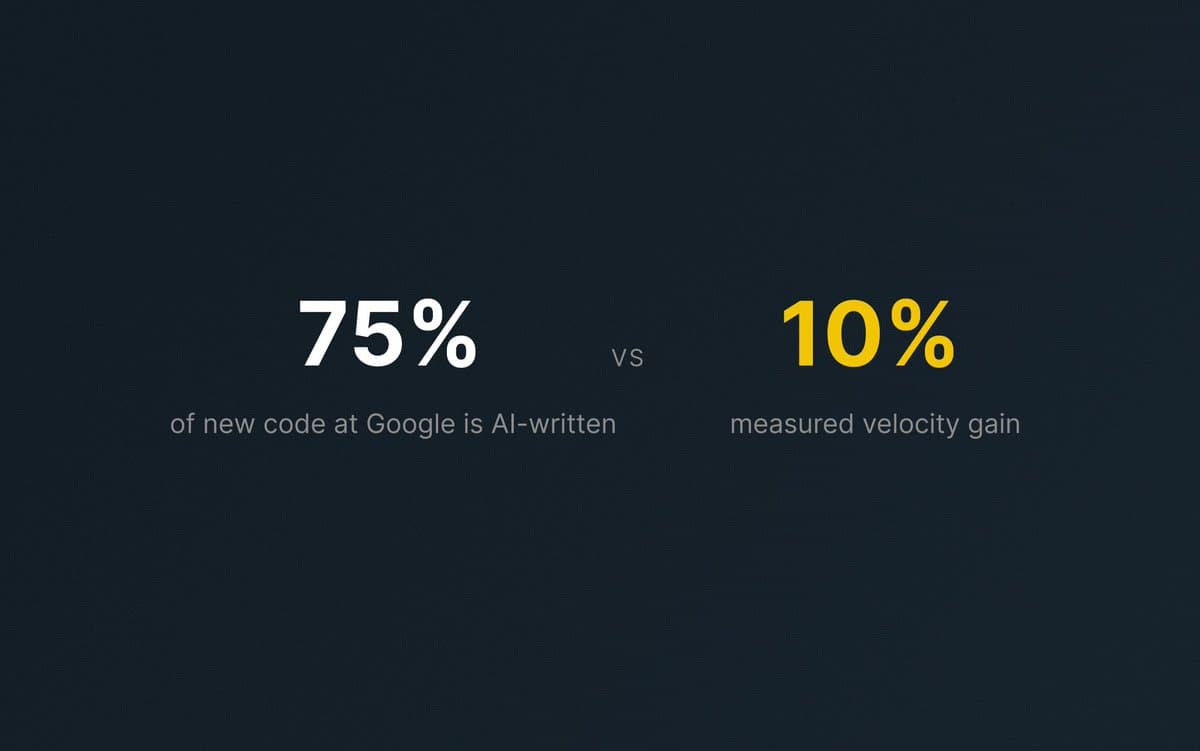
Linus Ekenstam opened a sponsored Sonar thread with Google's reported split, AI now writes over 75% of new code, while measured velocity gain is 10%.
The thread then used Sonar's survey numbers to define the verification bottleneck:
- 42% of committed code is now AI-generated
- 96% of developers do not fully trust it
- 48% always check AI-generated or AI-assisted code before committing
Sonar's own survey writeup adds another number: 38% of developers said reviewing AI code requires more effort than reviewing code written by human colleagues. Sonar's trust-gap post repeated the 96% distrust and 48% always-verify figures.
Adversarial code review
Bcherny's post named the bug category shift: fewer off-by-one errors, more system design issues, UI usability problems, and missing broader context.
The review mechanics were concrete:
- A one-line prompt can ask the model to “adversarial test every edge case in an iOS simulator,” according to bcherny's post.
- Claude's built-in
/code-reviewhas effort levels, including/code-review low,/code-review medium, and higher modes, per the same post. - Low effort “sips tokens,” according to bcherny's token reply, and another reply said
/code-review lowcost less than $0.01 in their evals bcherny's cost reply. - Low effort uses no agents; higher effort levels use up to 10, according to bcherny's effort reply.
/code-reviewshould use a forked agent since Claude Code 2.1.218, but bcherny later found a bug that could explain one user's issue and said a fix was incoming in one forked-agent reply and the bug reply.
Review tools
Jakub Krehel released /interface-review, a skill that reviews UI, typography, layout, color, writing, and accessibility. The linked skills repo also lists better-interface, better-ui, better-typography, better-colors, better-accessibility, better-layout, and better-writing as modular review skills.
Other tools in the evidence point at the same workflow shape:
- Human Review lets reviewers edit HTML and Markdown, leave comments, and send all feedback to an AI agent in one batch, according to the human-review repo.
- Linear Agent coding sessions now appear as live Slack cards, and reviewers can open the diff directly from Slack when the agent is ready Linear's Slack card post.
- Gitar reviews a PR, writes the fix, checks CI, and iterates until green, according to Ekenstam's Gitar post and his Gitar flow post.
- SonarQube Architecture reverse-engineers an interactive codebase map and compares intended architecture against actual code paths in Ekenstam's architecture post and his drift-detection post.
- Vortex runs inside Claude Code, Cursor, and Copilot, feeds standards to the agent before writing, and verifies edits mid-task, according to Ekenstam's Vortex post. Sonar benchmarked it at up to 36% lower token consumption and up to 92% fewer issues introduced in the Vortex benchmark post.
Firefly and Grok Bot workflows
Glenn made a moodboard, story, five scenes, motion, and score in one Firefly thread in one afternoon, with no exporting. Four of five scenes landed on the first generation, and he said almost every good result arrived after he described what the thing was not.
In replies, Glenn said agent-style workflows still need iteration and checking in one reply. He also said he was not sold on agent-based creation, but liked Adobe's attempt to make something “you direct” rather than something that creates for you in a later reply.
Danny Limanseta reported a broader game-dev workflow: Grok Bot generated, cleaned, cropped, and integrated 74 card art assets in about 2 hours, then helped with playtesting, itch.io build uploads, subscription audits, newsletter unsubscribes, and UX flows plus wireframes through Figma MCP.