
Amir Mushich introduces Nano Banana brand-asset pipelines for mockups and embossed logos
Amir Mushich shared a reference-image mockup generator and a long embossed-metal logo prompt for Nano Banana, both aimed at turning one brand input into repeatable asset sets. Try the recipes if you need packaging or identity visuals with explicit slots for brand names, colors, and reference files.
TL;DR
- Amir Mushich shared two reusable Nano Banana recipes on March 31: a reference-image mockup pipeline for turning one brand input into many ad visuals mockup pipeline, and a long embossed-logo prompt for turning a brand name plus color into a raised metal identity render embossed logo prompt.
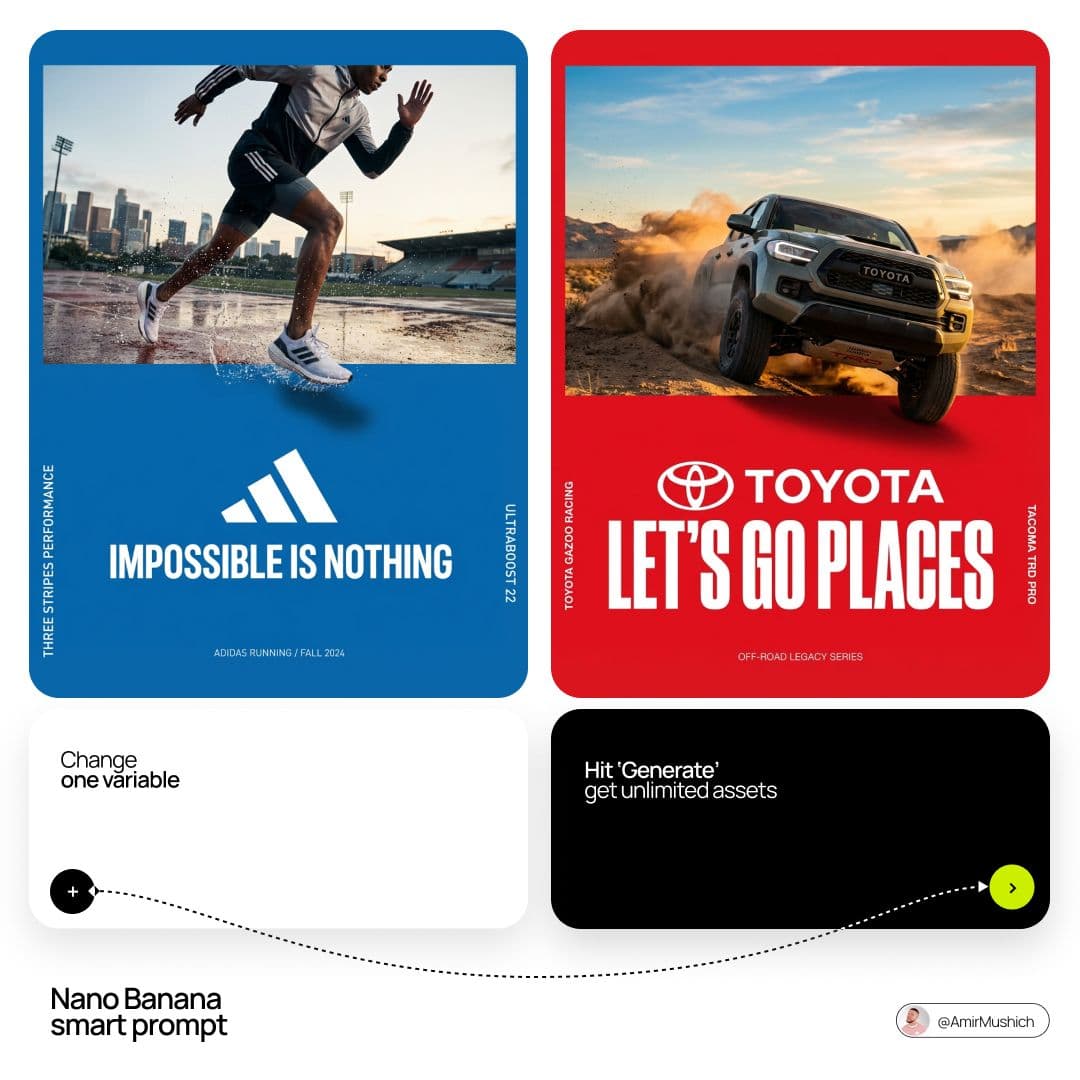
- The mockup recipe is structured like a tiny production system: input a reference image and base prompt, swap the brand variable in preprocessing, generate in Nano Banana inside LTX, then export final images pipeline diagram.
- The embossed-logo prompt is unusually specific about material behavior, asking for a full bas-relief form, curved bevel walls, controlled light direction, and a small typographic lockup on the same surface embossed logo prompt full prompt thread.
- The linked destination is LTX Studio, which pitches image and video generation from text prompts, image references, or a mix of both, plus persistent elements for logos, fonts, objects, and style consistency across a project embossed logo prompt What Is Nano Banana 2 & How To Use It Today In LTX Studio.
You can open the full embossed prompt on X, jump from Mushich's link into LTX Studio, and cross-check the platform's own writeups on Nano Banana 2 and multi-image references. The useful bit is how little changes between outputs: one workflow swaps a brand variable into a reference-led mockup system, the other keeps the whole composition fixed and only changes brand name and color.
Mockup pipeline
Mushich's first recipe is dead simple, which is why it is useful. The pipeline has four stages:
- Input:
reference_image.jpgplus a base prompt. - Preprocessing: replace
[brand_name]and inject the reference image. - Generation: run Nano Banana inside LTX.
- Output: export a folder of final images.
The point is not novelty, it is repeatability. The attached examples show the same layout logic applied to Adidas, Toyota, and Heineken style treatments, with the brand identity swapped in while the overall ad structure stays stable Adidas and Toyota examples.
Embossed metal logo
The second recipe is a much heavier prompt, but it is tightly organized. Mushich breaks it into a parameter block plus four phases.
- Brand intelligence system: resolve logo geometry, color palette, surface material, and light direction.
- Phase 1, Surface and atmosphere: one continuous material plane with grain, radial lighting, and tactile texture.
- Phase 2, The emboss: render the entire logo as a unified raised bas-relief, not an object placed on top.
- Phase 3, Lighting: one soft key light from upper left, one subtle fill, no hard shadows.
- Phase 4, Typography: add a minimal stacked lockup below the logo on the same surface.
The strongest instruction is also the most specific: the logo should look pushed outward from the sheet, like a die stamp seen from the front, not a floating 3D badge and not an engraved cutout full prompt thread. That level of physical direction is what makes the prompt read more like art direction than generic prompt padding.
Reference controls inside LTX Studio
Mushich's link lands on LTX Studio, which frames the product as an AI studio for films, ads, stories, and visual assets. Its landing page says creators can generate with text prompts, image references, or both, and keep projects consistent with AI Characters, Objects, Fonts, Logos, Style, and other reusable elements.
LTX's own coverage points in the same direction. The Nano Banana 2 guide positions the model inside that workflow, while the multi-image references guide and brand-consistent ad walkthrough focus on holding identity cues steady across many outputs. That makes Mushich's posts feel less like isolated prompt tricks and more like small, reusable recipes for a reference-driven brand asset pipeline.