
Nano Banana 2 supports 3D glass logo prompts with single-variable brand swaps
Creators shared reusable Nano Banana 2 prompt systems for blind-embossed glass logos, paint-heavy brand visuals, editorial officewear concepts, and isometric office dioramas. Use one-variable swaps like name, color, or material to keep a brand system consistent across outputs.
TL;DR
- Creators are treating Nano Banana 2 less like a one-off prompt box and more like a brand template engine: Amir Mushich’s glass logo system and paint-stroke system both keep composition and texture fixed while swapping a single variable such as brand name or color.
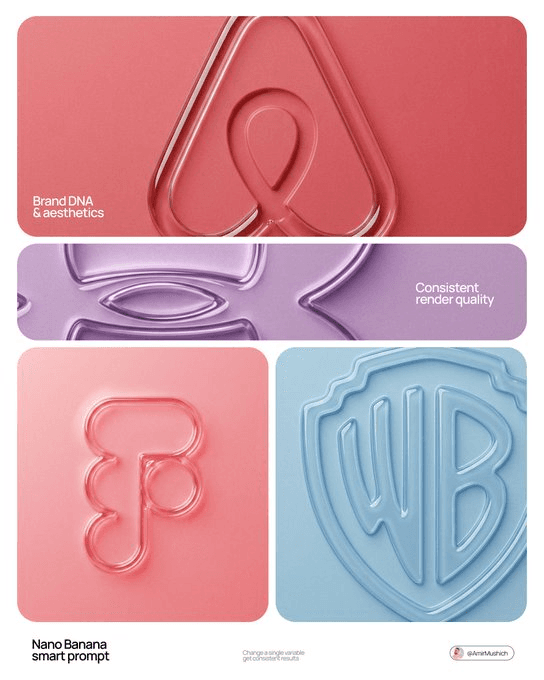
- The glass-logo setup in the full prompt is tightly constrained around center alignment, monochrome palettes, blind embossing, matte grain, and specular edge highlights, which is why the Airbnb, Fandom, and WB examples hold a consistent premium look in [img:0|glass logo examples].
- Other creators are pushing the same pattern into fashion and spatial concepts: a Nike officewear demo uses Recraft V4 plus Nano Banana 2 for Vogue-style editorial outfits, while an office diorama workflow maps brand identity onto an isometric workspace and then animates it with Kling 3.0.
- Across the examples, the shared trick is structured prompt scaffolding: lock camera, materials, lighting, and layout first, then let brand tokens, palette, or material do the variation, as shown in the diorama prompt and the fashion prompt.
What are the reusable prompt systems?
The cleanest system is the 3D glass logo recipe in Amir Mushich’s prompt thread. It specifies a top-down view, center-aligned mark, ample negative space, monochromatic gradients, a liquid-glass or chrome rim, and a blind-emboss interior that matches the background. That stack of constraints turns [BRAND] and [COLOR] into the main moving parts instead of reopening composition every generation.
His second system shifts from minimal product-identity renders to mixed-media brand art. According to the full paint prompt, the model should analyze a brand’s identity, remap the two impasto strokes and central paint dollop to primary and secondary colors, and fold the product, logo, slogans, and doodles into one heavy-grain canvas surface. The Baskin Robbins and Gucci examples in [img:4|paint examples] show the same macro, tactile look surviving the brand swap.
What do the swaps change in practice?
The Nike officewear set shows how far the same logic can stretch. In the fashion prompt, the variables are less about logo replacement and more about genre framing: tailored trousers, structured blazers, subtle swoosh branding, corporate interiors, cinematic lighting, and a 35mm editorial finish. The result is not generic sports merch but a consistent “Nike goes office” fashion fiction across multiple looks in
.
That is the useful pattern for brand work. Instead of prompting from scratch for every deliverable, creators are defining a visual grammar first — camera angle, surface behavior, texture language, lighting, and brand-placement rules — and only then swapping the token that personalizes the system.
Where does the workflow expand into motion?
0xInk_ applies the same template thinking to environments. The Nano Banana 2 office-diorama prompt in the setup locks an isometric cutaway view on white, requires 5–10 people, open-plan collaboration zones, visible brand screens, and a wall logo, while leaving [Brand] and [Material] open for customization.
The interesting addition is the handoff to motion. According to the animation prompt, the static output can be sent into Kling 3.0 with a simple instruction — “people working and talking, slow rotation around the isometric scene” — turning a brand styleframe into a short moving showcase, as seen in [vid:8|office diorama clip].