
AI frontend builders add reusable design-system skills; Taste Skill hits 67,000 GitHub stars
Bolt.new and related AI frontend workflows let teams store brand rules or design-system skills once instead of pasting them into every prompt. Taste Skill was cited with 67,000 GitHub stars after heavy Codex use.
TL;DR
- Bolt.new shipped Skills as persistent context, rules, and actions for builds, while hasantoxr's Bolt post framed the key win as saving teams from re-pasting brand guidelines into every prompt.
- Team-level design memory is the actual product hook: aakashgupta's post described standards that get set once, then stacked onto the right build automatically.
- Taste Skill became the loud reference point for AI frontend taste, with LLMJunky's post citing a 16-year-old builder, 67,000 GitHub stars, and 813 billion Codex tokens used.
- Skills are spreading into frontend choices and assets: emilkowalski's /pick-ui-library post covers curated UI dependencies, and MengTo's image-to-Three.js post turns one image into editable Three.js code.
- Claude Design also moved toward reusable design systems, with nateparrott's update listing public links, richer exports, built-in design systems, and lower token use.
Bolt's launch post defines Skills as reusable context, rules, and actions that can live on one project or across a workspace. Taste Skill's docs now default to a v2 experimental frontend skill that drops a SKILL.md into compatible agents; emilkowalski's SKILL.md makes UI library choice a lookup table; the Resource2Skill paper treats tutorials, repos, docs, and videos as raw material for executable skills.
Bolt Skills
Bolt's new Skills are persistent build rules, not prompt snippets. Bolt's official post says a skill can remember fonts, tech stacks, naming patterns, code-review workflows, SEO/GEO steps, framework configs, deployment setups, or a theming agent that matches a brand.
The mechanics are simple:
- Select a pre-built skill from Bolt's library.
- Build a custom skill for internal conventions.
- Upload skills from other tools or skill repos.
- Scope a skill to one project or share it across the workspace.
The FAQ makes the promptcraft shift explicit: a detailed prompt works for one session, while Skills persist across projects and apply when Bolt decides they are relevant. Tiny feature, nasty amount of leverage.
Taste Skill
The creator-side breakout was Taste Skill, which LLMJunky described as a high-school builder's frontend design skill with 67,000 GitHub stars and massive Codex usage.
The Taste Skill site calls it an open-source “Anti-Slop Frontend Framework for AI Agents,” with support for Cursor, Claude Code, Codex, Gemini CLI, v0, Lovable, OpenCode, and any tool that reads SKILL.md files.
The docs show a skill kit, not a single prompt:
design-taste-frontend, the default v2 experimental skill.design-taste-frontend-v1, preserved for older workflows.gpt-tasteskill, a stricter GPT/Codex-oriented variant.redesign-skill, for auditing and fixing existing UI.image-to-code-skill, for image-first frontend implementation.brandkit,imagegen-frontend-web, andimagegen-frontend-mobile, for visual and brand references.
The GitHub repo describes the project as a way to stop agents from generating “boring, generic slop.” The current docs say installing a skill adds a SKILL.md file that the agent reads automatically.
/pick-ui-library
emilkowalski turned frontend taste into dependency selection. His new /pick-ui-library skill tells the agent which trusted library to use instead of hand-rolling a toast component or installing an abandoned package.
The skill file is deliberately a lookup skill. It only runs when invoked, checks the project first, then maps the task to a curated list:
- Unstyled accessible components:
base-ui. - Command menus:
cmdk. - Toasts:
Sonner. - OTP inputs:
input-otp. - Charts:
Livelineorrecharts. - Drag and drop:
dnd kit. - Virtualization:
Virtuoso. - State:
zustand. - Dynamic OG images:
Satori. - Syntax highlighting:
shiki.
That is a design-system move disguised as a package picker.
Claude Design systems
Claude Design's July update put similar reusable-system language into a visual workflow. nateparrott listed public share links, better PDF, PNG, MP4, and Google Slides export, handmade built-in design systems, lower token use, and bug fixes.
Claude's Design product page says teams can import design systems from GitHub, design files, or raw uploads. It also says Claude checks output against the imported system and can correct mismatches before the user sees them.
The replies added two product details:
- Public prototypes do not support comments yet, according to nateparrott's reply.
- Private sharing can be done by publishing the artifact, then sharing with specific email addresses, according to nateparrott's sharing reply.
Image-to-Three.js skills
MengTo highlighted a skill that turns a single image into editable Three.js code. The creator use case is clean: static reference in, animation-ready object out.
The img2threejs repo says the output is a TypeScript THREE.Group factory built from primitives, procedural shaders, and generated geometry. It describes the approach as reconstruction-by-code, not photogrammetry, mesh extraction, or downloaded art packs.
The workflow includes quality gates, detail inventory, pivots, sockets, colliders, and runtime metadata for animation. For web designers, that means a product visual can become code that lives inside the site instead of a flat exported asset.
Process skills
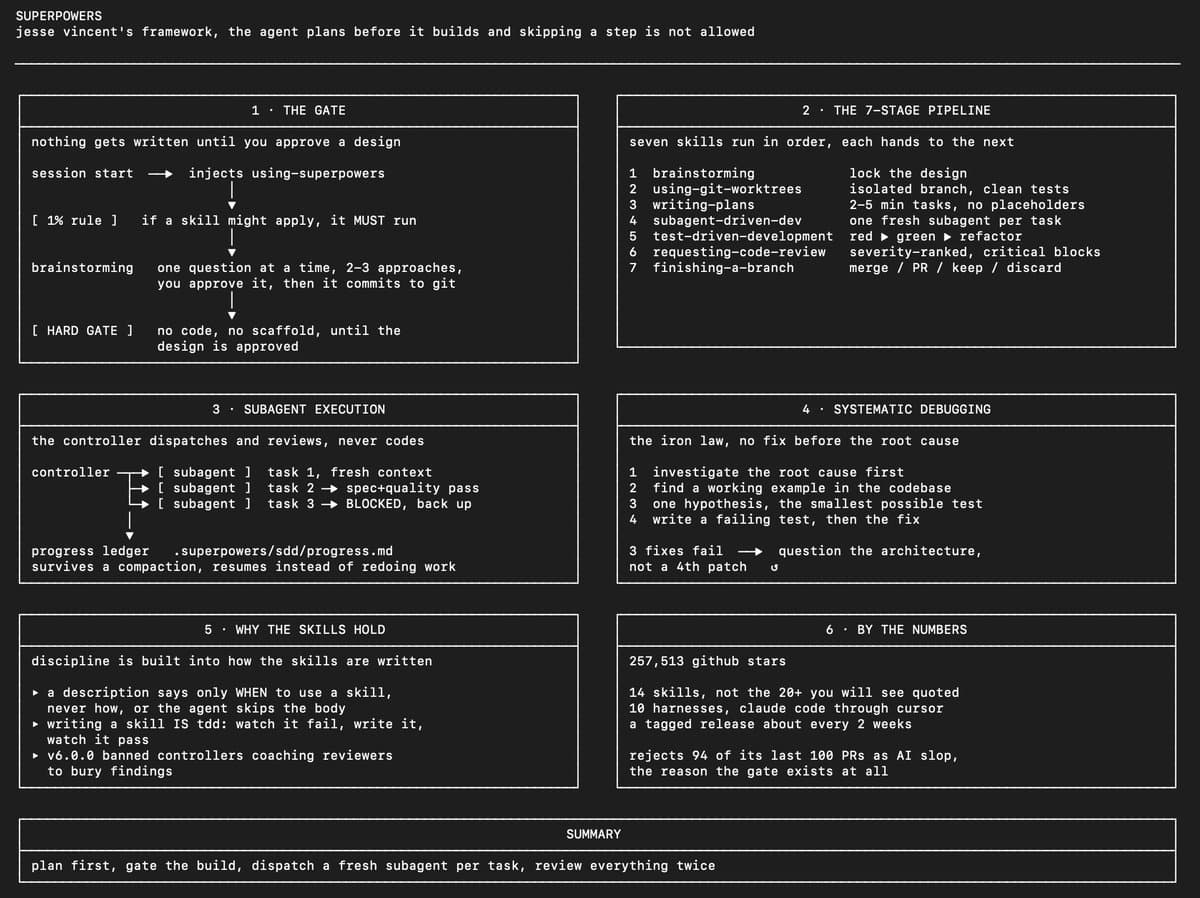
The skill pattern is also moving into process control. shannholmberg broke down Superpowers as a skill framework for Claude Code and other harnesses with 14 skills, 10 supported harnesses, and a hard gate before code starts.
Its seven-stage pipeline is built around forced sequence:
- Brainstorming, with questions, file reads, trade-offs, and an approved design saved to
docs/superpowers/specs/. - Git worktrees, with a fresh branch and clean test baseline.
- Writing plans, with 2-to-5 minute tasks, exact paths, full code, and verification commands.
- Subagent-driven development, with fresh subagents per task and branch-level review.
- Test-driven development, with red, green, refactor enforced in order.
- Code review, with severity-ranked issues and critical blockers.
- Branch finishing, with merge, PR, keep, or discard options.
Creative agents are getting their own verification loop. fabianstelzer said Glif's creative agent can identify issues in its own outputs and iterate without the user babysitting each model call.
Screen-recorded skill capture is the next adjacent workflow. shannholmberg's marketer example described teaching Claude a task by recording the screen and narrating each step, while ozansihay's comparison said Codex had a similar Record & Replay feature and framed Claude's addition as voice narration about why each step happens.
Resource2Skill
The research version of this trend is Resource2Skill. _akhaliq linked a paper on distilling executable agent skills from human-created multimodal resources.
The arXiv paper says skill libraries are usually hand-written, text-centric, or derived from agent traces. Resource2Skill instead extracts skills from tutorial videos, source repos, articles, documentation, and reference artifacts, then organizes them into a hierarchical multimodal Skill Wiki.
The evaluated domains were slide design, web page generation, spreadsheet authoring, Blender scene creation, CAD design, Unreal Engine 5 scene construction, and music production. The paper reports an average overall performance gain of about 11.9 percentage points over agents without skills.