
X creators report 93% reach drops after Phoenix code release and paid-post disputes
Several X creators posted metrics showing 85-95% reach declines after viral posts and tied the drop to Phoenix-era trust scoring and paid-post handling. The evidence is still partly anecdotal, so watch disclosure and penalty transparency before drawing firm conclusions.
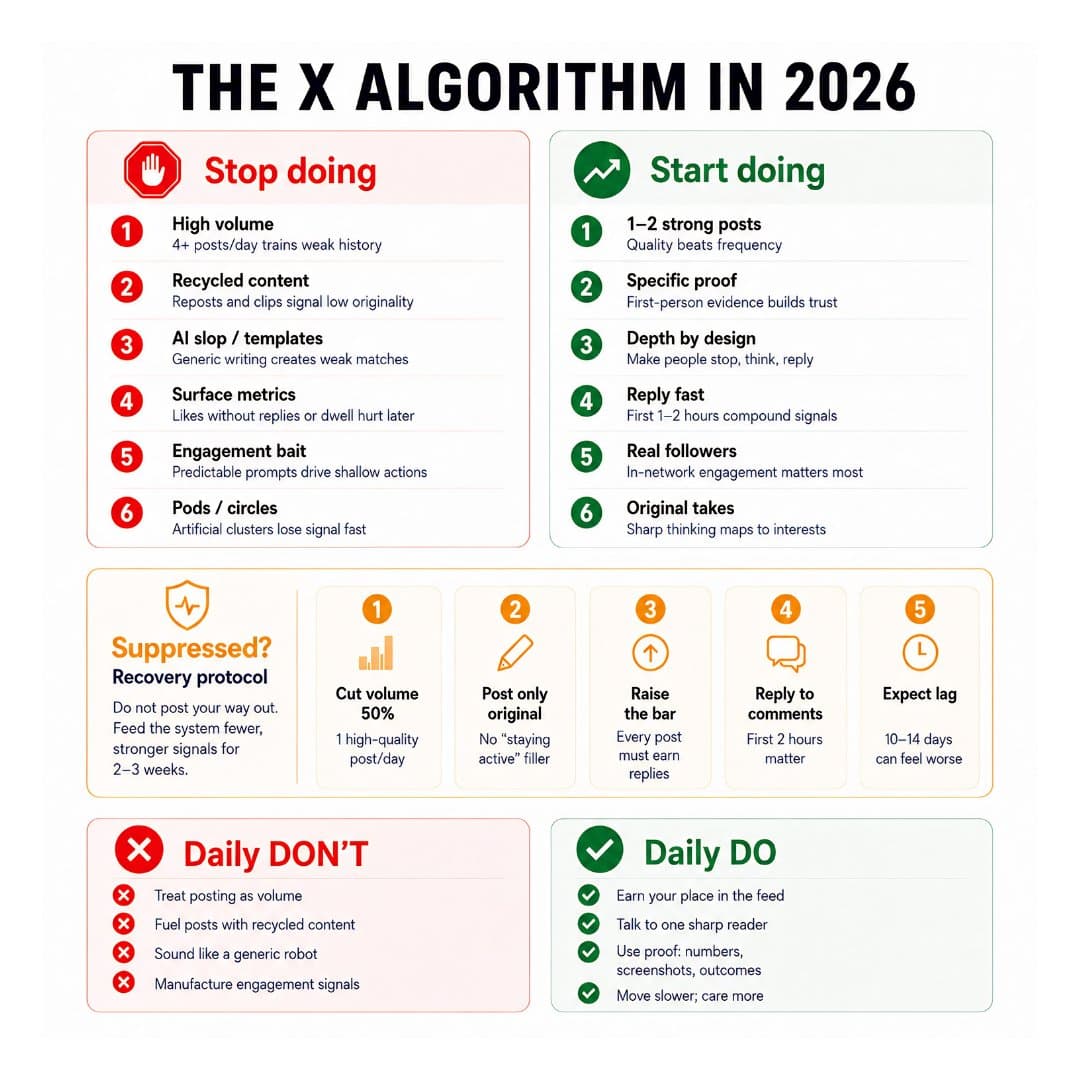
TL;DR
- After X published its recommendation code to GitHub, creators used the repo and Grok summaries to argue that the feed now ranks posts with a much broader action set, including replies, dwell, clicks, follows, blocks, mutes, and reports, not just likes, according to techhalla's repo thread and minchoi on reply weights.
- Several creators then posted analytics showing abrupt reach collapses after viral posts. LinusEkenstam's metrics thread showed an 85 to 95 percent drop across major stats, while another LinusEkenstam post contrasted a 116K-view post with a follow-up that reached 1.6M mostly through angry replies.
- The creator takeaway forming inside X is that negative feedback now matters more. minchoi on negative signals said blocks, mutes, reports, and low dwell can directly lower score, and minchoi's low-reach-prison post framed the post-viral crash as a quality judgment made after the spike.
- A separate fight broke out around paid-post labeling. AIandDesign argued properly disclosed paid posts appear to be penalized, while LinusEkenstam's reply said the unpaid-ad accusation was a distraction from the larger reach-collapse claim.
X's own repo link is public at the x-algorithm repository, and Elon Musk said in Elon Musk's update post that the company plans monthly GitHub updates with release notes. Creators quickly turned that transparency into their own reverse engineering project: Everlier's diagrams sketched the Phoenix and Grox pipeline, minchoi's 10-point breakdown turned it into posting heuristics, and LinusEkenstam's complaint thread supplied the before-and-after graphs that made the backlash travel.
Phoenix
The official repo release gave creators a concrete map of how the For You feed is assembled. In minchoi on the three-stage feed, the pipeline is summarized as user understanding, roughly 1,500 candidate posts, then filtering, scoring, and selection.
The pieces people kept citing were:
- Phoenix retrieval and ranking: out-of-network posts are embedded and retrieved for ranking, per Everlier's component diagram.
- Grok and Grox content understanding: creators reading the repo said Grok-linked systems now handle content understanding, spam detection, safety screening, reply quality, multimodal embeddings, and topic matching, according to minchoi on Grok-heavy ranking.
- Multi-action scoring: the model predicts far more than likes. techhalla's summary listed likes, replies, reposts, quotes, video views, dwell, clicks, not interested, mute, block, and report.
- Author diversity limits: minchoi on author diversity said too many posts from one author in a feed slice can reduce later posts from that same author.
- Monthly iteration: Elon Musk's update post said the code will keep changing monthly, with release notes.
That last point matters because creators are not reacting to a frozen algorithm leak. They are reacting to a moving public codebase that is now fair game for amateur audits.
Negative feedback
The strongest shared reading of the repo is that bad feedback can now sink otherwise popular posts.
Across the commentary threads, the mechanics repeated in a tight loop:
- Replies are a strong positive signal, per minchoi on reply weights.
- Blocks, mutes, reports, not interested, and low dwell are explicit negatives, per minchoi on negative signals.
- Going viral is not enough if the post attracts the wrong reaction mix, as minchoi's post-viral explanation argued.
- Posting more can backfire, because minchoi on author diversity said each post has to earn a slot.
- Your reply behavior feeds future distribution, according to minchoi on reply history.
That is a rough shift from old creator folklore, where volume and lightweight engagement loops could still brute-force distribution. The new folk theory is harsher: virality can become evidence against you if the people who arrive mostly block, mute, report, or bounce.
The 93 percent drop screenshots
The most concrete evidence in the pool came from Linus Ekenstam, who posted side-by-side analytics screenshots showing a collapse after a viral spike.
The screenshots and follow-up posts gave the story structure:
- In his main post, Ekenstam showed prior-period metrics alongside a later window with impressions down 91 percent, engagements down 96 percent, likes down 93 percent, reposts down 90 percent, and shares down 93 percent.
- his earlier complaint thread said this was the third suppression episode in under 12 months, and tied it to out-of-network reach breaking past his normal audience.
- a later comparison post contrasted a first post that drew strong conversation at 116K views with a follow-up that hit 1.7M views but attracted mostly angry responses.
- another screenshot showed a separate post with 54 comments, 12 reposts, 117 likes, and only 7.7K views.
- In a notification bug clip, he said he could not even tap through some notifications to the underlying post.
He also claimed this pattern was not new. LinusEkenstam's long retrospective said a prior support case ended with a confirmation that Grok had "miss processed" one of his posts, which he says pushed his account into search and reply suppression.
Viral spikes, then flatlines
Ekenstam's more detailed thread argued that the collapse is tied less to ordinary posting cadence than to what happens right after a breakout post.
His sequence was specific:
- A viral April 26 post drew about 0.5M engagements and, by his account, a surge of blocks, threats, and mass reports.
- He then posted follow-ups he describes as satire, including foot- and iris-reading jokes, and said a cybersec subcommunity mass reported them, again in that same thread.
- By the next stage of the thread, he said posts that would normally clear 500 to 1,000 likes were getting one or two views after hours.
- A later update showed a spike after attention from Elon Musk, followed by Ekenstam wondering whether the account would flatline again once that intervention faded.
This is where the creator complaint and the public repo narrative fused together. The repo commenters were saying negative actions now count directly, while the creators posting screenshots were saying the worst crashes happen right after out-of-network exposure brings a flood of hostile viewers.
Paid partnership tags
The weirdest subplot was paid-post disclosure. It introduced a second possible explanation for reach loss, but it never cleanly displaced the first one.
The dispute ran in three directions at once:
- AIandDesign argued that properly disclosed paid posts appeared to be penalized, calling the logic ridiculous.
- LinusEkenstam's response said fewer than five historical posts lacked a tag, and two of those predated the feature.
- LinusEkenstam's monetization post then pushed the argument into absurdity by saying that if monetization counts as payment, essentially all posts from monetized users are paid.
- his Grok screenshots added a separate self-audit, where Grok estimated his paid ratio at roughly 3 to 5 percent and described the account as generally high value rather than spammy.
- In the later thread climax, he admitted he found "a handful" of unlabeled paid posts while insisting that trust erosion still could not explain a 93 percent collapse in 48 hours.
That leaves two unresolved claims sitting side by side in the evidence pool. One is that Phoenix-era scoring now punishes bad reaction mixes after virality. The other is that creators still have no usable in-product explanation when a score tanks, whether the trigger was reports, classification errors, disclosure issues, or some combination of all three.