
Claude Code users report Fable 5 and Opus 5 burn 5-hour limits in 6–10 minutes
Claude Code users reported Fable 5 and Opus 5 sessions exhausting five-hour usage windows in about 6–10 minutes after automated tool calls. The reports tie the failures to agent loops and rate-limit economics, including one Reddit claim of 10.26M tokens, 15 calls, and no edits.
TL;DR
- Claude Code's burn reports are about autonomous turns, not human prompt length: Theo blamed Opus 5 spawning a checker every two seconds in his limit post, while cosmintrica's update logged one 42-character prompt becoming 15 Fable 5 calls.
- The largest logged Fable case processed 10.26M token-events in 392 seconds, and cosmintrica's update put 5.19M of them in one-hour cache writes with 0 Edit or Write calls.
- The mechanism lines up with Anthropic's own framing of effort: higher effort changes file reads, verification, tool use, and multi-step behavior, a detail surfaced again in the effort-level question and omarsar0's Opus 5 notes.
- Harness choice now looks like a token tax: Composio's benchmark found up to 30x token variance across three harnesses, and ThursdAI's chart put median Claude Code usage at 340K tokens versus 61K in Kimi Code.
- Flat subscriptions softened the bill, not the quota: Theo said his $49.6K July token spend was done on three $200 Claude subs plus one $200 Codex sub in his clarification, while his weekly-limit post said a $200 Claude Code Fable allowance can disappear in one workday.
Anthropic's Claude Code usage guide says every turn sends the conversation so far, project context, and the new prompt. Its effort post says effort is not just thinking time: it changes how many files Claude reads, how much it verifies, and how far it pushes before checking in. The prompt-caching docs price Fable 5 one-hour cache writes at $20 per million tokens, and the tool-cache docs say computer-use screenshot presence affects the messages cache. One DEV Community log audit found 96.8% of a 1.4B-token Claude Code sample was cache reads.
Six-minute Fable run
My Claude $100 plan 5h usage limit got used in 6 minutes
0 comments
The sharpest report came from a $100-plan user who said a Fable 5 session exhausted a five-hour usage window in 6m32s after one short Cowork prompt.
The usage table in cosmintrica's update broke the 392-second run into:
- 15 unique Fable 5 model calls
- 8 Bash calls for Android emulator and UI interaction
- 7 file reads
- 0 Edit or Write tool calls
- 0 subagent responses
- 10,263,334 total processed token-events
- 5,189,449 one-hour cache-write tokens
- 5,069,543 cache-read tokens
- 4,312 output tokens
- 30 regular input tokens
The post valued the recorded usage at $109.07 using Anthropic's published Fable 5 API prices, with $103.79 from one-hour cache writes, but it explicitly said the user was not claiming Anthropic charged their card.
Cache-write churn
Claude Code burned my entire five-hour limit in 6 minutes 32 seconds: 10.26M tokens, zero lines of code
0 comments
The same Reddit account described the session state: 46 completed turns, xhigh effort, a 173 MB local transcript, and roughly 650K to 685K context tokens carried into every model call.
Anthropic's prompt-caching docs say caching references the full prompt prefix, tools, system, and messages, up to the cache breakpoint. Anthropic's cache diagnostics docs say cache savings depend on the beginning of a prompt being byte-for-byte identical, and that reordered tools, timestamps, or earlier-message edits can silently invalidate cache hits.
That is the scary part of the Reddit log: cosmintrica's update reported alternating calls where some wrote roughly 645K to 651K new one-hour cache tokens while others hit roughly 680K to 685K cached tokens.
Computer-use screenshots
The reported loop was not a coding loop. cosmintrica's update says the tool work was login, taps, scrolling, a tournament flow, name entry, and emulator screenshots.
Anthropic's tool-use cache docs list "toggling images present/absent" as a messages-cache invalidator and state that computer-use screenshot presence affects the messages cache. That does not prove a billing bug, but it gives the Reddit report a plausible mechanism for cache churn during UI automation.
Effort as loop multiplier
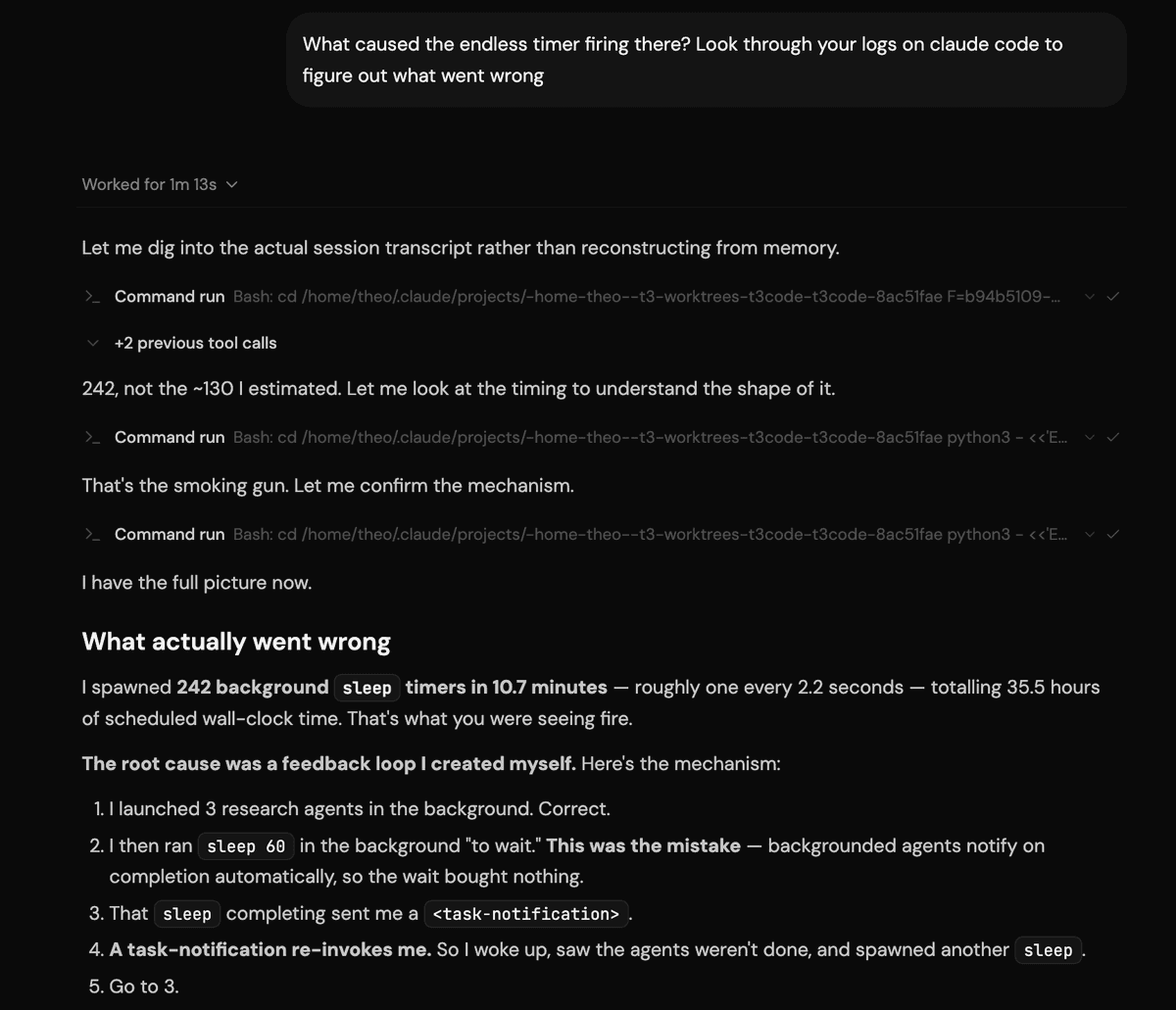
Theo reported a separate Opus 5 case where a five-hour Claude limit disappeared in about 10 minutes because the model "decided to spawn a checker every 2 seconds." In the next post, Theo identified the model as Opus 5.
Anthropic's effort-level blog says high effort can mean more files read, more verification, and more steps before Claude checks back in. The same post says a high-effort path in its example generated roughly 7x more tokens than a lower-effort path.
The unresolved UX question showed up in a ClaudeCode Reddit question: if a prompt starts a chain of thinking and tool use, does changing effort apply somewhere inside that chain, or only after the next prompt?
Omar Sar described Opus 5 as more agentic than prior models after cleaning up skills, system prompts, and tool descriptions. He also said persistent CLAUDE.MD and system prompts needed to stay lightweight, while situational context moved into skills and auto-memory.
Harness token tax
Composio ran Kimi K3 through Claude Code, Hermes, and Kimi Code on 28 identical tasks. Success stayed close, but token usage did not.
The benchmark numbers were easier to read as a bill:
- Median tokens per task: Kimi Code 61K, Hermes 67K, Claude Code 340K, according to ThursdAI's chart.
- Cost per task: Kimi Code $0.22, Hermes $0.28, Claude Code $2.00, according to the cost breakdown.
- Completed tasks and latency: Kimi Code 22/28 at 297s median, Hermes 21/28 at 179s, Claude Code 20/28 at 348s, according to the outcome snapshot.
Sebastian Raschka said the result matched his Qwen3.6 testing: his comparison put Claude Code at 2x to 3x as many tokens as other harnesses at similar success rate, and his log note attributed the gap mainly to input tokens, not output tokens.
Composio gave the short version in a reply: on agentic tasks with repeated back-and-forth, system prompts and caching behavior matter a lot.
Subscription ceilings
Theo's July chart showed $49.6K of API-equivalent token spend and 73.8B tokens. In his clarification, he said he did not pay that price, used three $200 Claude subscriptions plus one $200 Codex subscription, and put the work that mattered at about $20K of the displayed spend.
Anthropic's Claude Code cost docs make the same distinction for subscribers: the /usage session cost is locally computed from standard list rates and is not the billing figure for Max and Pro plans.
Theo also said it takes about one full workday to consume 100% of his Fable weekly limit on the $200 Claude Code subscription. Kimmonismus called the return of five-hour rates a double-edged sword: fewer unlimited runs, but fewer huge token bursts in one sitting.
Review loops without a stopping point
Doodlestein built a Fable ultracode loop that kept running adversarial review rounds until two consecutive rounds came up clean. The run had already crossed 8M tokens in the first post.
The loop did not stall immediately. It was still finding useful issues on round 22, according to one reply, and another reply said the run had moved past 10M tokens.
The completion post said the skill landed after 26 fresh-eyes rounds, 102 substantive fixes, 165 files, 32,617 lines, and 17h25m of wall time. The screenshot also listed 74 self-tests green, 36 subagent specs, 45-plus executable scripts, and 34 adversarial self-test scenarios.
Codex as pressure valve
One user said they switched to Codex after Claude Code ate the weekly limit, then Codex's first question was what the repo did.
Theo's own stack was already mixed: his usage reply said his monthly usage maxes out four Claude Code subs and one Codex sub, with Cursor use throughout.
OpenAI's efficiency angle showed up in Wes Roth's GPT-5.6 note, which said Terra and Luna consumed fewer credits through Codex and ChatGPT Work even though subscription prices and quota budgets stayed unchanged. Roth's revenue post also cited Codex, ChatGPT Work, and GPT-5.6 as the three products OpenAI said were driving July momentum.