
Anthropic ships Claude Opus 5 to paid plans and API at Opus 4.8 price
Anthropic released Claude Opus 5 with Fast Mode on paid plans and the API at the Opus 4.8 price. Benchmarks from ARC Prize, Artificial Analysis, Vals AI, and tool vendors put it near or ahead of Fable 5 on several agent and coding tests.
TL;DR
- Anthropic shipped Claude Opus 5 on paid plans and the API at the Opus 4.8 price, and claudeai's availability post says Fast mode runs around 2.5x default speed.
- The benchmark story is agent work per dollar: Opus 5 beats Opus 4.8 by +22.2 points on Frontier-Bench and +28.7 points on ARC-AGI-3 in Anthropic's table shown by Kimmonismus's benchmark post.
- The biggest independent pop is ARC-AGI-3, where Opus 5 hit 30.2% versus the previous 7.8% high from GPT-5.6 Sol, according to ARC Prize's result.
- The migration gotcha is reasoning: rohanpaul_ai's migration note says thinking is on by default, with low, medium, high, xhigh, and max effort levels behind one endpoint.
- First-day hands-on reports split between workhorse and weird: Dan Shipper's Day 0 vibe check saw broken existing workflows, while theo's coding report found code that looked worse than Fable's but caught more mistakes.
Anthropic's launch post frames Opus 5 as Fable-class intelligence at half the price, but OpenRouter's migration guide is where the breaking API detail lives: reasoning defaults changed. bcherny pulled out the buried prompt-injection result from the system card, and ClaudeCodeLog caught the Claude Code 2.1.219 surface area change: Opus 5 default, a bash-output tool, and an agent launcher. ARC Prize also pointed to downloadable ARC-AGI-3 replay logs with model reasoning and thought process for the public demo games.
What shipped
- Opus 5 is available on all paid Claude plans and the Claude API, according to claudeai's availability post.
- It is the default model on Claude Max and the strongest model on Claude Pro, according to claudeai's availability post.
- Anthropic kept Opus 4.8 token pricing, $5 per million input tokens and $25 per million output tokens, per ArtificialAnlys's pricing note.
- Fast mode runs about 2.5x default speed, according to claudeai's availability post, while ClaudeCodeLog's changelog lists Fast mode pricing at $10 per million input tokens and $50 per million output tokens.
- The model has a 1M token context window, according to ValsAI's evaluation setup and ArtificialAnlys's model details.
- It exposes five effort settings, low, medium, high, xhigh, and max, according to rohanpaul_ai's migration note and ArtificialAnlys's model details.
- Anthropic's public materials do not say whether Opus 5 is a new base model or a post-trained variant; the launch post calls it the latest Opus model and an upgrade over Opus 4.8.
Benchmarks that moved
First-party
- Frontier-Bench v0.1: Opus 4.8 21.1% → Opus 5 43.3%, +22.2 points, in the launch table shown by Kimmonismus's benchmark post.
- GDPval-AA v2: Opus 4.8 1593 Elo → Opus 5 1861 Elo, +268 Elo, in the launch table shown by Kimmonismus's benchmark post.
- ARC-AGI-3: Opus 4.8 1.5% → Opus 5 30.2%, +28.7 points, in the launch table shown by Kimmonismus's benchmark post.
- OSWorld 2.0: Opus 4.8 55.7% → Opus 5 70.6%, +14.9 points, in the launch table shown by Kimmonismus's benchmark post.
- AutomationBench: Opus 4.8 17.0% → Opus 5 26.0%, +9.0 points, in the launch table shown by Kimmonismus's benchmark post.
Third-party evaluators
- ARC-AGI-3: GPT-5.6 Sol 7.8% → Opus 5 30.2%, +22.4 points, according to ARC Prize's result.
- ARC-AGI-3 public demo environments: Fable-class models around 20% → Opus 5 30.2%, +10.2 points, according to ARC Prize's analysis.
- Vals Index: Fable 5 75.1% → Opus 5 74.8%, -0.3 points, according to ValsAI's index post.
- Artificial Analysis Intelligence Index: Opus 4.8 56 → Opus 5 61, +5 points, according to ArtificialAnlys's index post.
- GDPval-AA v2: Fable 5 1747 Elo → Opus 5 1861 Elo, +114 Elo, according to ArtificialAnlys's GDPval note.
- AA-Briefcase: Fable 5 1574 Elo → Opus 5 1720 Elo, +146 Elo, according to ArtificialAnlys's AA-Briefcase post.
Customer-reported
- CursorBench default effort: Fable 5 66.5% → Opus 5 66.7%, +0.2 points, according to Cursor's launch post.
- CursorBench Max: Fable 5 Max 70.5% → Opus 5 Max 70.0%, -0.5 points, while cost fell from $17.32 to $8.23, -$9.09, in bridgemindai's CursorBench table.
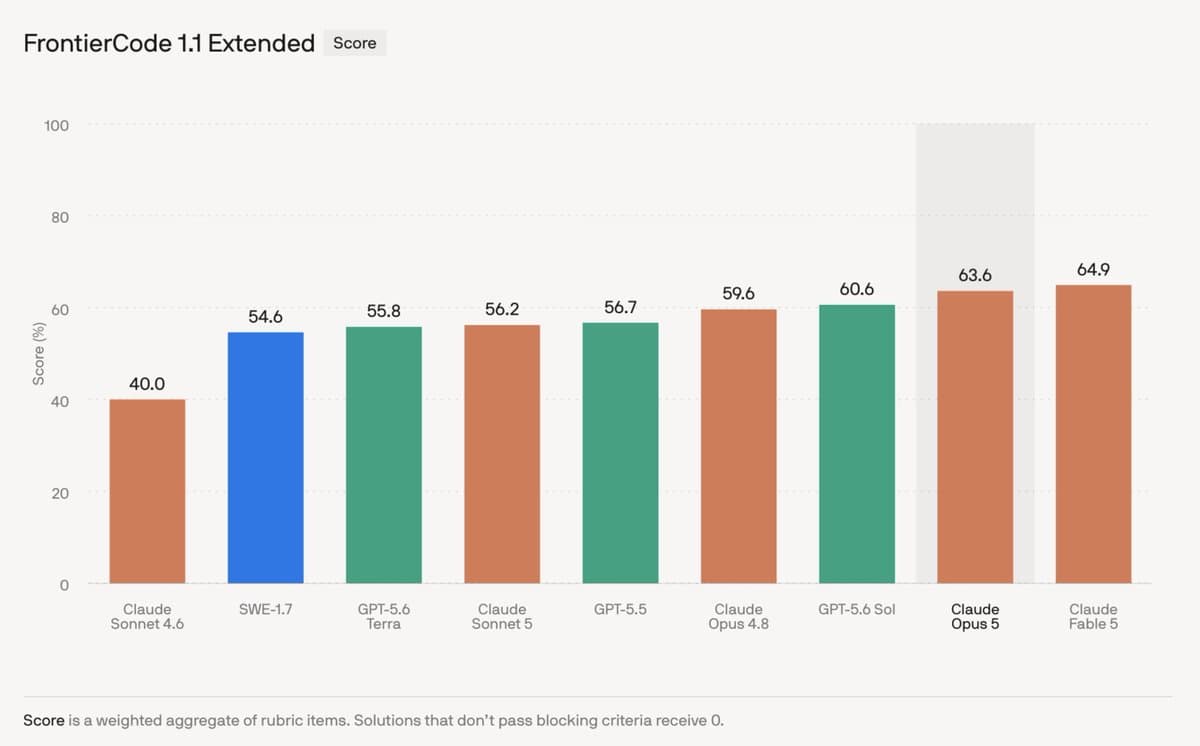
- Devin FrontierCode 1.1 Extended: Opus 5 scored 63.6% with a 69.6% pass rate, and cognition's benchmark note described the result as approaching Fable 5 at half the cost.
- Box Complex Work Eval: Opus 4.8 → Opus 5, +17% in due diligence, +30% in life sciences, +12% in legal, +19% in technology, and +13% in healthcare, according to levie's Box eval.
- Perplexity Computer WANDR: Fable 5 0.427 → Opus 5 0.352, -0.075, while cost fell from $28.79 to $12.35, -$16.44, in Perplexity's WANDR chart.
- Lovable's demanding coding tasks: Opus 4.7 → Opus 5, +22%, according to Lovable's rollout post.
Where it regressed
DeepSWE still has GPT-5.6 Sol ahead. The launch table shown by rohanpaul_ai's DeepSWE note puts GPT-5.6 Sol at 72.7% and Opus 5 at 68.8%, -3.9 points versus Sol.
Higher effort did not monotonically improve Opus 5. On FrontierCode main, Ben Hylak's chart shows Opus 5 peaking at 53.4% on medium effort, then dropping to 43.6% at xhigh, -9.8 points.
Vals saw the same shape on Vibe Code Bench: low to medium to high improved, while xhigh and max were worse within error bars and more expensive, according to ValsAI's effort sweep. On Terminal Bench, ValsAI's Terminal Bench note says max was more expensive and underperformed high partly because strict timeouts left fewer turns.
Document parsing was not the win. Jerry Liu's ParseBench table put dense tables at Opus 4.8 89.7 → Opus 5 86.7, -3.0 points, and semantic formatting at 71.4 → 65.6, -5.8 points, even though average ParseBench rose from 63.7 to 66.6, +2.9 points.
Artificial Analysis found a factuality caveat: ArtificialAnlys's index post says Opus 5 improved AA-Omniscience Accuracy by +7 points over Opus 4.8, while its hallucination rate rose +14 points to 50%.
Under the hood
Reasoning is now part of the default path. rohanpaul_ai's migration trap note says disabling thinking while selecting xhigh or max returns an API error, and OpenRouter's migration guide describes the same xhigh and max restriction.
The prompting guidance changed in a way that breaks old harness habits:
- Opus 5 verifies its own work without being told, according to Cedric Chee's prompting-guide notes.
- Explicit verification instructions can cause over-verification and wasted tokens, according to Cedric Chee's prompting-guide notes.
- Opus 5 delegates to subagents more readily than Opus 4.8, according to Cedric Chee's prompting-guide notes.
- It can expand task scope by adding steps that were not requested, according to Cedric Chee's prompting-guide notes.
Claude Code shipped the harness changes the same day. ClaudeCodeLog's full changelog lists Opus 5 as the default Opus model, a strict sandbox network allowlist, nested subagent forwarding, a workflow-size guideline, and subagents that can spawn nested subagents up to depth 3 by default.
Prompt-injection robustness is the buried safety headline. bcherny's prompt-injection note says layered defenses with prompt-injection probes and Auto Mode in Claude Code drove attack success near zero, while Cedric Chee's system-card excerpt says Opus 5 reduced Gray Swan IPI success within 15 attempts from 5.5% on Opus 4.8 to 2.0%.
Cyber stayed deliberately asymmetric. scaling01's system-card excerpt quotes Anthropic saying Opus 5 was not deliberately trained on cybersecurity tasks; claudeai's cyber post says it is stronger than Opus 4.8 on cyber tasks but remains substantially behind Mythos 5 at developing exploits.
Vibe Check
First-run usage reports were unusually operational: people were not just saying smarter or dumber, they were reporting harness failures.
- Dan Shipper's Day 0 vibe check said existing Every skills and plugins made Opus 5 argue with instructions and stop early, then got much better after the team deleted old workflows and started from scratch.
- kunchenguid's first-day notes called it fast and capable enough to become a daily driver, but said it made technical mistakes when the user had not gathered the right context.
- theo's coding report described it as between GPT-5.6 Sol and Fable 5: less pretty code than Fable, more likely to be correct, and often catching things Fable missed.
- emollick's pre-release note found it could match or beat Fable on shorter tasks but was less ambitious on longer tasks.
- doodlestein's workflow split put Opus 5 on implementation work and kept Fable 5 for planning, reviewing markdown plans, and long-tail knowledge.
- dexhorthy's SlopCodeBench final note said Opus 5 won the run, but none of the models did a good job on the benchmark.
The SlopCodeBench context matters because it tests iterative self-extension, not one-shot patching. The SlopCodeBench paper reports no agent solved all 20 problems end to end, with degradation in 80% of trajectories and verbosity increasing in 89.8%.
Where it shows up
Opus 5 landed across the coding-agent stack within hours.
- Cursor shipped Opus 5 with Zero Data Retention compatibility and a CursorBench default-effort comparison, according to Cursor's launch post.
- Devin shipped it across Desktop, CLI, and Devin Cloud's mode mix, according to cognition's launch post.
- OpenRouter made Opus 5 and Opus 5 Fast available, according to OpenRouter's launch post and OpenRouter's Fast mode note.
- Vercel AI Gateway added the model slug
anthropic/claude-opus-5with Fast mode support, according to Vercel's AI Gateway post. - GitHub Copilot started rolling Opus 5 into VS Code, according to VS Code's rollout post.
- Lovable, v0, Rork, Cline, Warp, Perplexity, Linear, Julius, Letta, Factory, Hyperbrowser, OpenCode, Genspark, Hermes Agent, and Venice all posted day-one availability notes: Lovable, v0, Rork, Cline, Warp, Perplexity, Linear, Julius, Letta, Factory, Hyperbrowser, OpenCode, Genspark, Teknium, and Venice.
- Arena added Opus 5 to Agent Mode and Battle Mode, with scores still pending, according to Arena's launch post.
- Pi did not need a new release because dynamic model catalogs can pick it up through
pi update --models, according to pidotdev's model-catalog note.