
Conductor integrates Vercel Sandboxes for remote parallel coding agents
Conductor moved its parallel coding agents from local-only execution onto Vercel Sandboxes. That matters because teams can run isolated remote agent workspaces with near-local startup and feedback instead of depending on a developer laptop.
TL;DR
- vercel's launch post says Conductor's parallel coding agents used to run only on a developer laptop, and now run remotely on Vercel Sandbox.
- According to vercel's customer story, the pitch is near-local feel from the cloud, with Conductor quoting that users "can't tell the difference because Vercel's Sandboxes are so fast."
- The Vercel Sandbox docs frame Sandbox as an isolated environment for untrusted code, AI agents, live previews, and development servers, which matches Conductor's branch-per-workspace model in its parallel agents docs.
- In rauchg's post, Guillermo Rauch argues remote dev matters because many large organizations do not treat local execution as a real deployment surface.
You can read Vercel's full customer story, check the core Sandbox docs, browse Conductor's parallel agents guide, and even see that Conductor's homepage now teases Conductor Cloud.
Remote execution
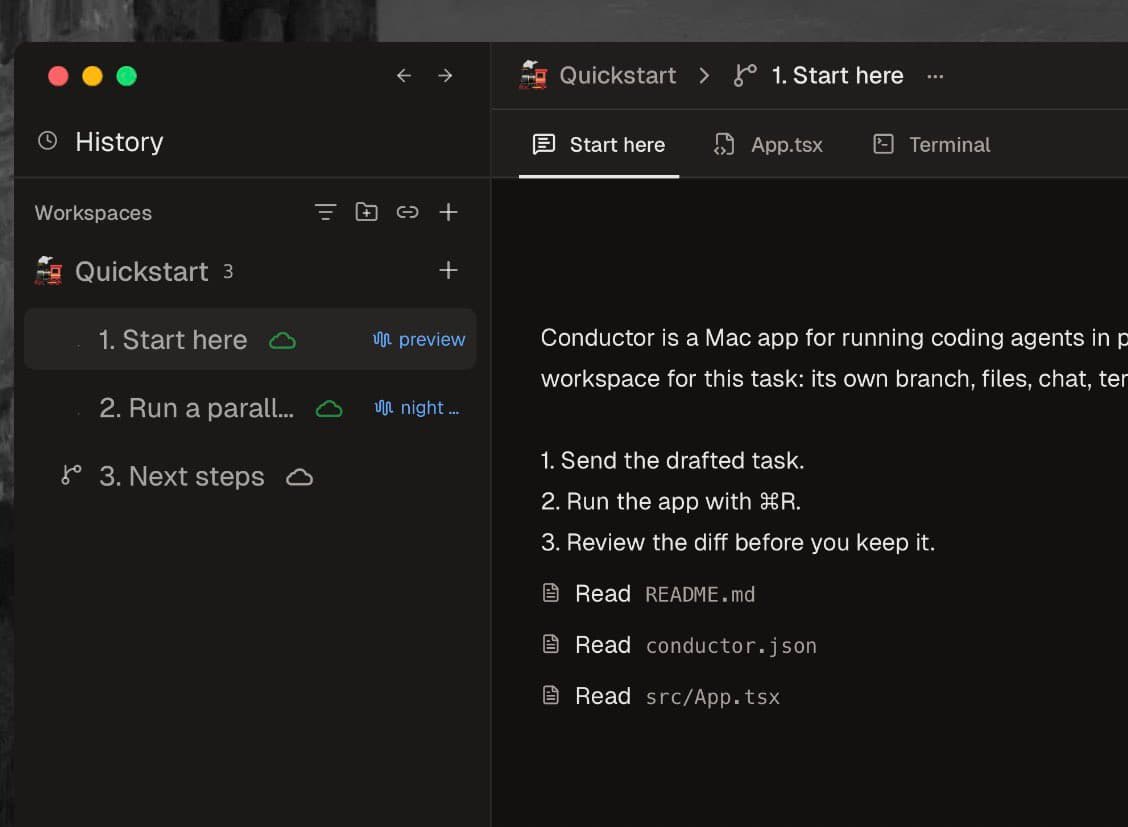
The product change is simple: Conductor's UI for running multiple coding agents no longer depends on the same Mac that opened the app. Vercel's writeup says the agents now run at cloud scale on Sandbox, while Conductor's homepage still describes the product as a Mac app for spawning parallel Claude Code and Codex sessions in isolated workspaces.
That split is the interesting bit. The control surface stays local, but the workspaces move off the laptop.
Sandbox mechanics
Vercel's Sandbox docs describe the service as an on-demand isolated Linux environment for untrusted code, agent-generated code, file edits, logs, and live previews. The companion concepts page adds one detail that matters for agent workflows: sandboxes are persistent by default, so filesystem state can be snapshotted and restored across sessions.
That lines up neatly with how Conductor's workspace docs define a workspace: a separate git-backed copy of a project for one stream of work, with its own branch, files, and review path. Conductor's parallel agents guide says teams should use separate workspaces when tasks need independent branches, running environments, or test runs.
Merge transcripts
A smaller product detail surfaced the same day from Conductor founder Charlie Holtz. In charlieholtz's post, he said the next version will optionally upload an agent chat as a GitHub gist on every merge and attach it to the pull request. In another charlieholtz reply, he also pointed to shortcuts for copying either a concise transcript without tool calls or the full transcript.
That gives the remote-agent push a paper trail. The agent run is no longer just a diff, it can also ship with the conversation that produced it.