
Developers publish loop libraries and control-loop guides for long-running agents
Builders released reusable loop artifacts this week, including a Loop Library Skill, repo templates, and published control-loop definitions for docs sweeps, onboarding checks, and error triage. It matters because teams are turning one-shot prompting into persistent agent runs with explicit stop conditions and shared repo state.
TL;DR
- MatthewBerman's Loop Library launch turned the week's loop chatter into a reusable catalog, and his Loop Library Skill post framed it as something an agent can query to find or create loops.
- A shared pattern emerged across dexhorthy's control-loop definition, MatthewBerman's deterministic-versus-LLM-judge split, and omarsar0's verifier note: loops need an explicit success test, not just a long prompt.
- Builders published concrete loop artifacts, including aibuilderclub_'s repo template, a new root-cause loop submission, and the Fresh-Clone Loop repost, which is more operational than the generic "/goal" demos.
- Teams are already using loops for narrow maintenance work, from aibuilderclub_'s docs and error-sweep examples to 0xblacklight's daily React cleanup loop and bridgemindai's Sentry-fix run.
- The limiting factor is still steering: petergostev's advisor-thread workflow, unclebobmartin's deterministic thresholds, and theo's blunt critique of /goal all point to the same bottleneck.
You can browse the library, inspect the repo template, and read a full loop engineering walkthrough. The interesting bit is how fast the examples got specific: one published loop repeatedly reruns onboarding from a clean clone MatthewBerman's Fresh-Clone Loop post, another turns production error triage into a bounded repair cycle aibuilderclub_'s loop examples, and a third asks an agent to stop only when a root cause, patch, and reviewer-ready handoff exist MatthewBerman's root-cause loop submission.
Loop Library
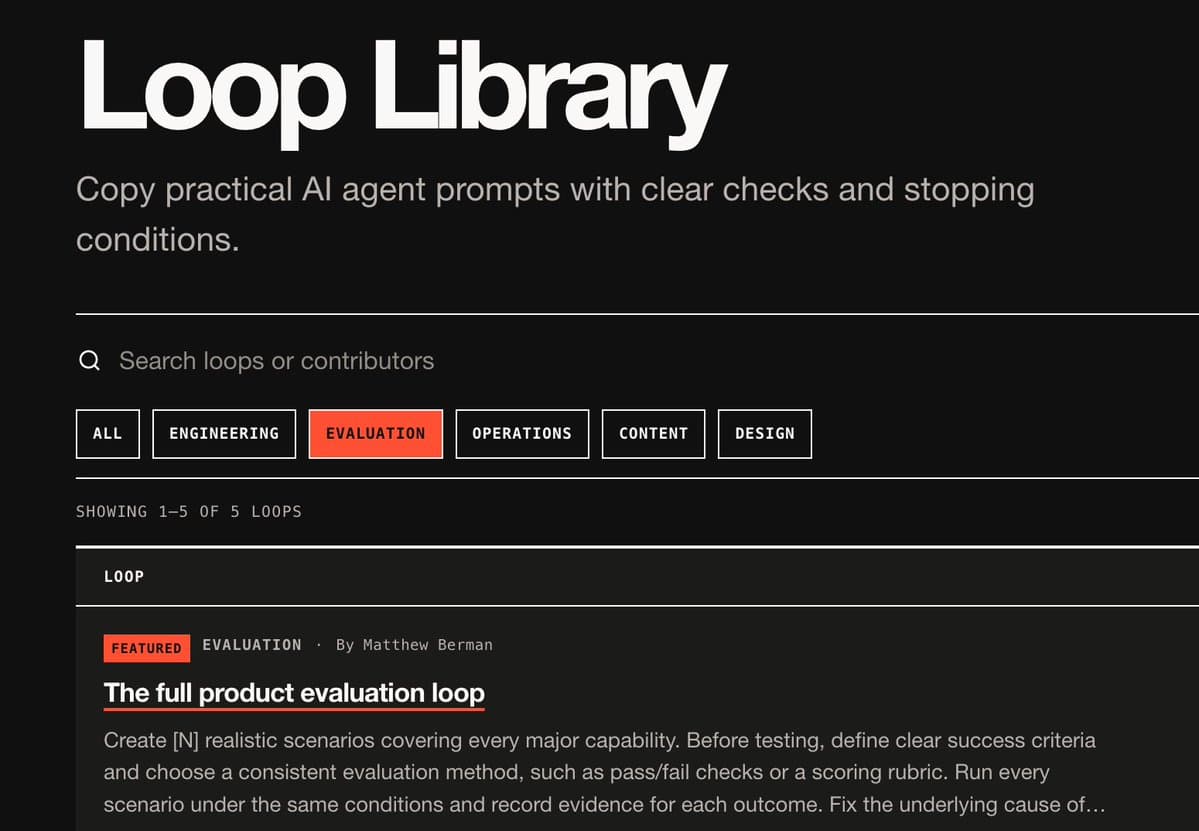
The main ship this week was packaging loops as reusable artifacts instead of scattered prompts. MatthewBerman's launch post described Loop Library as a curated list of agent loops people can use now, while his Skill announcement added a query layer so an agent can search for an existing loop or draft one from scratch.
The library also started behaving like a registry, not a static doc. Within a day, MatthewBerman's new submission post added a loop for turning a ticket or complaint into a proven root cause and minimal patch, and another submission post added a vision-based Three.js quality loop with self-verification.
Control loops
The cleanest definition came from dexhorthy, who reduced a control loop to four steps:
- Read current state.
- Read desired end state.
- Make one incremental change.
- Repeat on an interval.
That maps neatly onto MatthewBerman's split between deterministic loops, where the stop condition is measurable, and LLM-as-judge loops, where the model decides whether the target quality bar has been met. The difference matters because the published examples are mixing both styles in the same week.
Repo maintenance loops
The best material was not theory, it was the task inventory. aibuilderclub_ surfaced three immediately legible loops:
- Docs sweep: update stale docs from code.
- Production error sweep: trace logs, find root cause, fix, verify, open a PR.
- Fresh clone: rerun onboarding until the README works from zero.
MatthewBerman's Fresh-Clone Loop repost filled in the last one with unusually tight constraints: start from an empty environment, follow the README exactly, log every undocumented assumption, discard the environment after each fix, and stop only when a brand-new clone reaches a running app in one uninterrupted pass.
Other builders converged on the same small-batch style. 0xblacklight's React cleanup loop runs once daily, fixes the top five issues, and opens a PR, while the same author's iterated Ralph loop post describes one background iteration per day as the low-risk version of autonomous cleanup.
Verifiers and shared state
The strongest consensus was about what makes loops hold together. omarsar0 argued that /goal and /loop break without good verifiers, and unclebobmartin's example list gave the concrete version of that idea: coverage above 95%, CRAP scores below 6, mutation tests with no surviving mutants.
Shared repo state is the other recurring ingredient. In kevinkern's planr example, a loop skill dispatches work to a reviewer subagent while keeping common state in planr itself. aibuilderclub_'s inner-loop and outer-loop post pushes the same pattern further: the inner loop drafts and retrieves context, then human edits feed back into the skill so the next run tracks closer to judgment.
Long-running agent UX
The last new wrinkle is interface, not prompting. mathemagic1an posted a 10-hour run and joked about standups with an agent team, while Kimi_Moonshot's Goal Mode launch shipped a desktop mode pitched explicitly for 24/7 long-horizon work.
The friction shows up in the replies. petergostev's advisor-thread post says a separate review thread works better than writing a giant plan up front, because guidance has to change as the agent drifts. theo's critique called "/goal" one of the worst loop implementations, which lands differently next to Vtrivedy10's UX take that the same mode is compelling precisely because it teaches users to define verifiers after the first flashy run fails.