Nous Research shipped Hermes Agent 0.7.0 with pluggable memory backends, local stealth browsing via Camofox, inline diffs, and rotating provider credentials. The release makes memory and browser layers replaceable and gives long-running agents more production control.
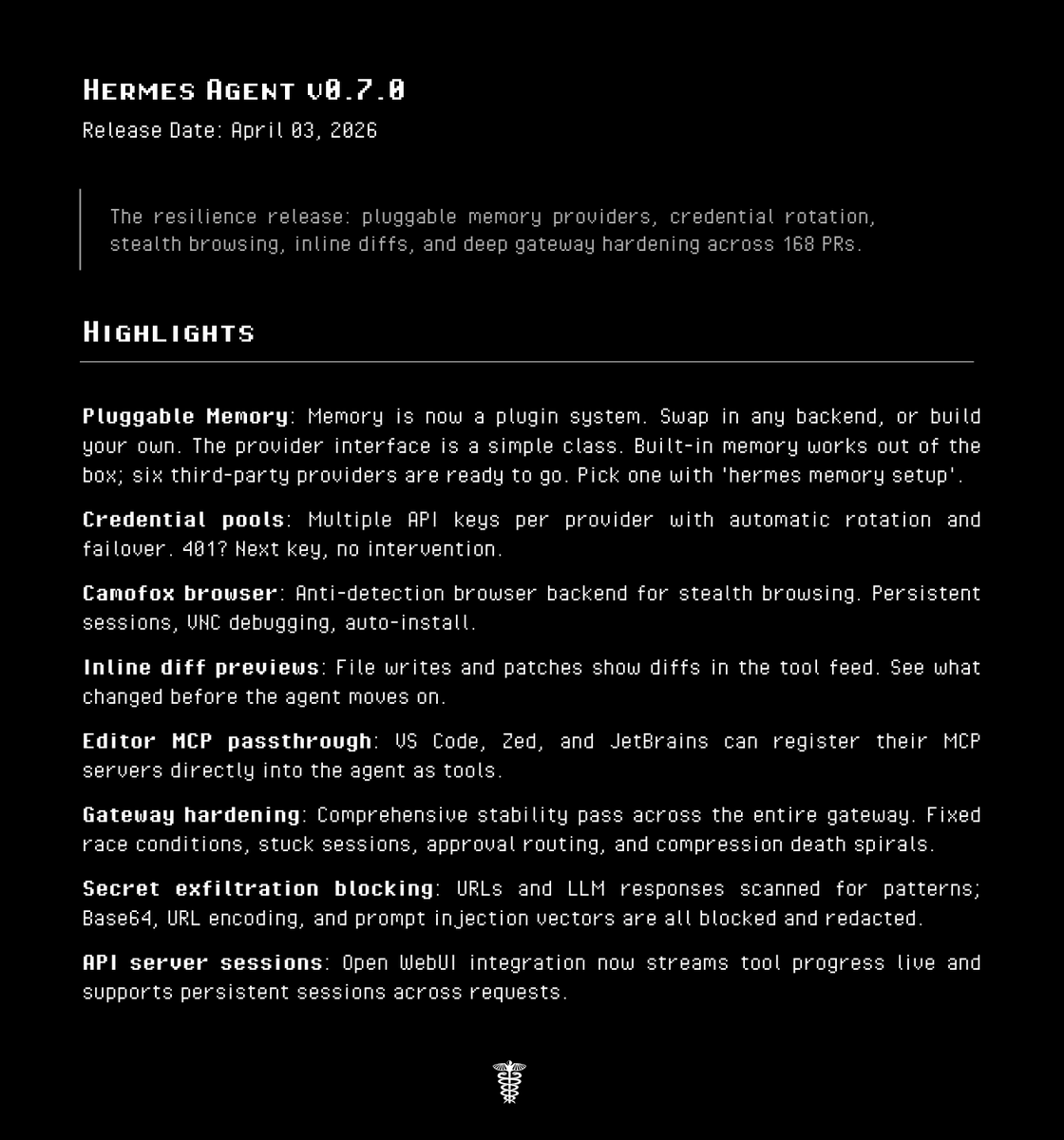
hermes memory setup release thread Teknium on memory.You can read the full v0.7.0 release notes, browse the new memory providers docs, check the credential pools page, and see how browser automation now includes a Camofox local mode alongside Browserbase, Browser Use, CDP, and local Chromium.
Nous pitched this as the headline change, and it is the architectural one. Memory is no longer a hardwired Honcho integration inside the agent core, it is a provider interface that third-party backends can plug into.
The official docs list seven external memory provider plugins:
That lines up with Teknium's explanation: Honcho was pulled out of core, turned into a plugin, and six more provider PRs were promoted into first-class options Teknium on memory. The release notes add one important constraint: only one external provider can be active at a time, while the built-in MEMORY.md and USER.md path remains available as the default memory layer.
Credential pools are the production feature in this release. Instead of defining one API key per provider and jumping straight to a different provider on failure, Hermes can now keep a pool of credentials for the same provider and rotate inside that pool first.
The credential pools docs describe four selection strategies:
round_robinleast_usedfill_firstrandomThe release notes single out least_used as the thread-safe default for spreading load across keys, and say 401 responses trigger automatic rotation to the next credential. The docs add the other half of the routing order: pool rotation happens before fallback providers, so same-provider retries come first and cross-provider failover only starts after the pool is exhausted.
Hermes already had multiple browser paths, but v0.7.0 adds a local anti-detection option. The new backend is Camofox, a self-hosted wrapper around Camoufox, which the Hermes docs describe as Firefox-based fingerprint spoofing for local stealth browsing.
The browser automation docs say Camofox sits beside Browserbase cloud mode, Browser Use cloud mode, local Chrome over CDP, and Hermes' local Chromium flow. The release notes attach three concrete ops details to the new backend: persistent sessions, VNC URL discovery for visual debugging, and auto-install through hermes tools.
A separate Camofox browser repository describes the server as a REST wrapper around a stealth-focused Firefox fork with persistent browser profiles and concurrent isolated sessions, which explains why Nous framed it as a local browser backend rather than just another website tool.
The smallest feature here is also one of the most immediately useful. File writes and patches now show inline diffs in the CLI TUI, so the tool feed exposes exactly what changed before the run continues.
The release notes say the preview applies to both write and patch operations, and Teknium says it ships on by default with a config toggle to disable it Teknium on inline diffs. For coding-agent users, that moves inspection from git after the fact into the live execution loop.
Buried below the headline features, v0.7.0 also upgrades Hermes' interfaces to other tools. The release notes add API server session continuity through an X-Hermes-Session-Id header, real-time tool progress streaming, and SessionDB persistence for API sessions.
The API server docs already frame Hermes as an OpenAI-compatible endpoint for frontends like Open WebUI, LobeChat, LibreChat, and NextChat. With session IDs and tool-event streaming added, that endpoint looks less like a stateless wrapper and more like a reusable agent runtime.
The same release also adds client-provided MCP servers from editors including VS Code, Zed, and JetBrains, according to the release notes. Hermes can pick those up as extra tools, which connects its MCP support to editor-native tool ecosystems without requiring Hermes-specific integrations for each one.
