
Hermes Agent adds /claude-code orchestration and cron hooks
Hermes Agent added direct /claude-code orchestration and cron-time script hooks, and the team also shipped Hermes-focused datasets and agent-tuned model variants. The update turns Hermes into a harness that can steer Claude Code and inject recurring context automatically.
TL;DR
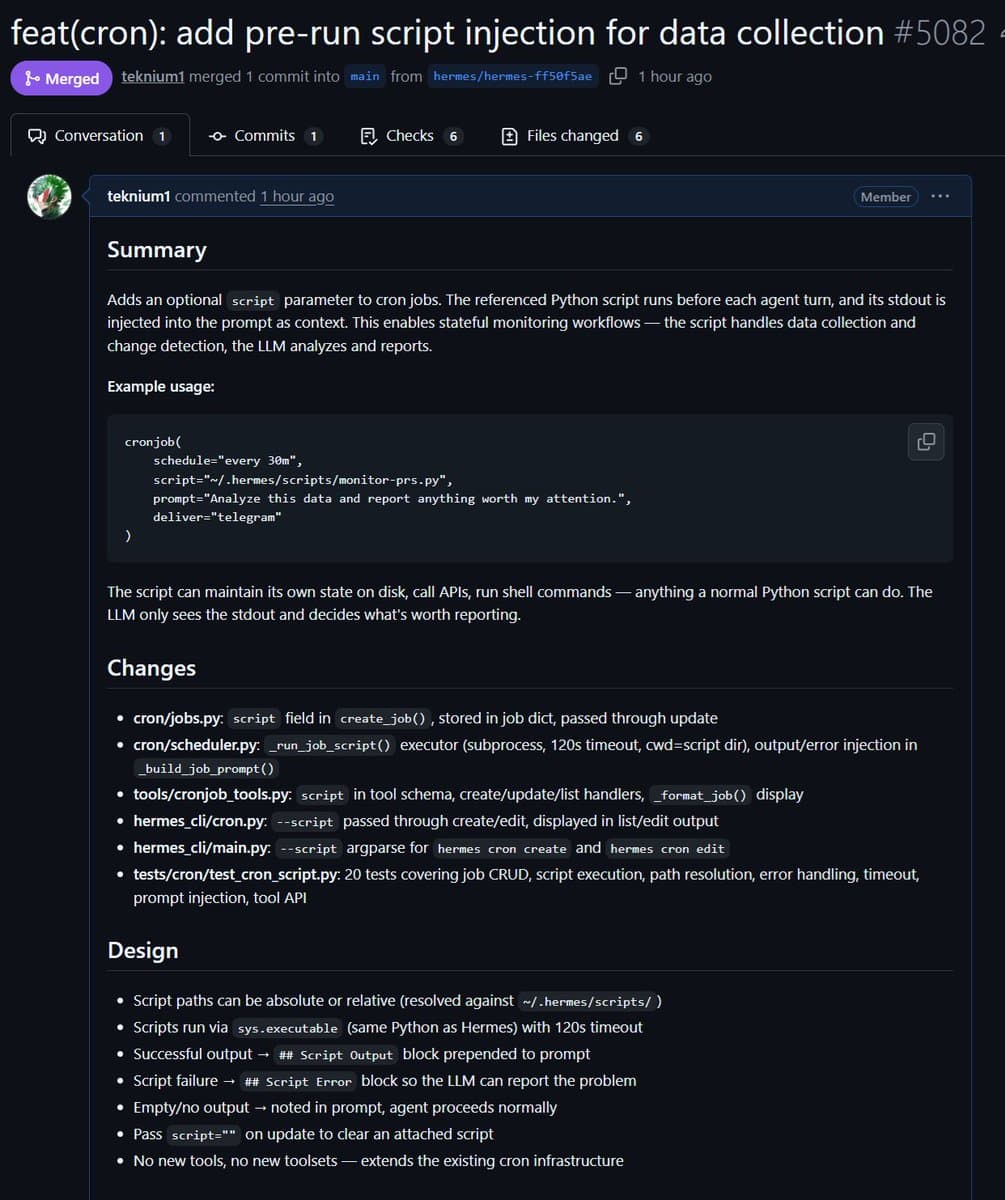
- Teknium's cron update and the merged pre-run script PR add a
scriptfield to Hermes cron jobs, so a Python script can run before each turn and inject its stdout into the prompt. - Teknium's /claude-code demo and the merged Claude Code skill rewrite position Hermes as a harness for steering Claude Code sessions instead of just calling Claude as a plain model.
- According to the cron PR, the script runs with Hermes' own Python, gets 120 seconds, and can be cleared later with
script=""; according to the follow-up security fix, the team patched path traversal and output redaction within hours. - Teknium's follow-up says the new Claude Code skill now covers print mode, interactive tmux sessions, and edge cases that Hermes learned through live testing with Claude Code v2.1.
- Teknium's dataset post, the Harmonic-Hermes-9B launch, and Teknium's model-training note show this was not just a feature drop. Nous also pushed Hermes-specific data and model work around the same window.
You can read the exact cron design notes, skim the current scheduled tasks docs, and browse the rewritten Claude Code skill PR. The repo's latest v0.7.0 release notes already framed Hermes around native Anthropic support and Claude Code credential discovery, which makes this week's /claude-code push feel like an extension of that line rather than a one-off.
Cron scripts
The new cron hook is simple and useful. A scheduled Hermes job can now run a Python script first, then prepend either ## Script Output or ## Script Error to the model prompt, as described in PR #5082.
That gives Hermes a clean split of labor: the script collects state, calls APIs, or shells out; the model only sees the resulting text. The existing cron docs already supported recurring jobs, skill attachment, and delivery back to chats or files, so the new script field drops into a system that was already built for background runs.
The security patch landed the same day
The first version had a sharp edge. According to PR #5093, relative script paths could escape ~/.hermes/scripts/, and raw script output could leak secrets into prompts or logs.
Nous patched both on April 4. The fix verifies that relative paths stay inside the scripts directory and redacts sensitive output before injection, which matters because the feature is explicitly meant to run unattended on cron.
/claude-code turns Hermes into a harness
Teknium's short demo is the important one: start a new session, type /claude-code <prompt>, and Hermes can pilot a Claude Code session while keeping Hermes' own self-improvement loop intact. The repo README still sells Hermes as a self-improving agent that creates skills, searches past sessions, and builds long-term user context, so this is a harness sitting on top of Hermes' existing memory-and-skill machinery, not a replacement for it. See the main repository README.
The rewritten skill in PR #5155 is basically a field manual. It documents two orchestration modes:
- Print mode (
-p) for one-shot tasks and scripting. - Interactive PTY via tmux for multi-turn sessions.
- Session continuation with
--continueand--resume. - Structured output through JSON parsing and
--json-schema. - Tooling hooks for slash commands, hooks automation, custom subagents, and MCP integration.
One weirdly concrete finding from the PR: in PTY mode, the workspace trust dialog defaults to yes on Enter, while --dangerously-skip-permissions defaults to exit unless Hermes sends Down then Enter. Those are the kinds of stupid terminal details that usually stay buried in somebody's notes.
Hermes-specific data and models
Nous also used the same window to push training inputs for the stack itself. Teknium's dataset post called out a quality-filtered Hermes Agent dataset, while his follow-up framed it as part of a broader push for more open models tuned specifically for Hermes.
That showed up almost immediately in model form. NousResearch's repost described Harmonic-Hermes-9B as a dedicated Stage 2 agentic variant, and Teknium's earlier comment said it was the first of what would likely be several models trained to work better inside Hermes Agent.