
Hermes Agent updates to v0.8.0 with Browser Use, remote backends, and worktree parallelism
Hermes Agent v0.8.0 added remote code-execution backends, Browser Use cloud browsing, prompt caching, shared sessions, and CLI workflow upgrades like `hermes -w`. Try the new browser-backed and parallel execution paths if you need more persistent, multi-provider agent runs.
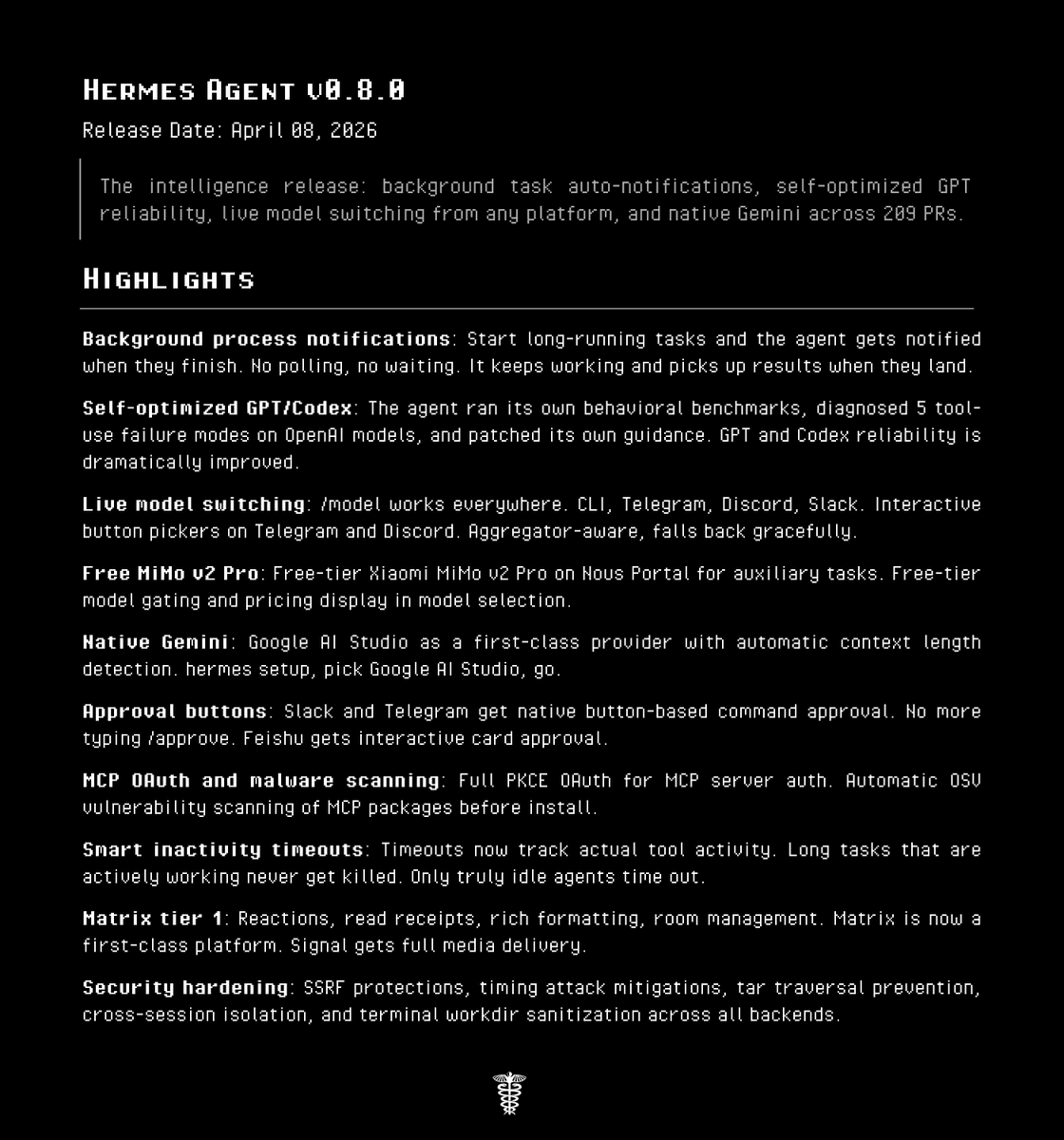
TL;DR
- NousResearch's launch post frames Hermes Agent v0.8.0 as a broad platform release, while the official release notes list 209 merged PRs and 82 resolved issues.
- According to the changelog thread, the headline additions include
execute_codeon remote backends, Browser Use and Firecrawl browser integrations, xAI prompt caching, shared thread sessions, Supermemory support, andnotify_on_completefor background jobs. - Teknium's worktree tip surfaced one of the most practical CLI upgrades,
hermes -w, and the Git worktrees docs say each run gets its own isolated branch and checkpoint history. - Browser Use's launch thread turned Hermes into a cloud-browser client with free proxies, persistent authentication, and unlimited browser hours, while a Browserbase demo showed the parallel push toward browser-driven shopping and web interaction.
- Teknium's PR screenshot shows Nous also used Hermes to patch OpenAI model behavior, benchmarking five tool-use failure modes and pushing both GPT-5.4 and Codex-5.3 from partial success to 16/16 in the posted evals.
You can read the full release notes, skim the worktree guide, and browse the Browser Use integration docs. The oddest detail is that Browser Use's setup flow includes agent self-registration, so Hermes can provision its own API key, while the code execution docs still describe execute_code as a tool that writes Python, calls Hermes tools over RPC, and collapses multi-step workflows into one turn.
What shipped in v0.8.0
The shortest way to read this release is as a widening of Hermes' execution surface. The changelog thread stacks cloud browsing, remote execution, memory backends, provider tweaks, and session plumbing into one drop, while the official notes add live /model switching, Google AI Studio support, MCP OAuth 2.1, inactivity-based timeouts, and centralized logging.
The features called out most clearly across the tweet thread and release notes are:
execute_codeon remote backends- Browser Use provider
- Firecrawl cloud browser
- xAI prompt caching
- thinking prefill continuation
- shared thread sessions
- Supermemory memory provider
notify_on_completefor background processes
Browser Use and Browserbase
The browser story has two tracks. Kyle Jeong's demo shows Hermes driving Browserbase through a full shopping flow, while Browser Use's announcement pitches a free cloud browser layer with unlimited browser hours, free proxies, and persistent authentication.
The Browser Use integration docs fill in the mechanics:
- Hermes can point its built-in
browser_*tools at Browser Use as a cloud backend. - Browser Use also offers a CLI path, where Hermes drives browser sessions through terminal commands.
- The CLI mode exposes shared browser sessions, persistent cookies and logins, and profile management.
- Hermes can self-register for a Browser Use API key by solving a CLI signup challenge.
Worktrees and long-running sessions
The -w flag is the cleanest operator-facing upgrade in the batch. Teknium's tip pitches it as a way to put Hermes sessions in separate worktrees so multiple agents can work on the same repo in parallel.
The worktree docs add the missing details: hermes -w creates a disposable worktree under .worktrees/, checks out an isolated branch, and keeps checkpoint history separate for /rollback. The CLI reference documents --worktree as a first-class global option, not a hacky wrapper around Git.
That fits the rest of the release. The changelog thread also calls out shared thread sessions and notify_on_complete, and the release notes describe background processes that can notify the agent when a long-running task finishes.
GPT and Codex got a self-patched tool-use fix
The most fun part of the release is that Hermes apparently helped tune Hermes. Teknium's screenshot describes a closed-loop benchmark and patch cycle that found five common tool-use failures in GPT-5.4 and Codex-5.3, including mental arithmetic, guessed system state, guessed time, clarification instead of action, and memory-based hashing.
The fix in that PR was narrow: two XML prompt sections, <mandatory_tool_use> and <act_dont_ask>. The posted eval table claims both models reached 16/16 after the patch, and the release notes fold that work into v0.8.0 as “self-optimized GPT/Codex tool-use guidance” plus thinking-only prefill continuation.