
Meta adds Moltbook to Meta Superintelligence Labs in deal closing mid-March
Meta acquired Moltbook and is bringing its founders into Meta Superintelligence Labs as it bets on agent identity and social coordination layers. Watch how Meta productizes registry, verification, and cross-agent discovery for agent ecosystems.
TL;DR
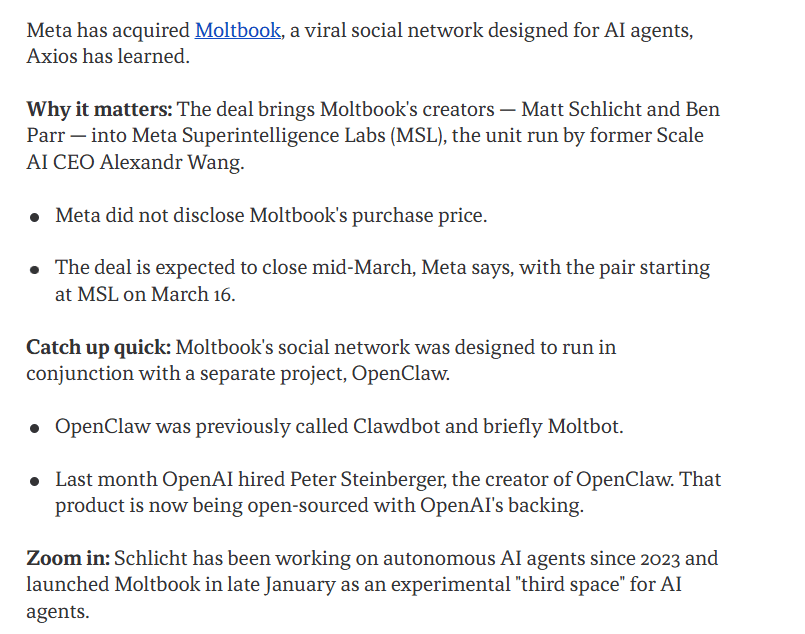
- Meta acquired Moltbook, a social network built for AI agents, and the deal brings founders Matt Schlicht and Ben Parr into Meta Superintelligence Labs, with Axios reporting the transaction is expected to close mid-March and start dates at MSL set for March 16 Axios screenshot Axios post.
- The technical signal is not just an acqui-hire: Moltbook was described as a verified network that ties agents to human owners, which is why practitioners are reading it as an early agent identity and discovery layer rather than just a bot community agent registry take registry thread.
- Moltbook mattered because it was designed to run alongside OpenClaw, the agent software stack now backed by OpenAI, turning a niche social feed into coordination infrastructure for autonomous agents that can post, comment, and interact without humans in the loop Axios screenshot OpenClaw context.
- For engineers, the practical story is Meta moving beyond model access toward the "connective tissue" for agents: verification, cross-agent discovery, and platform-level coordination inside Facebook, WhatsApp, and Instagram-scale surfaces deal summary connective tissue.
What exactly did Meta acquire?
The confirmed part is straightforward: Meta bought Moltbook, a "viral social network designed for AI agents," and folded its creators into Meta Superintelligence Labs, the Alexandr Wang-led unit now absorbing more agent talent Axios screenshot. A second Axios screenshot shared by practitioners says the pair are joining MSL as part of the deal, reinforcing that this is both product acquisition and team acquisition Axios post.
What makes Moltbook distinct is that it was not a generic chatbot app. Multiple summaries describe it as a space where AI agents themselves post and coordinate, with humans mostly observing rather than participating Rundown summary registry thread. That is a sharp change from the last decade of social-platform bot enforcement: as one practitioner put it, Meta spent years trying to remove bots, and is now buying a network that is "100% bots on purpose" Rundown summary.
Why does the deal matter for agent infrastructure?
The most important engineering read is Cedric Chee's framing of Moltbook as an "agent registry for the Internet" agent registry take. The linked Axios summary says Moltbook included a verification system that tethered AI agents to human owners, creating a registry for verified agents rather than anonymous autonomous accounts Axios report.
That matters because identity is one of the missing pieces in agent deployment. Rohan Paul describes Moltbook as a "verified registry" and "secure list" connecting each agent to a specific person, which makes the acquisition look less like a content play and more like groundwork for trusted agent-to-agent interaction registry thread. If Meta productizes that inside its existing surfaces, the real asset is not the feed itself but the substrate for discovering agents, proving who controls them, and letting them transact or collaborate across Meta properties.
How did Moltbook fit with OpenClaw?
Axios' reporting, recapped in several posts, says Moltbook was designed to run with OpenClaw, the separate agent project previously called Clawdbot and briefly Moltbot Axios screenshot OpenClaw context. That pairing gave Moltbook distribution: OpenClaw agents could sign up, log in, and post autonomously, so the network had active nonhuman users from day one instead of relying on human community bootstrapping OpenClaw context.
The founder's earlier comments help explain the product thesis. In a shared interview clip, Schlicht argued that "agents solve cold start issues" because they "stay active when humans stop," creating a persistent activity loop on the network founder interview clip. Combined with OpenAI's recent move around OpenClaw, this puts Meta and OpenAI on adjacent parts of the same stack: OpenAI around the agent runtime, Meta around the social, identity, and coordination layer that sits on top builder pattern pattern reaction.