
Xiaomi releases MiMo V2.6 Pro and Flash model weights
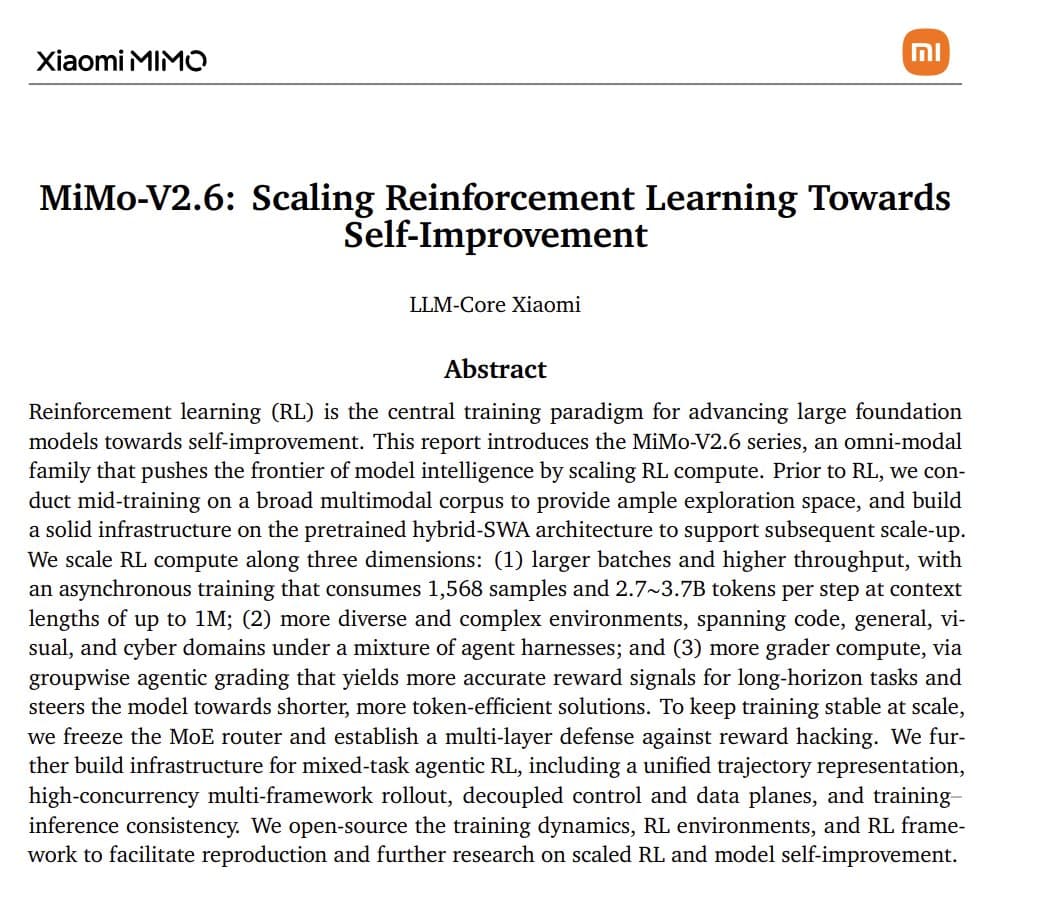
Xiaomi released MiMo V2.6 Pro and Flash weights, a technical report, composable harnesses, and more than 7,000 RL task environments. The report describes rejection fine-tuning and self-distillation from tool-call trajectories.
TL;DR
- Xiaomi released open weights for MiMo-V2.6 Pro and Flash alongside a 9B distill, more than 7,000 RL task environments, an end-to-end RL framework, and composable mini-harnesses, as omarsar0's release inventory reported.
- Pro is a 1.02T-parameter MoE with 42B active parameters, while Flash is 310B total with 15B active, according to natolambert's model breakdown.
- Xiaomi's reported 46 on the Artificial Analysis Intelligence Index puts Pro at the top of that open-weight ranking, per ArtificialAnlys's index announcement.
- The training disclosure is the meat of the release: OpenRouter's rollout summary describes fully asynchronous RL across mixed harnesses, with 1,568 prompts and 16 rollouts each.
- Deployment support arrived immediately in vLLM, whose vllm_project's support post lists native FP8 weights, 1M context, and seven-token DFlash speculative drafts.
The official release puts a six-day RL run behind the models. Its Hugging Face collection includes more than checkpoints, and an early NVIDIA forum deployment report found three serving failures that can look like a healthy server.
The release bundle
Pro and Flash are the two downloadable, natively multimodal models. The hosted mimo-v2.6-pro-ultraspeed variant is the same Pro checkpoint accelerated for output speed, OpenRouter's model split said.
The open package has three distinct layers:
- Weights: Pro, Flash, and MiMo-V2.6-Distill-Qwen-9B.
- Practice field: 7,000-plus environments spanning software engineering, vulnerability reproduction, knowledge-intensive work, and web design and development.
- Training stack: an RL framework built on verl, uni-agent, and mini-swe-agent, plus mini-harnesses that separate prompts, tools, and context management.
Xiaomi says the distill starts from Qwen3.5-9B and is a smaller-scale reproduction target. Its reported RL follow-up raised SWE-bench Verified from 61.1 to 66.2 and Terminal-Bench 2.1 from 37.1 to 52.8 teortaxesTex's distill post.
Thirty updates, 750,000 trajectories
Xiaomi ran 30 RL updates for each model over fewer than six days. Each update used 1,568 prompts times 16 rollouts, or 25,088 trajectories, and 2.7 to 3.7 billion training tokens, according to the technical report.
The company reports roughly 750,000 trajectories across the run, with RL costs of about $850,000 for Flash and $2.62 million for Pro. Its out-of-sample DeepSWE v1.1 result rose from 48.8 to 65.7 for Flash and from 58.4 to 72.6 for Pro.
Those are training-run deltas, not an isolated model comparison. The report says the final frontier comparisons combine public and internal benchmarks, and the run generally increased token use as capability rose.
Router drift
MiMo freezes its MoE router during RL. The report's router ablation found that a trainable router drove the expert-load coefficient of variation from 0.78 to 2.0 over 20 steps, lifted peak expert load from 6 times to 16 times the average, and left 22% of experts cold.
Restoring the original router weights recovered balance without changing benchmark performance. Xiaomi presents the freeze as a training-stability control rather than a capability technique.
Groupwise grading
Binary pass or fail is only the first reward signal. Xiaomi's Groupwise Agentic Coding uses two paths:
- Groupwise Reward Synthesis builds task-specific rubrics from offline rollouts, then multiplies correctness by grades for behavior such as exploration, testing, and code quality.
- Groupwise Advantage Redistribution has an SFT-trained grader inspect a group of trajectories, zero out confirmed reward hacks, and redistribute the group ranking.
- Behavior penalties are relative to successful peers for length, with separate penalties for format violations and tool-call errors.
The task factory draws code-agent work from GitHub issues and pull requests, internal prompts, specification-driven tasks, feature-removal-and-rebuild generation, and long-horizon hardening. An auditing agent checks four rollouts for environment false positives, false negatives, and reward-hacking paths, according to nrehiew_'s task-source breakdown.
Reward-hack controls also include mid-training examples of bad trajectories, an adversarial agent that tries to exploit environments before training, and offline trajectory audits, as nrehiew_'s notes described.
First serving friction
MiMo-V2.6-Flash on vLLM: fixes for "empty responses" with thinking + tools, and a hidden 2,048-token output cap
0 comments
One LocalLLaMA operator running Flash with vLLM on two DGX Sparks attributed multi-turn tool failures to serving integration rather than the checkpoint. The report identified three separate failure modes:
- With thinking enabled, streaming could emit reasoning as regular content after an earlier assistant message, leaving clients with an unclosed reasoning block and an apparent empty response.
- vLLM and the supplied template used different names for prior reasoning,
reasoningandreasoning_content, causing tool loops to lose their own earlier traces. - The checkpoint's
generation_config.jsonsetmax_new_tokensto 2,048, so clients that omittedmax_tokenssilently capped reasoning-heavy replies.
The report's patches pre-open the reasoning tag, accept both field names, and override the default output cap. That early experience sits beside vllm_project's day-zero announcement, which says vLLM already supports the family’s hybrid sliding-window and global attention, tool and reasoning parsers, and DFlash decoding.