
MIT Technology Review reports OpenAI targets an AI research intern by September 2026
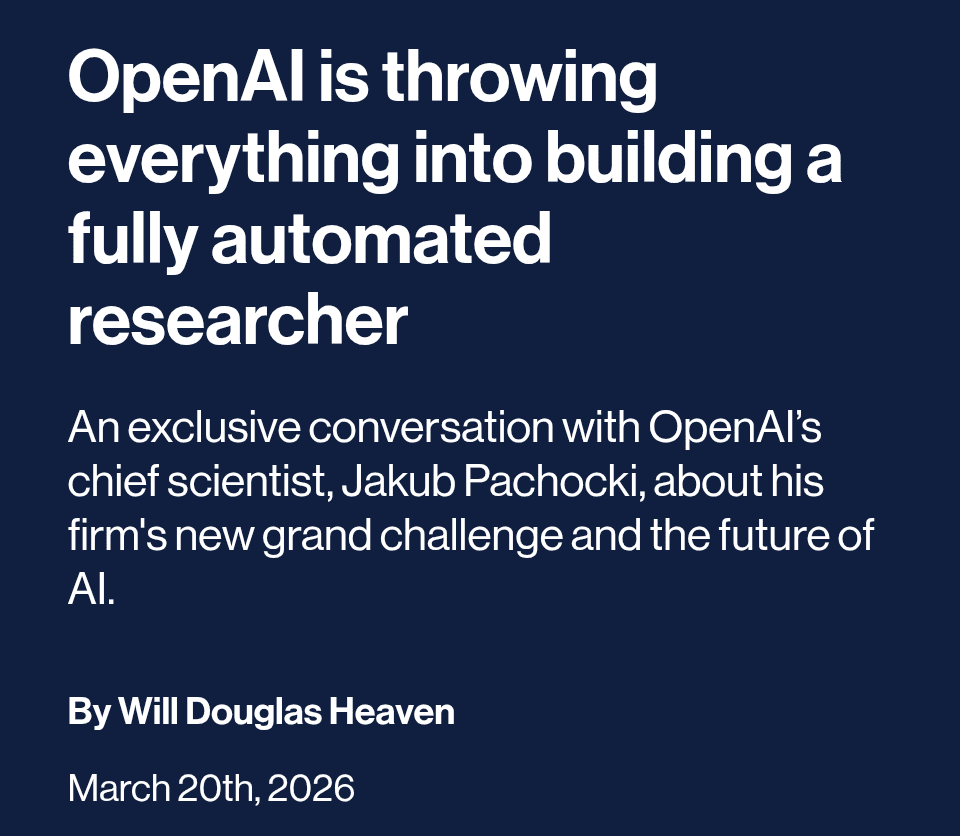
OpenAI told MIT Technology Review it wants an autonomous research intern by September and a multi-agent research lab by 2028, with Codex described as an early step. Treat it as a roadmap for longer-horizon agents, not a shipped capability.
TL;DR
- MIT Technology Review reports that OpenAI has set a September 2026 target for an “autonomous AI research intern,” with chief scientist Jakub Pachocki positioning it as a system that can handle “a small number of specific research problems” on its own MIT report highlighted excerpt.
- The same roadmap points to a 2028 “fully automated multi-agent research system,” and OpenAI reportedly sees the recently released Codex agent as an early version of that direction MIT report article link.
- Pachocki’s framing is broader than AI R&D: according to interview summary, the long-term system is meant for problems expressible in “text, code or whiteboard scribbles,” spanning math, biology, chemistry, business, and policy.
- This is a roadmap, not a product launch: the concrete signal for engineers is OpenAI tying longer-horizon agent work to reasoning models, agents, and interpretability, while the shipped reference point remains Codex rather than a new research API MIT report timeline screenshot.
What did OpenAI actually say?
OpenAI told MIT Technology Review, via Pachocki, that building an AI researcher is now its “North Star” and that the first milestone is an “autonomous AI research intern” by September 2026 MIT article. The highlighted excerpt says that intern should take on “a small number of specific research problems” by itself, not run an end-to-end lab.
The longer target is more ambitious. OpenAI describes a 2028 “fully automated multi-agent research system” able to tackle problems “too large or complex for humans to cope with,” with humans still setting goals and the system doing the sustained work inside a data center MIT report. In the same reporting, Pachocki says he sees Codex as an early version of this trajectory, which ties the vision to agentic coding systems that already exist rather than to a newly announced standalone platform article link.
How broad is the scope, and what matters for engineers?
The scope is wider than automated AI research. In the interview summary, Pachocki says “in theory” the system could be aimed at any problem formulated in “text, code or whiteboard scribbles,” including math, physics, biology, chemistry, and “even business and policy dilemmas.” He also says OpenAI is getting close to models that can work “indefinitely in a coherent way,” which is the clearest technical clue about the kind of longer-horizon execution the company is optimizing for.
For engineers, the useful read is that OpenAI is explicitly converging three threads it has discussed separately: reasoning models, agent systems, and interpretability highlighted excerpt. The timeline screenshot also reinforces that OpenAI is treating the “AI intern” as a precursor milestone, so the near-term implementation signal is continued investment in coding and task agents like Codex, not evidence that a reliable autonomous research stack is already deployable.
What remains uncertain?
The timeline is specific, but the capability boundaries are still thinly defined. OpenAI’s public description talks about problems that take “a few days” for a person and about a “small number” of tasks, which leaves open questions around failure recovery, tool use, evaluation, and how much human oversight is required in practice timeline screenshot highlighted excerpt.
That uncertainty is why this lands more as a roadmap than a shipping event. Even supportive summaries describe today’s agents as showing “dramatic productivity gains” while still facing “reliability and safety challenges,” which is consistent with Codex being framed as an early step rather than proof that OpenAI has already built the research intern it is targeting timeline screenshot.