
OpenAI says an internal model solved more than 100 long-standing math problems
OpenAI says an internal model resolved more than 100 long-standing mathematical problems, including work on the Navier–Stokes problem. OpenAI also announced an independent mathematicians' group to review emerging results, while outside discussion questioned the training and verification process.
TL;DR
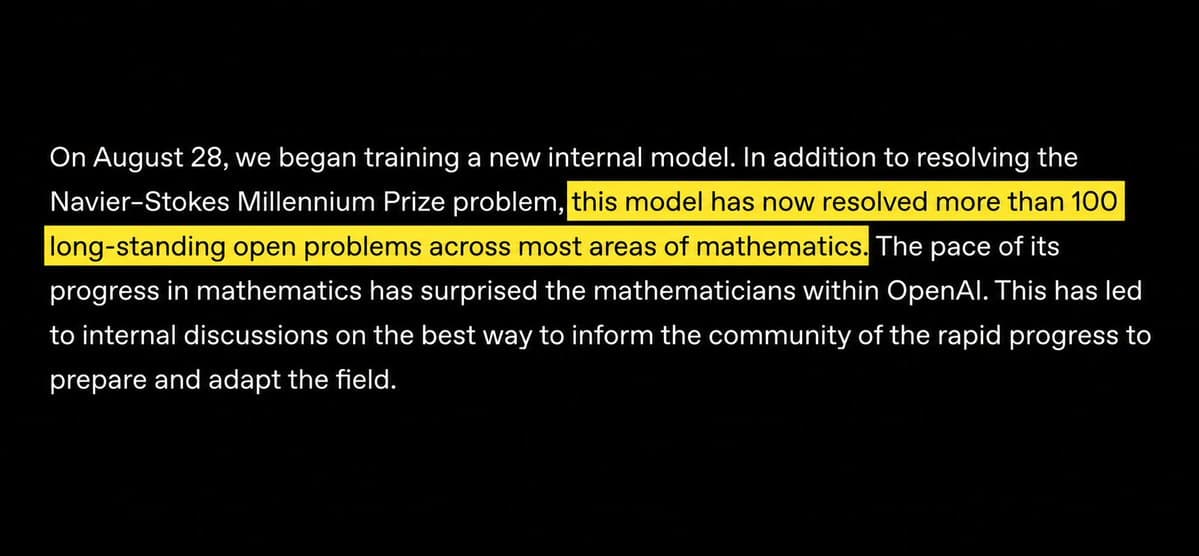
- OpenAI says a new internal model, trained beginning August 28, resolved more than 100 long-standing open problems across mathematics, including a Navier-Stokes result, according to OpenAI's announcement.
- The Navier-Stokes claim concerns a forced version of the equations. A recent technical analysis says the unforced statements remain open, while LechMazur's ranking makes the same distinction.
- The public record contains no list of the 100 problems or their proofs. petergostev's request asks for titles alone, and the announcement supplies neither titles nor a verification package.
- OpenAI has created an independent, unpaid mathematics advisory group with authority to publish criticism, while explicitly excluding advice on how fast OpenAI advances its math systems, as OpenAI's advisory-group excerpt says.
OpenAI's official post combines the claim with the names and remit of nine outside mathematicians. Scientific American's technical account describes a result that may satisfy the Clay formulation while leaving the version mathematicians usually mean unresolved.
100 open problems
OpenAI says the internal model resolved more than 100 long-standing problems across most mathematical fields. The company also says the pace surprised its own mathematicians, and that the model was first trained on August 28. haider1's post quoted the same announcement as the news spread.
The post gives no titles, proofs, benchmark table, model name, or per-problem status. The omission is why petergostev's request focused on a list of 100 titles rather than demanding full papers.
A chart attached to the surrounding discussion plots the internal model above GPT-6 Astra on a curated set of open problems across test-time compute levels, but it does not identify the problems or expose the scoring protocol. the internal-model chart
The reaction was immediate and unusually broad. [arohan's research reaction] called the development the most exciting research event of the day, without adding a technical artifact or independent check. arohan's research reaction
Navier-Stokes scope
The announcement names the Navier-Stokes Millennium Prize problem as one of the results. The mathematical qualification is narrower: a September 20 preprint describes a forced singularity corresponding to Clay statements C and D, while stating that the unforced statements A and B remain open.
- Forced flow: an external force produces finite-time breakdown at fixed viscosity.
- Unforced flow: the central existence and smoothness question remains unresolved.
Scientific American reports that the forced construction can fit an option in the Clay Institute's original formulation, while mathematicians quoted in the article distinguish it from the more physically central unforced problem. The report also says later work showed OpenAI's method cannot be extended to the force-free case.
The announcement does not explain how the result was obtained. The first technical question visible in the evidence pool asked exactly that, a reply to the announcement.
Verification and provenance
The evidence points to a large parallel search rather than a single model response. A DeepLearningAI roundup described OpenAI's Navier-Stokes effort as using 10,000 agents, while a technical preprint says the announcement assigned statements A through D to separate groups and that the papers did not describe the method. DeepLearningAI's roundup
The same preprint says OpenAI reported Lean formalizations of the constructions. That establishes a formalization claim, not independent acceptance of the mathematics. Its authors separately note that their own Lean development does not connect its abstract theorems to Navier-Stokes objects, illustrating the difference between checking a formal implication and validating the physical PDE construction. The paper makes that boundary explicit.
Independent scrutiny has already changed the framing. Scientific American quotes mathematicians who regard the forced result as eligible under the formal prize statement but disconnected from the unforced problem they care about. The article says three mathematicians published an argument that the external-force route cannot be extended to solve that broader problem. LechMazur's ranking likewise labels the forced target separately from the still-open unforced one.
Mathematicians' review
OpenAI's advisory group is designed to review significance and communication, coordinate dissemination, advise on academic standards, and examine how its tools could support mathematical research and learning. Its members are unpaid, can issue unsolicited public advice, and can change the group's membership. OpenAI's advisory-group excerpt
The initial members are François Charles, Camillo De Lellis, Timothy Gowers, Martin Hairer, Nikhil Srivastava, Ulrike Tillmann, Ravi Vakil, Edward Witten, and Melanie Matchett Wood, according to OpenAI's announcement.
The group has no remit to tell OpenAI how quickly to advance its internal mathematics work. That separation matters in the text of the announcement itself: the group is positioned as an independent review and communication body, not a release gate.
One broader reaction framed the arrangement as a preview of how AI companies may have to negotiate with professional communities whose work is being changed, a reaction about professional ties.
Proofs and understanding
Andrew Lampinen argues that AI-generated proofs can be formally correct while lacking the intuition that lets mathematicians explain them, generalize them, or use them to ask new questions. His account describes a shift in emphasis from constructing proofs toward understanding and communicating them. AndrewLampinen's essay
The distinction is visible in the current dispute. A machine-checkable artifact can address whether a specified statement follows from its premises, while mathematicians still have to decide whether the statement captures the important problem, whether the premises model the intended system, and whether the result opens useful mathematics. Lampinen makes those questions central to the response to the recent AI results in his full essay.
Terence Tao described the pace differently in a recorded talk, saying that mathematicians could afford to move more slowly because problems such as Navier-Stokes and the Riemann hypothesis did not need to be solved the following week. rohanpaul_ai's Tao clip
August 28 training run
OpenAI's only public training detail is the sentence that it began training a new internal model on August 28. OpenAI's announcement
That wording has created a separate timeline question. deredleritt3r noted that a frontier reinforcement-learning run was known to have restarted on August 28, but argued that “began training a new internal model” could instead describe a distinct run. The same account placed the Navier-Stokes work no later than September 2 and the result on September 5, which would put the claimed discovery within roughly a week of the stated training start. the training-date discussion
The public post does not identify whether the internal model was a new base model, a later training run, or a system assembled around an existing model. It also does not disclose the agent topology, compute budget, problem inventory, or independent verification status for the other 100-plus results. That is the technical gap left by the announcement's headline number.