
OpenBMB releases MiniCPM-Robot models and PhyAI runtime with 33-36 Hz throughput claim
OpenBMB open-sourced MiniCPM-RobotManip, MiniCPM-RobotTrack and PhyAI, claiming local robot tracking, robot memory and throughput gains from 10 Hz to 33-36 Hz. The release packages model artifacts and a runtime path for local robot perception and manipulation experiments.
TL;DR
- OpenBMB open-sourced MiniCPM-Robot as a three-part embodied AI release: a 1.5B manipulation VLA, a compact tracking model, and the PhyAI inference framework, according to OpenBMB's launch post.
- RobotManip's key claim is memory, not size: OpenBMB's memory note says visual token compression enables streaming native context without extra inference cost.
- RobotTrack is aimed at local robot following: OpenBMB's tracking note says it supports zero-shot language-guided tracking, ambiguous instructions, and Unitree Go2 Edu deployment without cloud dependency.
- PhyAI is the runtime hook: OpenBMB's PhyAI note claims MiniCPM-Robot throughput rises from 10 Hz to 33 Hz, then 36 Hz on NVIDIA H20 with CUDA Graphs and custom Triton fused kernels.
The MiniCPM-Robot GitHub repo gives the useful robotics numbers: 60-frame, roughly one-minute visual memory, 125 to 3.3 TFLOPs per decision step, 256 to 64 visual tokens per frame, and 5+ FPS at about 180 ms on Unitree Go2 EDU. The PhyAI Day 0 post adds the runtime plumbing: preprocessing contracts, weight mapping, CUDA Graph capture, selectable action precision, and dedicated Triton kernels. The weights are posted on Hugging Face for MiniCPM-RobotManip and MiniCPM-RobotTrack.
What shipped
OpenBMB packaged MiniCPM-Robot as a model family for real-world perception, decision-making, and action.
- MiniCPM-RobotManip: a 1.5B general-purpose vision-language-action model for robotic manipulation, described by OpenBMB as one set of weights across simulation and real robot tasks.
- MiniCPM-RobotTrack: a compact target-tracking model for real-world robots, with the repo describing it as a 0.9B fully on-device tracker built around local natural-language tracking.
- PhyAI: an open-source inference framework for Physical AI workloads, with Day 0 MiniCPM-Robot support in the PhyAI repo.
- Licensing: the MiniCPM-Robot repo lists code and model weights under Apache-2.0; PhyAI is MIT licensed.
RobotManip memory
RobotManip is the most interesting part of the release because OpenBMB is making a small-model memory argument for robotics control loops.
The model card and repo give the mechanics:
- Context: 60 frames of history, roughly one minute of visual memory.
- Compute: traditional recomputation at 125 TFLOPs per decision step versus 3.3 TFLOPs with streaming inference.
- Vision compression: MiniCPM-V 4.6 reduces each frame from 256 visual tokens to 64, a 4x cut.
- Latency: H100 BF16 single-frame model-forward latency is listed at 120 ms, versus 234 ms for π0.5; OpenBMB says the measurement excludes task autoregressive decoding.
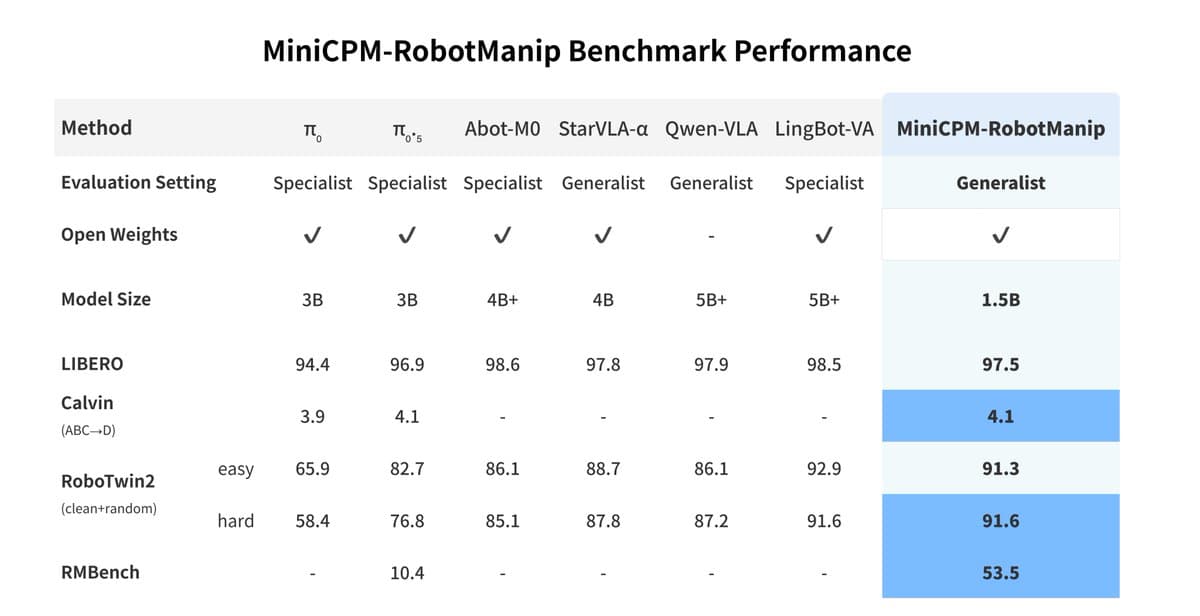
- Benchmarks: the repo table lists MiniCPM-RobotManip at 97.5 on LIBERO, 4.1 on Calvin, 91.3 and 91.6 on RoboTwin2 clean and random, and 53.3 on RMBench.
Christmas came early for robotics engineers who care more about context management than another huge VLA checkpoint.
RobotTrack local tracking
RobotTrack is the mobile-robot half of the release: language-conditioned following that stays onboard when the network is bad.
OpenBMB's launch thread lists four supported tracking modes:
- zero-shot language-guided tracking
- dynamic multi-target environments
- ambiguous instructions and challenging scenarios
- fully local deployment without cloud dependency
The RobotTrack model card adds the implementation shape: natural-language instructions are fused with DINOv3 and SigLIP visual features, then the model predicts eight future [x, y, yaw] waypoints for embodied following.
Training uses what the card calls Quality-driven Self-evolving Data: automated checks plus manual review remove bad trajectories, while a DAgger-style loop adds hard cases such as target crossings, rapid turns, occlusions, and multi-person interactions.
PhyAI runtime path
The PhyAI numbers are the release's cleanest systems claim.
The Day 0 PhyAI post says MiniCPM-RobotManip support includes:
- preprocessing contracts for camera images and task instructions
- checkpoint weight mapping into PhyAI inference modules
- a complete VLA execution path through the
minicpm_gr00tplugin - separate CUDA Graph capture for the fixed-shape VLM path and the four-step action loop
- selectable action precision
- dedicated Triton kernels
On NVIDIA H20 in BF16, PhyAI reports this optimization sequence:
- Native path: 10.12 Hz
- CUDA Graph execution: 33.28 Hz, a 3.29x speedup
- CUDA Graphs plus Triton fusions: 36.77 Hz, a 3.63x speedup over native and 10.5% over CUDA Graphs alone
The fused kernels target two repeated pieces of the Qwen3.5 hybrid backbone: RMSNorm plus SiLU gate, and depthwise causal Conv1d plus SiLU plus Q/K/V split. The same post says the benchmark excludes one-time preprocessing and uses a three-view workload with 448x448 images and 64 text tokens.
Quick start and Go2 defaults
The repo is already shaped like a reproducibility package, not just a model-card announcement.
RobotManip's quick start uses Python 3.10, PyTorch 2.6.0, and CUDA 12.4, then runs vla_infer.py with one or more images plus a language instruction. The repo says the model returns an action chunk of shape (30, 80).
RobotTrack's simulation path uses Python 3.9, Habitat-Sim 0.3.1, Bullet, PyTorch 2.4.1, and CUDA 12.1. Its Go2 deployment path targets Unitree Go2 EDU with Jetson Orin NX 16GB, Jetson Linux R36.5, CUDA 12.6, TensorRT 10.7, ROS 2 Humble, and MAXN mode 0.
The Go2 runtime defaults to dry-run, which sends no motion commands, and the repo's safety note says live control comes after camera, model, latency, and stop-path validation on a stand with an on-site operator and emergency stop.