
Perplexity releases Unigram tokenizer with 5-6x lower CPU use
Perplexity open-sourced the XLM-RoBERTa Unigram tokenizer it rebuilt for ranking and retrieval, reporting 5-6x lower CPU use and 63 microsecond p50 at 514 tokens. Teams running fast rerankers and embedders should watch tokenization cost as a latency bottleneck.
TL;DR
- Perplexity said it rebuilt and open-sourced its Unigram tokenizer to cut CPU utilization by 5 to 6 times in production, according to perplexity_ai's launch post.
- The company framed the payoff around fast ranking and retrieval systems, where perplexity_ai's launch post said small rerankers and embedders already run in single-digit milliseconds on GPU, making CPU tokenization a noticeable chunk of end-to-end latency.
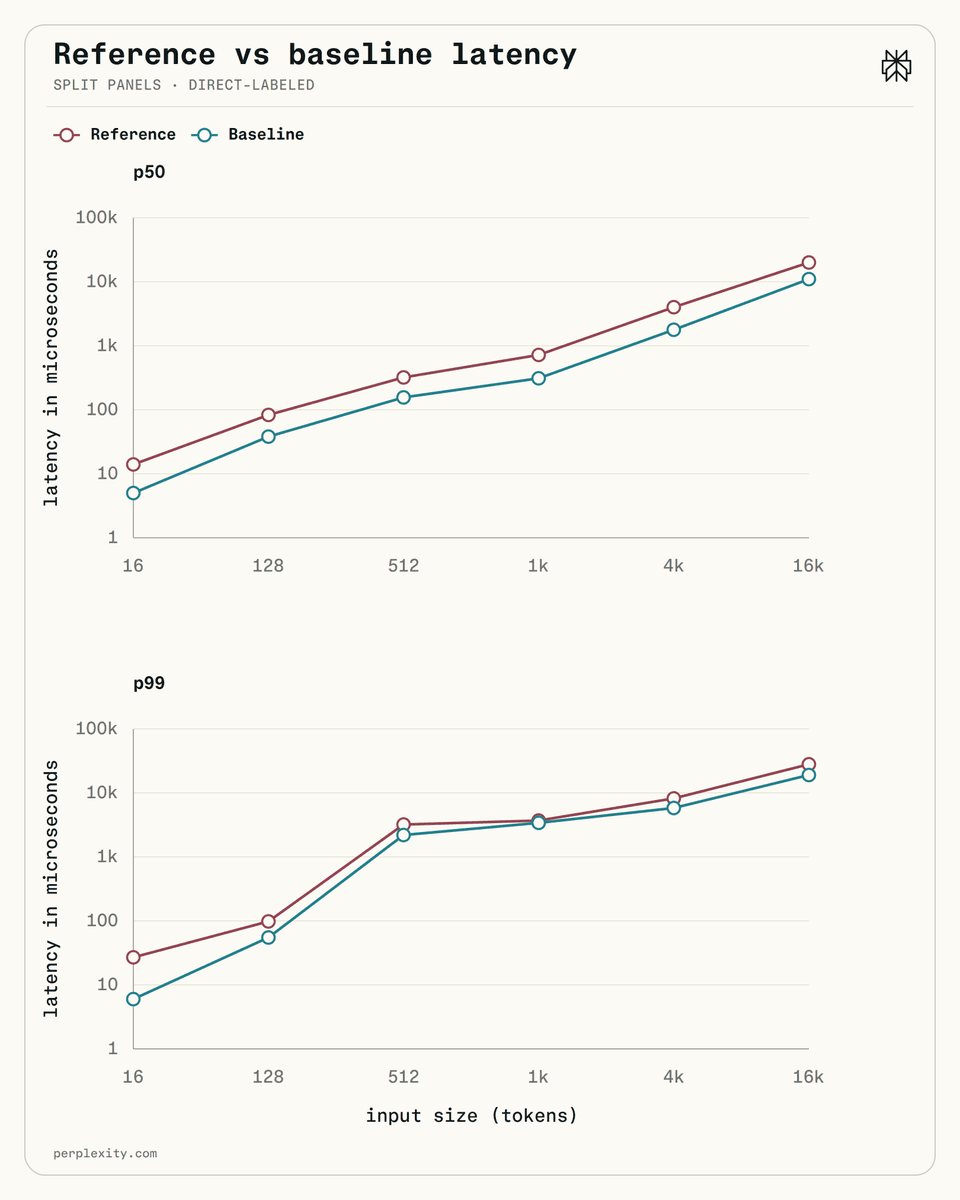
- In Perplexity's benchmark, perplexity_ai's benchmark post reported about 5 times lower p50 latency than Hugging Face tokenizers, 2 times lower than SentencePiece C++, and 1.5 times lower than IREE C at production input lengths.
- At a 514-token input length, perplexity_ai's benchmark post said the encoder ran in 63 microseconds p50 with zero heap allocations.
- The release targets XLM-RoBERTa's 250K-token Unigram vocabulary, which WesRoth's summary described as common in reranking and embedding systems.
You can read Perplexity's official blog post, browse the GitHub repo, and compare the launch framing in perplexity_ai's thread with the benchmark-specific follow-up on 514-token latency.
Tokenization became the bottleneck
Perplexity's core claim is straightforward: tokenization stopped being a rounding error once the downstream model got fast enough. In perplexity_ai's launch post, the company said small rerankers and embedders now finish in single-digit milliseconds on GPU, so CPU-side tokenization can meaningfully drag total latency.
Aravind Srinivas, Perplexity's CEO, pushed the same point in plainer language when AravSrinivas's post said the tokenizer was already deployed in production because every millisecond matters.
63 microseconds at 514 tokens
Perplexity's benchmark post gave the cleanest numbers in the release:
- p50 latency at production input lengths: about 5 times faster than Hugging Face tokenizers, per perplexity_ai's benchmark post
- Versus native alternatives: about 2 times faster than SentencePiece C++ and 1.5 times faster than IREE C, again per perplexity_ai's benchmark post
- At 514 tokens: 63 microseconds p50 with zero heap allocations, according to perplexity_ai's benchmark post
That makes this less about tokenizer research as a standalone topic, and more about shaving the CPU tail from retrieval stacks that are already highly optimized elsewhere.
XLM-RoBERTa's 250K-token vocabulary
The target matters. WesRoth's summary said the tokenizer is built for XLM-RoBERTa's 250K-token Unigram vocabulary, which is still common in reranking and embedding systems.
That lines up with Perplexity's own pointer to the write-up in perplexity_ai's blog link post, which sends readers to the company's technical article on the CPU-performance work. The result is a narrowly scoped open-source release aimed at a specific pain point in ranking and retrieval pipelines, not a general-purpose replacement for every LLM tokenizer.