
Google releases Veo 3.1 Lite in Gemini API at $0.05 per second
Google released Veo 3.1 Lite in Gemini API and AI Studio with 720p and 1080p output, 4-8 second clips, and text-to-video plus image-to-video support. Watch the April 7 Veo 3.1 Fast pricing drop if you need lower video generation costs.
TL;DR
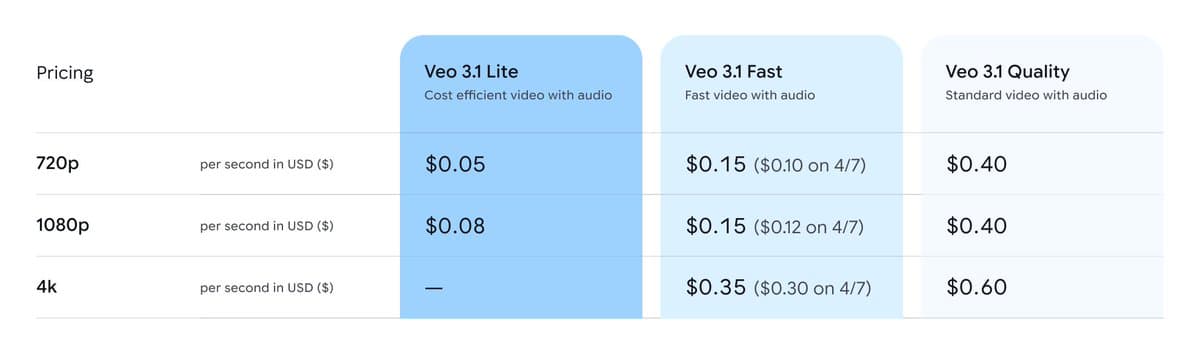
- Google launched Veo 3.1 Lite in the Gemini API and Google AI Studio as a cheaper tier for high-volume video generation, with list pricing starting at $0.05 per second for 720p and $0.08 for 1080p Google launch tweet Phil Schmid summary.
- Lite sits below Veo 3.1 Fast at less than half the cost, and Google says it runs at the same speed as Fast according to the official launch post and Google pricing card.
- The feature set is narrower than the flagship tier: Lite supports text-to-video and image-to-video, 16:9 and 9:16 outputs, and 4, 6, or 8 second clips, but the official model page says it does not support 4K output or Extension Phil Schmid summary Veo 3.1 Lite model page.
- Google is also cutting Veo 3.1 Fast pricing on April 7, taking 720p from $0.15 to $0.10 per second, 1080p from $0.15 to $0.12, and 4K from $0.35 to $0.30 Google pricing card Pricing recap.
- The rollout already reached third-party infrastructure on launch day: fal exposed text-to-video, image-to-video, and a separate first-last-frame-to-video endpoint with the same 720p and 1080p price points fal launch Veo 3.1 Lite on fal.
You can read Google’s launch post, skim the official model page, and compare the live pricing table. Google also quietly framed Lite as a developer-first model for “high-volume video applications,” while fal shipped a same-day first-last-frame endpoint that makes the launch feel more like infrastructure than demo bait.
Pricing
The headline is simple: Google added a third pricing tier to the Veo 3.1 lineup, and the new floor is much lower. The launch card pegs Veo 3.1 Lite at $0.05 per second for 720p and $0.08 for 1080p, versus Veo 3.1 Fast at $0.15 today and Veo 3.1 Quality at $0.40 for both 720p and 1080p.
Google paired the launch with another cut on April 7. After that date, Fast drops to $0.10 at 720p, $0.12 at 1080p, and $0.30 at 4K, according to both the launch image and the official Gemini API pricing page.
Generation surface
Lite keeps the parts most developers actually wire into products:
- Text-to-video
- Image-to-video
- 16:9 landscape and 9:16 portrait
- 4, 6, or 8 second clips
- 720p and 1080p output
That matches Google’s launch post and the official model documentation. It is a clean product boundary: shorter clips, HD outputs, and a format menu that maps directly to ads, shorts, and app-native video slots.
Same speed, smaller ceiling
Google’s main technical claim is unusually direct. The company says Lite is priced at less than 50 percent of Veo 3.1 Fast, but runs at the same speed, which is the part that makes this more than a simple quota reset in a pricing table.
The tradeoff shows up in the ceilings. The official model page says Veo 3.1 Lite Preview does not support 4K outputs or Extension, while full Veo 3.1 remains the cinematic tier and Fast stays the middle lane for teams that still need 4K at lower cost than Quality.
Community reaction landed in the obvious place: cheap iterative footage. One early tester said Lite feels especially strong for “stock video” style scenes where vibe matters more than exact text placement, which lines up with Google’s own positioning around high-volume generation. Docs and pricing link
Access paths
Google shipped Lite in two official surfaces on day one, the Gemini API and Google AI Studio. That means the launch is available both as a programmable model and as a browser tool for prompt iteration.
fal widened the access story a few hours later with three separate product surfaces:
That last mode was not part of Google’s launch bullets, but it is live as its own fal endpoint with the same per-second pricing and standard API parameters like prompt, aspect ratio, duration, and resolution. For engineers, that is the freshest detail in the rollout: the cheapest Veo tier already has a broader integration shape in the ecosystem than Google’s own announcement emphasized.