
Claude Fable 5 builds RC car in Autodesk Fusion after 3 prompts
New creator demos pushed Claude Fable 5 into CAD, landing pages, and web game ports, including an Autodesk Fusion RC car built in three prompts. Watch for longer runs to trip safeguards and fall back to Opus 4.8.
TL;DR
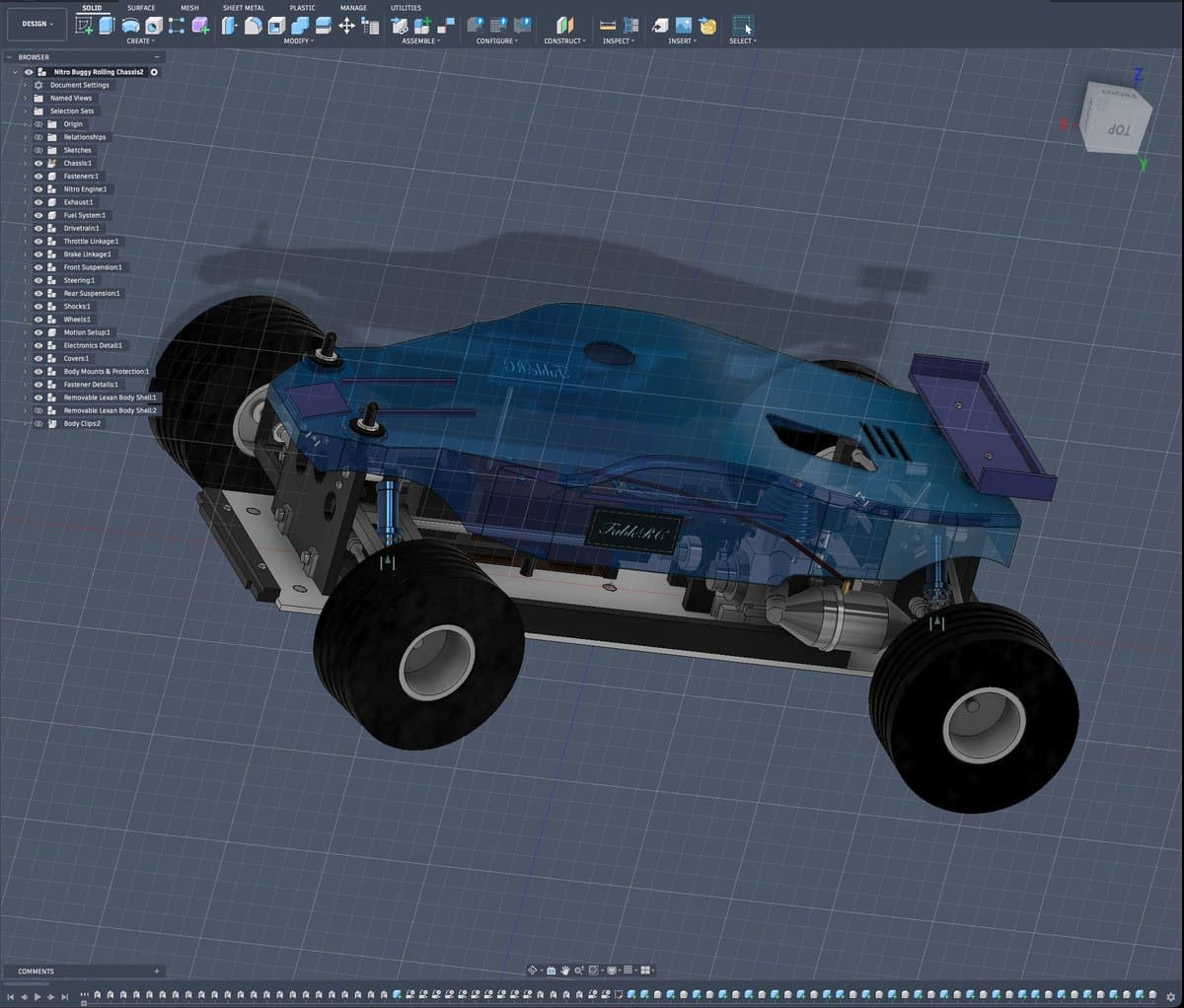
- In one of the clearest non-game demos so far, LLMJunky's Fusion RC car demo says Claude Fable 5, inside Adam's Autodesk Fusion extension, went from empty canvas to a theoretically functional nitromethane RC car in three prompts, with roughly $35 in tokens.LLMJunky's model clarification
- Web creators kept finding the same thing: MengTo's landing page demo, viktoroddy's website tutorial, and viktoroddy's later prompt pack clip all used Fable for polished page layout and motion, while MengTo's reply on purple gradients says the model still needs stronger design constraints.
- Game demos sprawled into three different buckets at once: AmirMushich's one-prompt arena shooter shared the exact prompt and remix link, levelsio's Quake 2 port revived an old map into a multiplayer web build, and levelsio's RTCW port documented the WebAssembly and asset extraction work behind a much heavier port.
- The best workflows were rarely model-only. icreatelife's Pablo game paired Fable with Firefly Boards assets, higgsfield_ai's fruit slicing demo paired it with Higgsfield MCP, and techhalla's GTA 2 prompt dump treated Fable as the coding layer around Tripo-generated 3D assets.
- Long autonomous runs also exposed the catch: danshipper's safeguard complaint says a bigger project tripped safeguards and fell back to Claude 4.8, and Anthropic's fallback docs confirm that Fable refusals return a normal response rather than an API error.
You can read Anthropic's launch post, skim Autodesk's Fusion-on-Claude writeup, and check Anthropic's refusal and fallback docs. The weirdest part is how fast the demo stack diversified: an RC car in Fusion, a Return to Castle Wolfenstein browser port, and a turtle platformer built from Firefly Boards assets all landed inside the same 48-hour wave.
Fusion CAD
The RC car demo matters because it is not another shader toy or browser clone. LLMJunky's post says the build happened inside Adam's Autodesk Fusion extension, and Autodesk's April post on bringing Fusion to Claude describes the broader push to let Claude act on Fusion context through MCP-style connections.
Two details make the post more concrete than most launch-day bragging. LLMJunky's prompt reply says the prompts were very detailed, and LLMJunky's follow-up caveat says the powertrain was not literally printable, but the drivetrain was mostly functional in simulation.
That same CAD thread cut both ways. LLMJunky's crescent wrench test says Fable nearly one-shotted a moving wrench in Onshape, but LLMJunky's padlock failure post and LLMJunky's disagreement reply say a simple padlock still broke down on the internals.
Landing pages
Design Twitter found Fable unusually good at polished front-end work, but only when the brief had teeth. MengTo's landing page demo and viktoroddy's website tutorial both show glossy marketing sites, while MengTo's purple gradient reply says the model will still drift toward default gradient mush without design context.
A few recurring patterns showed up across the design posts:
- Motion-heavy hero sections, per viktoroddy's tutorial post
- Stronger output from long, requirement-heavy prompts, per MengTo's value-to-cost reply
- Faster first drafts than final polish, per MengTo's timing reply
- Better results when Fable was used as a layout and interaction engine, not as the taste source, per MengTo's purple gradient reply
There was also a more product-design flavored angle. marckohlbrugge's fake app screenshot post says Fable one-shotted an entire app UI when asked for screenshots, which is a very different failure mode than image-only mockup tools.
Game ports
Games became the public proof format because they surface code quality, asset handling, browser output, and iteration speed all at once. AmirMushich's one-prompt arena shooter shipped with both the exact prompt and a live remix link, which made it one of the cleanest reproducible examples in the wave.
The heavier examples were less magical and more interesting. levelsio's RTCW port spelled out the stack in bullets:
- iortcw as the source base
- Emscripten patches borrowed and re-grafted from a single-player WASM port
- GL4ES to translate OpenGL 1.x calls into WebGL2
- A native dedicated server built from the same source tree
- Game PAK files extracted from a 2001 installer and cached in IndexedDB
That is the pattern to pay attention to. Fable could get the port over the line, but the result still depended on existing open source code, old patch sets, manual asset extraction, and a human willing to keep poking at broken textures. levelsio's Quake 2 post even says the first pass failed to load textures before some PAK repacking fixed it.
Asset stacks
The fastest demos were usually toolchains, not pure prompts. techhalla's GTA 2 prompt dump is basically a mini production spec for a Fable-built game, covering TypeScript interfaces, Tiled map imports, InstancedMesh rules, asset wrapper groups, JSON configs, and a preset editor.
That post also makes the stack explicit:
- Tripo for mesh and texture generation, per techhalla's GTA 2 prompt dump
- Fable for the game architecture and implementation, per techhalla's GTA 2 clone post
- GitHub as the handoff layer, per techhalla's open-source repo link
- Roughly $60 to make the demo, per techhalla's cost reply
The Firefly version was even more structured. icreatelife's Pablo game and its thread turn the workflow into steps:
- Generate assets in Firefly Boards, per Firefly Boards step 1
- Share or remix the board assets, per Firefly Boards step 2
- Feed those assets into Fable because Fable is strong at assembly but weaker at raw asset generation, per Firefly Boards step 3
- Iterate on backgrounds and new items back in Firefly Boards, per Firefly Boards step 4 and Firefly Boards step 6
- Publish the result as a Claude artifact, per Firefly Boards step 8
Safeguard fallbacks
The most useful negative signal came from long runs that suddenly changed models. danshipper's safeguard complaint says a big Fable project triggered safeguards after about ten minutes and fell back to 4.8, and ClaudeDevs' safeguard update says Anthropic is now making those fallbacks visible because the original invisible behavior was the wrong tradeoff.
The official picture is pretty specific. Anthropic's launch post says Fable is the public version of a Mythos-class model with conservative safeguards that route some cyber, bio, chem, and distillation-adjacent requests to Opus 4.8, on average in less than 5% of sessions. Anthropic's fallback docs add that API refusals come back as stop_reason: "refusal", not an error, and unstreamed refusals are not billed.
That change also explains why some users felt blindsided. MayorKingAI's launch summary repeated Anthropic's claim that high-risk routes were flagged in under 5% of sessions, but ClaudeDevs' safeguard update says making those safeguards visible will probably mean more false positives for a while as the classifiers get tuned.