
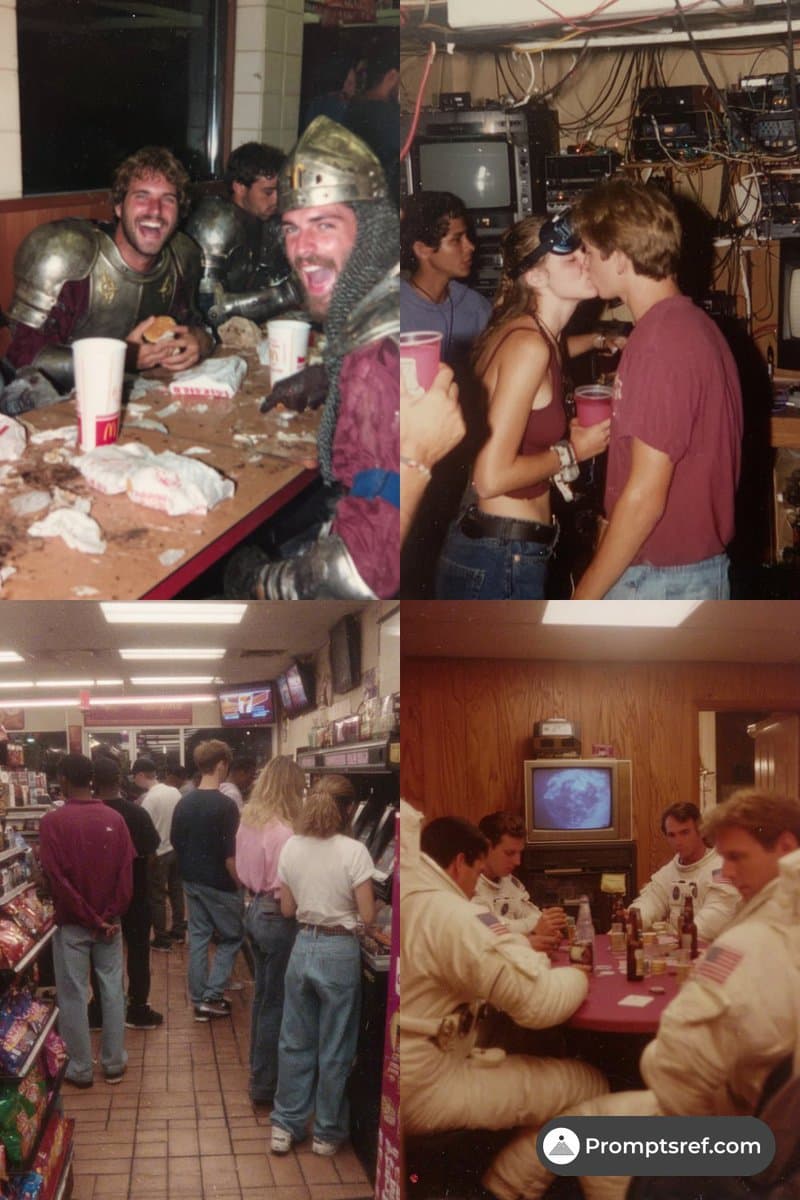
Midjourney adds --sref 3204209964 for 90s disposable-camera looks
Fresh Midjourney sref posts centered on code 3204209964 for dirty-flash 90s snapshots, alongside Matrix-green, warm-glow, and retro-futurist looks. The workflow keeps turning sref into a reusable prompt layer, but results remain highly code- and subject-dependent.
TL;DR
- Prompt creators are circulating Midjourney
--sref 3204209964as a fast route to 90s disposable-camera images: direct flash, messy framing, dirty grain, slight blur, and a warm yellow-green cast, according to the 90s snapshot post. - The same posting pattern is turning
srefinto a reusable prompt layer: one shared code targets Matrix-green cyberpunk with--v 7 --sv6, while another pushes a warm, glowing storybook look built around exaggerated light and amber color the Matrix post the warm-glow post. - A separate creator is also sharing
--sref 271058507for Moebius and Métal Hurlant-style retrofuturism, widening the current mix from faux-photo grime to illustration-heavy worldbuilding the retrofuturist post.
What the new sref playbook looks like
The clearest shift is not a single aesthetic but a repeatable workflow. In the 90s snapshot post, the code does most of the visual heavy lifting while the text prompt stays focused on scenario: “aliens at a messy 90s house party,” “awkward 1998 family dinner with harsh flash,” or “mythical creature in a convenience store at 3AM.” That makes sref behave like a reusable style layer rather than a one-off prompt recipe.
The other primary posts show the same structure. The Matrix post keeps the recipe simple—--sref 3661625414 --v 7 --sv6 plus prompt fragments like “code rain,” “holographic glitch,” and “digital deconstruction”—to push subjects into neon-green data space. The warm-glow post does the opposite, framing --sref 662429692 --niji 7 --sv6 around soft edges, glowing jars, lantern light, and children’s-book illustration. The retrofuturist post adds a fourth lane: organic sci-fi cities and cockpit views inspired by 70s–80s European comics. The pattern is useful, but the outputs are still highly dependent on matching the code to the subject and medium.