
Nano Banana 2 supports reusable brand prompts for 3D logos and retro electronics
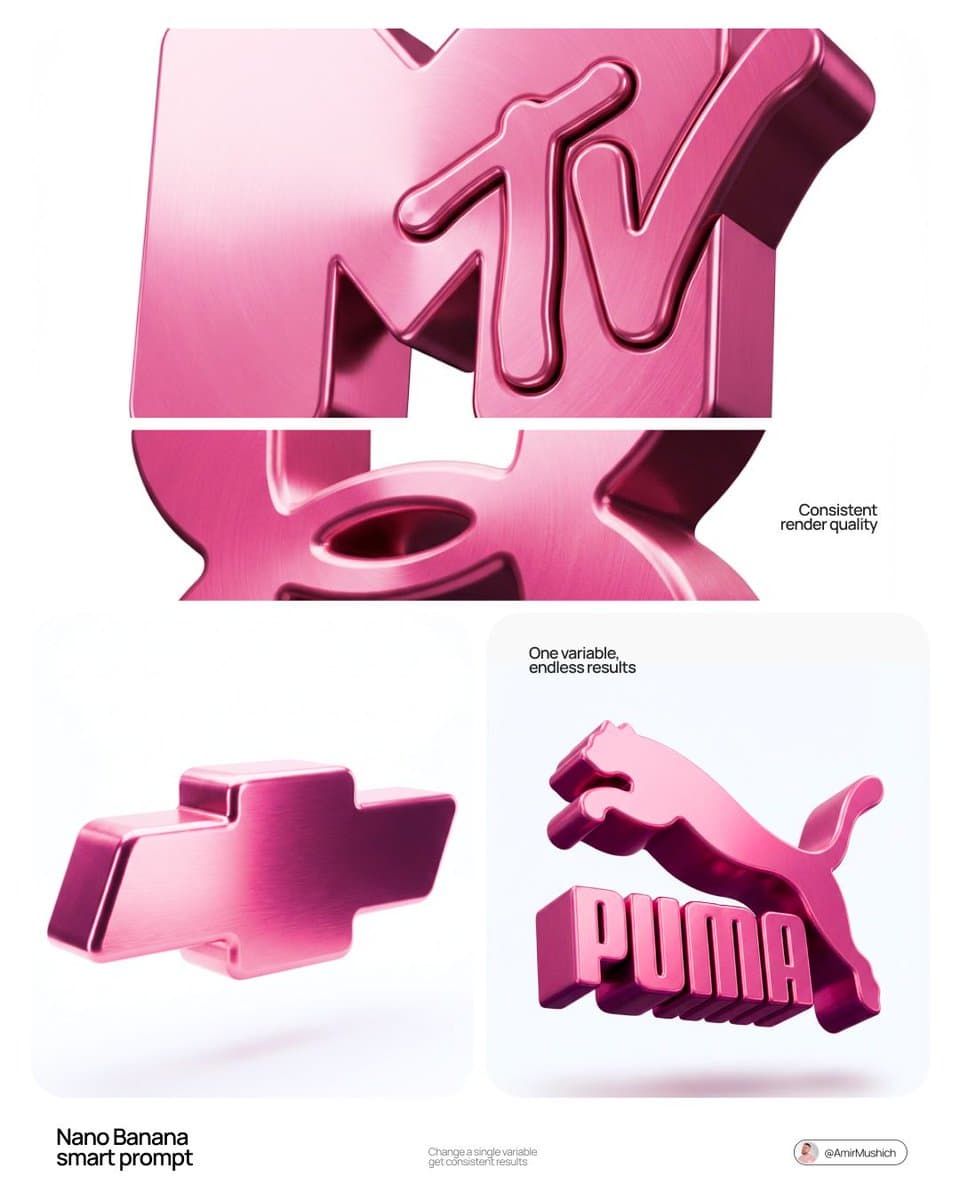
Designers shared Nano Banana templates that keep composition, material, and lighting stable while swapping a single brand or object variable. These reusable formulas are better for client work than one-off prompts because they make campaigns repeatable.
TL;DR
- Designers are turning Nano Banana 2 into a template engine: Amir Mushich's 3D logo formula locks material, camera, and lighting, then swaps only the brand name to generate consistent luxury-style logo renders.
- A second formula from the editorial outfit prompt keeps the scene photoreal while treating clothing as glowing 1987-1995 computer graphics, giving brands a repeatable retro-fashion look.
- The same reusable-prompt pattern also works beyond logos and apparel: Glenn's macro template fixes lens, lighting, and composition while changing the object and its reflected "impossible scene."
- Supporting experiments around packaging mockups and decorative lettering suggest creators are using the model less for one-off images and more for systematized brand explorations.
What the reusable formulas actually lock down
The clearest shift is from descriptive prompting to art-direction scaffolds. In Amir Mushich's thread, the variable is just [BRAND NAME]; everything else is fixed, down to 8-12mm fillets, 40-60mm depth, pink metallic color values, roughness 0.2, a 10° downward camera angle, and a white void with a 90%-transparent shadow. That is much closer to a repeatable product-visualization brief than a one-off image prompt.
The fashion version uses the same logic. According to the prompt share, the environment and skin stay realistic while the outfit is forced into chunky pixel structure, RGB subpixels, scanlines, glow bleed, and chromatic aberration. The result is a brand-swappable editorial setup: Versace, Puma, Ellesse, and Diesel all inherit the same visual grammar while only palette and logo cues change.
Where creators are extending the pattern
Glenn's macro setup shows the formula can travel outside branding. His template fixes a 100mm macro lens, chiaroscuro lighting, deep focus, and a close-up product-photography composition, then changes the metal object and the impossible reflected scene inside it: a deer by a stream in a gauntlet, a jazz quartet in a saxophone, gears in a pocket watch, a desert road in a motorcycle tank.
The supporting examples point in the same direction. One creator pairs a retro-electronic logo treatment with animation generation retro logo demo, while another uses a strict top-down food-packaging prompt to align a real pastry or donut with printed line art on the wrapper food packaging prompt. Even the decorative-lettering experiments from word design post and word illustrations behave like brand systems: one word changes, but the compositional recipe stays intact.