
Nano Banana prompt turns brand logos into glass mockups with caustics
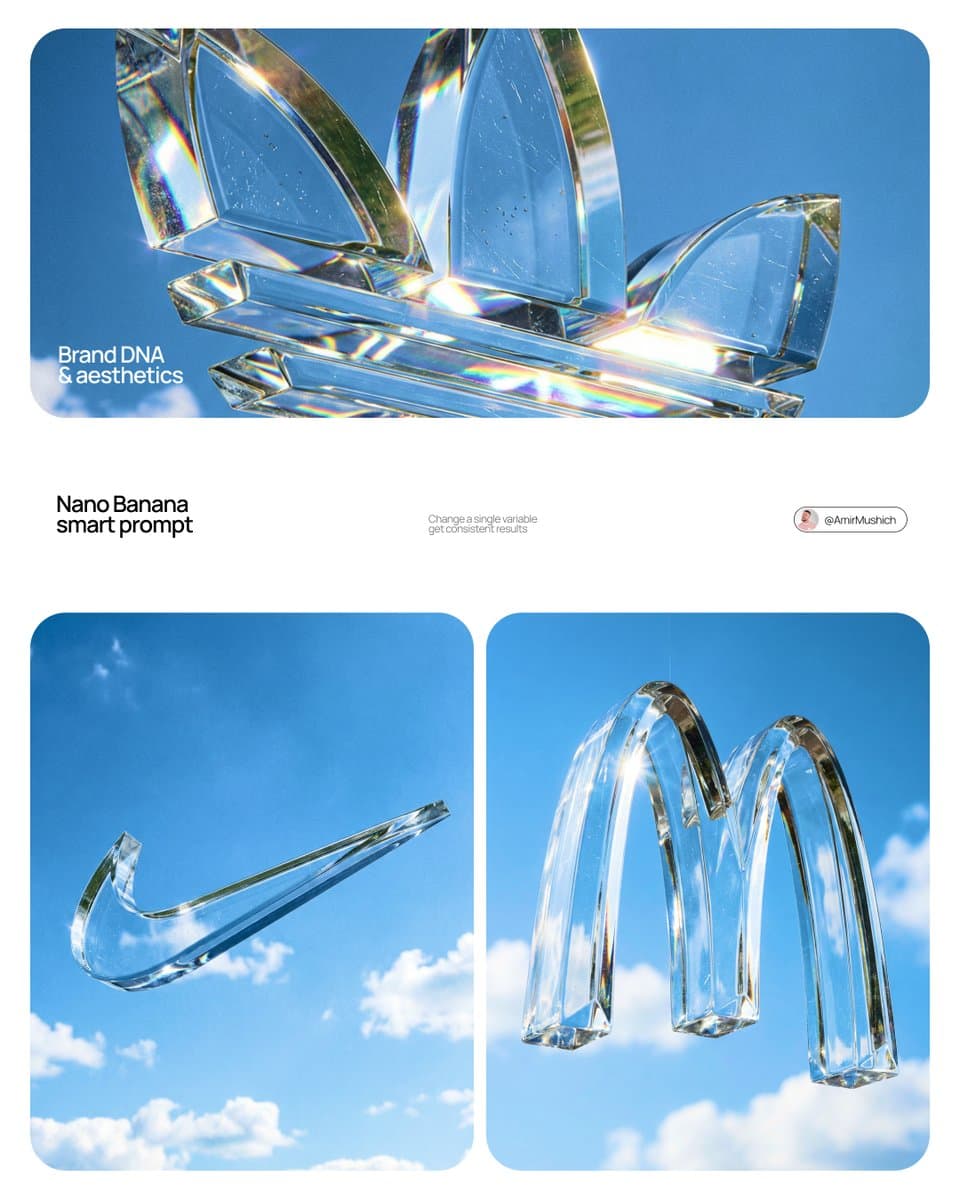
Amir Mushich published a Nano Banana prompt that keeps official logo geometry while rendering brands as beveled glass sculptures against an open sky. Follow-up examples showed the setup working across multiple logos with only small variable changes, so creators can reuse it for mockup work.
TL;DR
- Amir Mushich's main post shared a Nano Banana prompt that keeps a brand's official logo geometry intact while turning it into a suspended glass sculpture with sharp sky-driven caustics.
- In the full prompt text, Mushich split the setup into subject logic, glass materiality, and environment plus tech specs, which makes the look easy to copy and swap across brands.
- A follow-up example from youraipulse showed the same aesthetic working on a VANS wordmark, backing Mushich's line in the original thread that changing one variable can keep results consistent.
- Google's Nano Banana image generation docs already pitch logo-aware editing and high-fidelity detail preservation, and the DeepMind prompt guide explicitly recommends adding detail bit by bit for tighter control.
You can open Google's Nano Banana image generation docs, skim DeepMind's prompt guide, and see Google AI Studio pitch Nano Banana Pro around consistency, readable text, and mockups. The interesting part here is how neatly Mushich's thread turns those broad capabilities into one reusable brand treatment.
Glass logo prompt
Mushich's setup is simple in the useful way. The prompt asks Nano Banana to identify the official logo structure for any brand, keep the proportions unaltered, and render it as a single glass object floating in a clean blue-sky frame.
That geometry lock is the whole trick. Most fast logo mockups drift into fan art, while this one is written like brand policing, which is why the Adidas, Nike, and McDonald's outputs read like premium campaign comps instead of loose reinterpretations.
Three-phase prompt
The prompt is organized like a miniature production brief:
- Subject and logic: keep the logo exact, centered, and suspended.
- Materiality: use optical-grade crystal glass, beveled edges, and tiny flaws so it reads as heavy glass instead of CGI plastic.
- Environment and caustics: use direct sunlight, blue sky, sparse clouds, and strong internal refractions.
- Tech specs: call for Arnold or Octane style rendering, a Phase One XF with a 120mm macro lens, f/5.6, and subtle chromatic aberration.
That structure lines up with DeepMind's prompt guide, which tells users to get more control by specifying subject, setting, medium, and overall feel in detail.
Single-variable reuse
The thread's strongest claim is repeatability. Mushich's original image literally frames the method as "change a single variable get consistent results," and the VANS test shows the same glass-in-sky treatment transferring cleanly from symbol logos to a wordmark.
That fits how Google markets the model. The AI Studio model page describes Nano Banana Pro as a tool for consistency, adaptive styling, and flawless mockups, which is exactly the kind of work this prompt is pushing toward.
Color correction
Mushich added one more hint after the examples landed: color correction is part of getting the full range out of Nano Banana generations. The original prompt already leans hard on lighting cues, film stock, and refractive behavior, so that follow-up makes the workflow feel less like one magic paragraph and more like a mockup recipe with a post step attached.
Google's image generation docs make the same broader case for iterative editing, showing Nano Banana as a system for generating, refining, and compositing branded visuals rather than a one-shot image toy.