
PLY generates skate-park construction plans, cut lists and bills of materials
Linus Ekenstam demonstrated a browser-based skate-park designer that generates construction plans, cut lists and bills of materials. It also estimates store-linked prices and exports printable scale models.
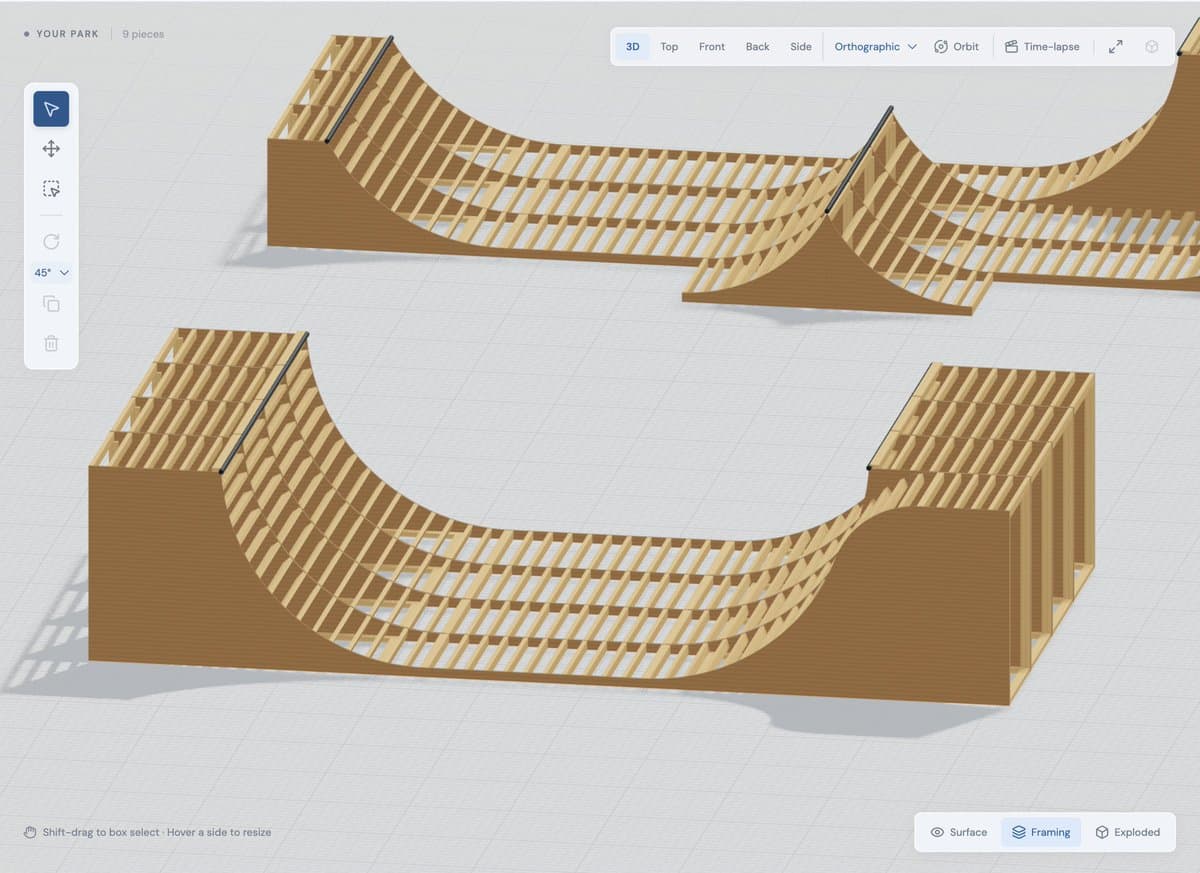
TL;DR
- PLY turns a browser-designed skate park into cut lists, a bill of materials and printable build instructions, according to the PLY demo.
- Its parametric editor snaps pieces to a material-aware grid; stairs can calculate their own step count and length, as the stairs update shows.
- Designs can become printable scale models: the model-kit demo shows STL exports, selectable scales and a PDF assembly guide.
- The prototype is still private. Ekenstam says he built it with Astra in Codex in a reply and will share a link when it is ready in another reply.
A mini-ramp requested by a skate teacher became a park you can skate inside the browser. The model-kit export even lets you choose your printer's plate size, while a renderer detail puts the 3D engine on vanilla WebGL.
A material-aware ramp editor
Linus Ekenstam's PLY demo starts with snap-together ramps and ends with a ride through the finished park. He says the browser-based editor uses real material sizes and supports both European and US standards.
The editor has surface, framing and exploded views, with live metric or imperial unit changes. The pictured mini-ramp measures 6,464.1 mm long, 4,880 mm wide and 1,108 mm high; its interface shows a 100 mm grid with edge snapping.
Among the parts Ekenstam lists are quarters, roll-ins, spines, boxes, pyramids, rails and stairs. Components can also be drawn and saved to a personal library; the grid can be detached for bespoke shapes. Stairs have their own controls:
- Set a width and step count, or let PLY calculate the count and length.
- Add optional railings and drop protection.
Cut lists, prices and assembly guides
PLY's material calculations tie the design to what a builder would buy. Ekenstam says the tool produces:
- A bill of materials and cut list, with material optimization and off-cut reuse.
- Price estimates using material costs from Home Depot and Beijer.
- Screw counts and types, which he claims fall within a ±2.5% margin.
- Printable PDF plans and step-by-step 3D assembly guides for sections or the full park.
A curved wooden ramp typically needs arc-cut plywood side templates, structural ribs, layered riding surfaces and metal coping, as Stalefish Labs' ramp anatomy explains. Those layers make the connection between editable geometry and a cut list more than a cosmetic feature.
A skateable preview in WebGL
The fly-through turns into a character skating the course in the browser. Ekenstam said in a reply that its renderer is custom vanilla WebGL, without a graphics framework; he claims the editor reaches 120 fps in the original demo.
A separate clip of park editing, fly-through and browser-based skating.
He also says a costly calculation went from 20 ms to “2m” as written in his performance update, while 510 automated tests still passed across the builder, visualizer and construction features. He did not give a clearer unit for the new timing.
The park as a printable model kit
PLY can export a scaled park as STL files split across print plates, plus a parts list and PDF instructions for putting the model together. Ekenstam described 1:24 as the default scale and 1:8 as an option for fingerboard-sized ramps; his later walkthrough adds user-selectable scales and print-plate dimensions.
Astra in Codex, with a test suite
Ekenstam says he is building PLY with Astra in Codex and says he has not written a line of code himself. He clarified in a reply that it has taken substantial work across many prompts. The reported 510 automated tests cover the builder, visualizer and construction features.
The unfinished component library
PLY is not publicly available yet: Ekenstam said he would send a link once it reaches a testable state. After showing it to the skate teacher, he reported interest from park builders and DIYers.
He says he is fixing snapping and alignment edge cases and expanding the library from 21 components to more than 100, including a rail builder, mega ramps and foam pits in that update. Concrete is a further plan: the original post describes future calculations for volume, rebar, drainage, slopes and anti-crack lines.