
RTX Spark launches with 128GB unified memory and 1 petaflop AI compute
NVIDIA launched RTX Spark as a 128GB unified-memory, 1-petaflop AI PC platform, with 30 laptops and 10 desktops due this fall. Watch for local Photoshop, Premiere, Substance 3D, and upscaling workflows to move onto the box.
TL;DR
- NVIDIA introduced RTX Spark as a Windows on Arm PC platform with up to 128GB of unified memory and 1 petaflop of local AI compute, according to markproduct's launch summary, while minchoi's post highlighted NVIDIA's claim that it can run 120B-parameter agents locally.
- The official rollout pairs an Arm CPU with up to 6,144 Blackwell RTX cores and targets slim laptops plus compact desktops shipping this fall, per the Windows announcement and NVIDIA's press release.
- For creative apps, NVIDIA says Adobe is rearchitecting Photoshop and Premiere for RTX Spark, a detail echoed by icreatelife's Adobe partnership post, while Topaz Labs says Spark will accelerate Topaz Photo and Topaz Video in topazlabs on creator workflows.
- NVIDIA's own pitch is unusually concrete: RTX Spark PCs are supposed to render 90GB-plus 3D scenes, edit 12K 4:2:2 video, generate 4K AI video, and play AAA games at 1440p over 100 fps, according to the official press release.
- The interesting part for creative work is not just speed. Microsoft says Prism will handle x86 app emulation on these Arm machines, while aakashgupta's thread frames the whole launch as NVIDIA pushing into the Windows PC stack itself.
You can read NVIDIA's AI Garage post for the creator and agent pitch, Microsoft's Windows post for the Arm app compatibility angle, and NVIDIA's press release for the hardest claims, including 12K video editing and local 120B-model runs. The weird bit is how much of the announcement reads like a creator workstation brief, not a gaming laptop teaser. There is also a quiet workflow hook in NVIDIA's own blog: Blender gets DLSS 4.5 Ray Reconstruction, and RTX Video Frame Generation is headed to ComfyUI in the same fall window.
RTX Spark
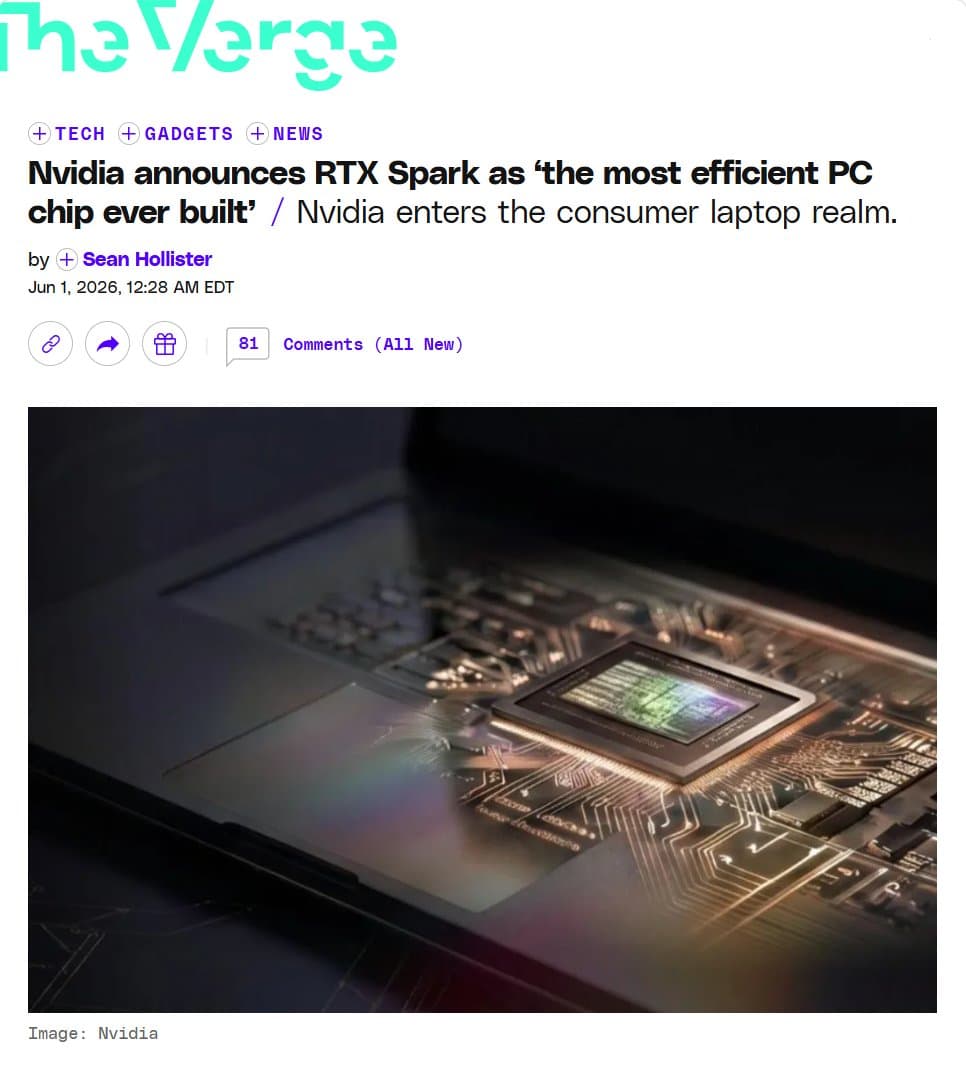
RTX Spark is NVIDIA's attempt to collapse AI box, creator laptop, and gaming PC into one Arm-based Windows machine. The core spec sheet is simple: up to 20 Arm CPU cores, up to 6,144 Blackwell RTX cores, up to 128GB unified memory, and 1 petaflop of AI performance, per the Windows announcement.
The more revealing claim lives in NVIDIA's press release: Spark is meant to run 120B-parameter LLMs with up to 1 million tokens of context locally, alongside 4K AI video generation, 12K 4:2:2 editing, and 90GB-plus 3D scenes. minchoi's post pulled that 120B figure into the social rollout because it is the part that changes what "local" can mean on a laptop.
Microsoft's post adds the compatibility answer. Prism will be the x86 emulation layer for 32-bit and 64-bit apps, which matters because this launch only lands if creators can keep running the odd plugin, utility, and legacy tool that has not gone native yet.
Adobe and creator apps
NVIDIA says in its AI Garage post and press release that Adobe is rearchitecting Photoshop and Premiere for RTX Spark, with Firefly-powered Generative Fill and Generative Extend among the accelerated features. The company also says those apps should see up to 2x faster AI and graphics performance on Spark.
Microsoft's Windows post broadens that beyond Adobe. It lists Blender, DaVinci Resolve, Maxon Cinema4D, Maxon Redshift, Topaz Photo, CapCut, Cubase, Bitwig Studio, and Affinity by Canva as native on Arm today.
That makes the early partner posts worth taking seriously. icreatelife's Adobe post points specifically to Photoshop, Premiere, and Substance 3D optimization, while topazlabs' congratulatory post and topazlabs' workflow post tie Spark directly to upscaling, denoising, and enhancement work in Topaz Photo and Topaz Video.
Local agents and video workflows
NVIDIA framed Spark as a "personal agent" machine first, and the AI Garage post is explicit about why: 128GB unified memory and 1 petaflop of AI compute are supposed to make on-device agents practical instead of toy demos. That same post also says llama.cpp and vLLM are getting performance work, including multi-token prediction, and that ComfyUI is in line for RTX Video Frame Generation this fall.
For creative readers, the more useful takeaway is the workflow mix NVIDIA is betting on:
- local LLM agents with long context, from the press release
- Firefly-powered image and video features inside Adobe, from the AI Garage post
- Blender upgrades including DLSS 4.5 Ray Reconstruction, from the same AI Garage post
- ComfyUI video acceleration arriving in the fall, also from the AI Garage post
It is a broad stack on purpose. Spark is being sold as a box where prompting, editing, rendering, and enhancement happen on the same machine instead of bouncing between browser tabs, cloud queues, and a separate GPU tower.
Fall hardware rollout
NVIDIA says in the press release that Spark systems will arrive this fall from ASUS, Dell, HP, Lenovo, Microsoft Surface, and MSI, with Acer and GIGABYTE models to follow. The company also says the laptops will range from 14 to 16 inches, reach as slim as 14 millimeters, and weigh as little as three pounds.
That scale is part of the story. aakashgupta's thread called out more than 30 laptops and 10 desktops in the launch window, which makes Spark look less like a one-off reference design and more like a coordinated platform push.
MediaTek's partner announcement fills in one last useful detail: the chip's pitch depends on tight integration between CPU, memory, connectivity, and power efficiency inside a thin SoC package. That is new information for creative laptop buyers because Spark is not being marketed as a bulky mobile workstation. NVIDIA wants the workstation claim and the thin-and-light claim at the same time.