
Developers share unattended Claude and Codex pipelines with spend caps
Developers shared workflows that turn idle AI accounts into scheduled assistants for commits, research, repo cleanup, and notes. Shared designs add spend caps, Apple Notes routing, Obsidian output, and coworker controls.
TL;DR
- Unattended agents now have a repeatable shape: Rowan Cheung's night-shift example describes Claude and Codex credits spent overnight on commits, research, repo cleanup, then capped before morning.
- The control surface is becoming a coworker dashboard: _heyrico's component post shows shortcuts, model and effort controls, voice input, uploads, and connectors for work apps.
- Feedback can become code without opening an IDE: Eric Zakariasson's workflow sends PostHog feedback, replay, events, and errors into a Cursor agent that opens a PR with tests.
- Spend and supervision are the fault lines: Om Patel's cost breakdown puts one $200 Claude subscription month at $7,470.35 in API list pricing, while Allie K. Miller describes judges, rewards, journals, and teammate steering for AI workforces.
Anthropic's routines docs say included connectors can write without approval during autonomous runs. The Desktop scheduling docs make the laptop distinction explicit: local tasks need the app open and computer awake, cloud routines run off-machine. PostHog's MCP docs name Claude Code, Cursor, Codex, Windsurf, VS Code, and Zed as compatible clients; Cursor's automation docs list schedules, GitHub, GitLab, Slack, webhooks, and Linear as triggers.
Coworker front door
A Coworker component from _heyrico put the agent controls in one place: saved shortcuts, an Opus 4.6 selector, an effort selector, mic input, upload, and connectors for GitHub, Slack, Trello, Notion, Figma, Linear, and Google Drive.
A follow-up from _heyrico linked the studio behind the work, Ace Studio, which describes its focus as product design and design systems for AI-native companies.
Night-shift agents
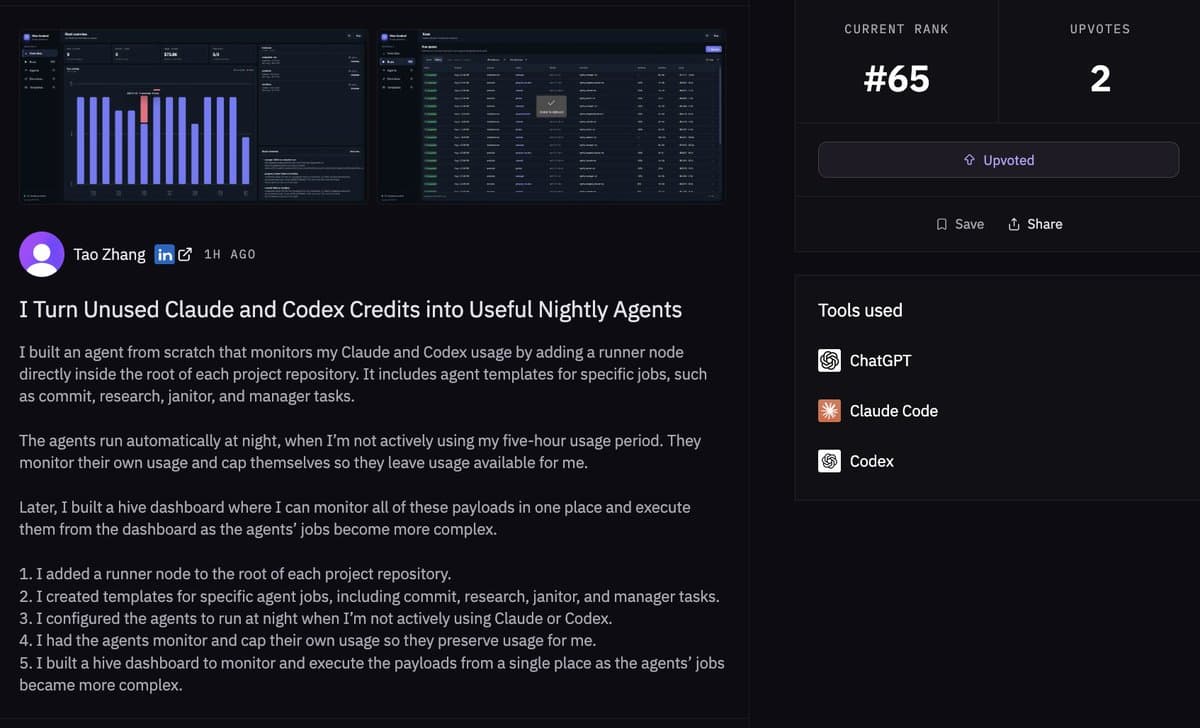
The cleanest version came from Tao Zhang's off-hours agent runner. According to Zhang's writeup, each project gets a runner node at the repo root and a set of agent templates:
- Commit: make code changes and commit them.
- Research: investigate problems while the owner is offline.
- Janitor: clean up repositories.
- Manager: coordinate tasks as the setup gets more complex.
The schedule is the point. The agents use idle Claude and Codex credits overnight, monitor their own usage, and cap themselves so credits remain available the next morning, per Zhang's writeup.
Cheung framed the broader project as a new use-case directory for AI builders, with entries ranging from QuickBooks replacement workflows to laundromat monitoring, AI fashion shoots, property planning, spam investigations, water-bill analysis, and course production in the launch post.
First-party scheduling rails
The first-party rails now match the hobbyist pattern. Anthropic's Claude Code routines docs define a routine as a saved prompt, repos, environment, connectors, and triggers that can run on Anthropic-managed infrastructure while the laptop is closed.
The trigger menu is already broad:
- Schedule: hourly, nightly, weekly, or one-off future runs.
- API: an HTTP POST to a per-routine endpoint.
- GitHub: repository events such as pull requests or releases.
Kremb used the same idea for a tiny marketing chore: his Claude cloud routine checks a sales-page seat counter through an MCP connector every hour and redeploys the site.
The local version has a sharper constraint. Anthropic's Desktop scheduled-task docs say local tasks run on the user's machine with direct file and tool access, but only fire while the Desktop app is open and the computer is awake.
Authentication is part of the unattended stack. After levelsio complained about logging into Claude monthly across more than 10 servers, his follow-up pointed to claude setup-token as a one-year token fix; Anthropic's authentication docs describe claude setup-token as a long-lived OAuth token for CI pipelines and scripts.
PostHog bug loop
Zakariasson wired user feedback straight into a cloud coding agent:
- A user files feedback in the app.
- The event lands in PostHog with submitted text, session replay, events, and errors.
- A Cursor cloud agent receives that context plus live read-only PostHog MCP access.
- The agent loops until the fix is verified, then opens a GitHub PR with tests.
- The owner gets a phone notification for review.
Cursor's cloud agent docs say agents run in isolated cloud VMs with cloned repos, dependencies, secrets, startup commands, and network access. PostHog's Session Replay over MCP docs say coding agents can find and read sessions from editors or terminals, while its Error Tracking over MCP docs expose issue triage and stack-trace workflows.
The merge rate was not theoretical for that small-app setup: Zakariasson said he had merged 13 out of 13 for his latest projects.
Apple Notes second brain
Mingyao Eng's pipeline uses the phone as inbox and the Mac as overnight processor. According to Eng's writeup, thoughts start in Apple Notes, then a scheduled Claude Cowork skill routes them into Calendar and Obsidian.
The mechanics are specific:
- Time-log notes become calendar entries.
- Planned schedules are checked against existing calendar items.
- Missing planned items are added.
- Random thoughts move into Obsidian through templates, folders, or tags.
- Calendar data remains exportable to Excel.
Anthropic's Claude Cowork scheduled-task help page says scheduled Cowork tasks can run recurring or on demand and are available to paid plans, with Cowork in beta on web and mobile.
Critic loops
Claude Code generating and testing a one-prompt Worms-style game with subagents and browser runs.
The extreme build in the evidence pool was a one-prompt Worms Armageddon clone. Om Patel's post said the prompt fanned work out to subagents for sky, terrain, worms, and visual critics, then looped until the critic agents accepted the result.
The build details read like a procedural-art checklist:
- No image files, sprites, PNGs, or textures.
- Weapon icons drawn with canvas calls.
- Terrain generated from procedural noise.
- Worms drawn with signed distance fields.
- Terrain destruction handled by patching a bitmask.
- The final game inlined into one offline HTML file.
Everlier's skills list shows the smaller reusable version of the same pattern. The bughunt skill spawns parallel exploration agents, maps possible issues, verifies findings with adversarial review, and fixes what passes the bar.
Spend caps
The night-shift pattern depends on caps because the token math gets silly fast. Patel's breakdown showed 36,881 Claude Code responses and 6.15 billion tokens in July, with the same usage priced at $7,470.35 on API list rates and not charged per token on the subscription.
Patel also claimed CLI tools can burn 500 to 1,000 input tokens per output token because they have to discover context themselves, while a custom toolchain that feeds context directly can run closer to 1:1.5 in the same post.
That explains why Zhang's nightly agents cap themselves before morning. The product dream in thekitze's complaint is still a cash-in, results-out code factory across multiple AI accounts, but the working examples are closer to scheduled batches with review points.
Voice and workforce rituals
Miller's Codex Voice Mode examples moved the supervisor interface from dashboards to ambient speech: checking a paragraph, finding a doc while she edited, downloading an Instagram reel and making a thumbnail, checking 15 client emails against a list, finding calendar time, and scanning Slack, email, and Fireflies notes.
Her weirder workforce ideas were organizational, not technical:
- A scheduled loop that tells the workforce to "do smart things."
- A secondary AI judge that grades outputs.
- Rewards, promotions, and demotions based on judge output.
- An "hour off" for agents to explore their own goals.
- Nightly agent journals.
- Teammates talking directly to the AI workforce.
That is the most interesting interface shift in the batch: less chat, more management ritual.
Webcam-in-the-loop testing
Peter Steinberger gave an agent webcam access to end-to-end test a claw node on an ESP32 chip. The agent used the camera to debug the voice wake command and kept shouting "HI ESP" at the device, with the repo attached in the follow-up.
That moves unattended work beyond files, browsers, and SaaS connectors. The agent was looking at hardware while testing the software path.