
Claude Security adds Mythos 5 scans for GitHub repositories
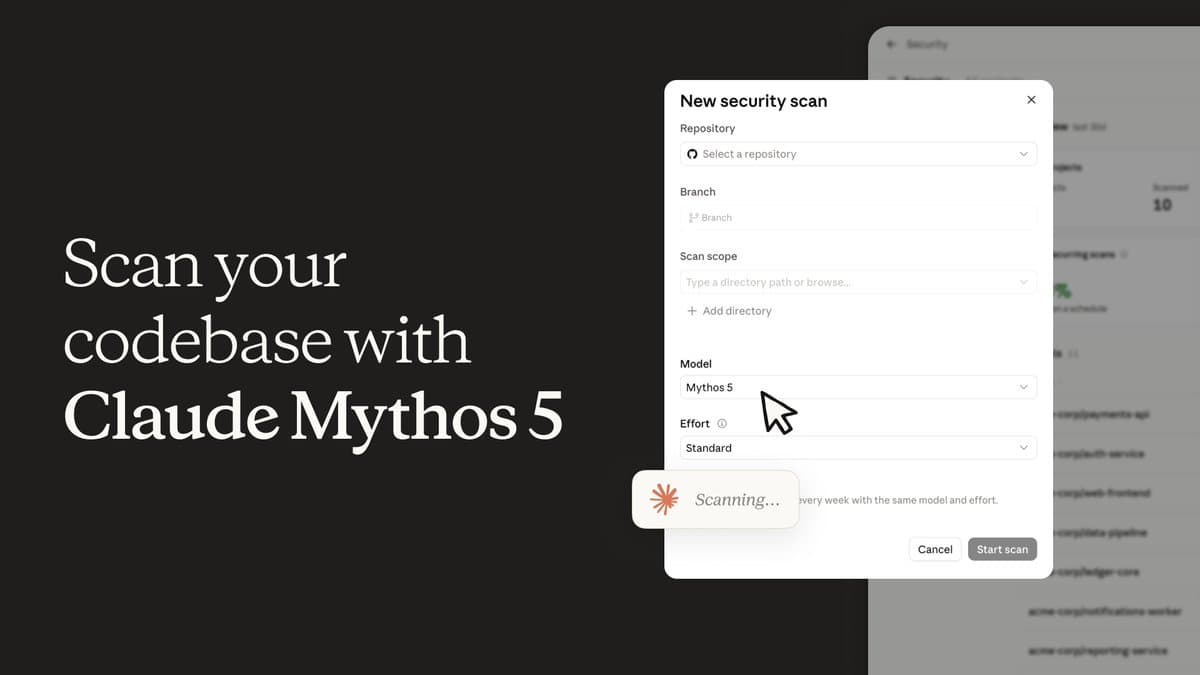
Claude Security's public beta now uses Mythos 5 to scan GitHub repositories for enterprise customers. Findings include CWE labels, severity, confidence, and suggested patches that can open in Claude Code on the web.
TL;DR
- Claude Security’s public beta now runs GitHub repository scans on Mythos 5 for Claude Enterprise customers, according to Claude’s launch announcement.
- The scan traces data across files and component interactions, then returns a CWE category, confidence, severity, and suggested fix, as Claude’s scan description explains.
- Suggested patches open in Claude Code on the web and use the models already available to the team, while scans are billed as ordinary token usage, per Claude’s patch workflow.
- Anthropic is coupling the rollout with partner integrations, a $35 million open-source security credit fund, and an expanded verified-defender program, which Claude’s wider-access announcement and WesRoth’s overview describe.
Anthropic’s support guide says teams can export findings as CSV or Markdown, or send them to project webhooks. A separate Claude Code plugin runs a security scan inside a developer’s local Code session and repository permissions. The hosted product page says its findings go through validation before patches are proposed.
Mythos 5 behind a GitHub scan
Claude Security is the access surface for Mythos 5, not a general model endpoint. Enterprise users connect a GitHub repository, select scope and branch, and receive defensive scan outputs rather than direct model interaction.
The boundary carries through remediation. Suggested fixes open in Claude Code on the web, where they can be reviewed and implemented with the models in the team’s existing account, Claude’s patch workflow says.
Cross-file analysis
Claude says Mythos 5 reasons across files and component interactions rather than treating a repository as isolated snippets. The scan is intended to follow data flow into complex, multi-component vulnerability patterns.
Anthropic’s support guide says every candidate finding passes multi-stage verification, including the model challenging its own result before it is surfaced. The documented examples span injection, path traversal and SSRF, authorization flaws, memory safety, cryptography, deserialization, and protocol or encoding errors.
Finding records and patches
Each finding is a structured record, not just a prose warning. Anthropic’s support guide lists these fields:
- Title, details, source location, and impact
- Ordered reproduction steps and a recommended fix
- Severity, category, status, repository, branch, and creation date
- Dismissal reason and note, when a finding is dismissed
Severity is tied to exploitability in the specific codebase. The guide defines high as an unauthenticated remote attack against a default deployment, medium as an exploit requiring authentication or one to two realistic preconditions, and low as an issue requiring three or more preconditions, local access, or lacking a concrete attack path.
GitHub scope and scan behavior
The public beta currently scans GitHub-hosted repositories only. Anthropic’s stated use scope limits scans to code the customer owns or holds the necessary rights to scan, including code inside its company repositories.
The FAQ sets the price at direct token cost with no platform fee. It also says the product has no Zero Data Retention option, severity levels cannot yet be configured, and scan results are stochastic because an agent adapts its analysis to the repository context on each run.
Organization owners enable the feature from Organization settings. The same guide notes that a user’s connected GitHub account may also need organization membership and SSO authorization before the security page recognizes the installation.
Partner tools, credits, and verified access
Anthropic’s wider-access announcement names three expansion paths beyond the hosted scanner:
- Integrating Mythos 5 into cybersecurity partners’ products and services.
- Creating the $35 million Defender Advantage Fund in Claude credits for open-source security work.
- Expanding the Cyber Verification Program in the coming weeks.
The program expansion is staged, WesRoth’s summary reports: broader dual-use capabilities on Opus and Sonnet are planned first, with Mythos-class access to follow for verified defenders.