
GPT-Rosalind introduces life sciences reasoning in trusted-access preview
OpenAI launched GPT-Rosalind for biology, drug discovery, and translational medicine, plus a life sciences plugin for Codex. Access starts as a trusted preview for qualified customers, so near-term use is limited to partner and enterprise workflows.
TL;DR
- OpenAI's launch thread says GPT-Rosalind is a new life sciences model series for biology, drug discovery, and translational medicine, and OpenAI's announcement says it ships as a research preview in ChatGPT, Codex, and the API.
- According to Kevin Weil, access is gated through a trusted-access program for qualified customers, while OpenAI's access form says eligibility is reviewed around beneficial use, safety practices, and organizational readiness.
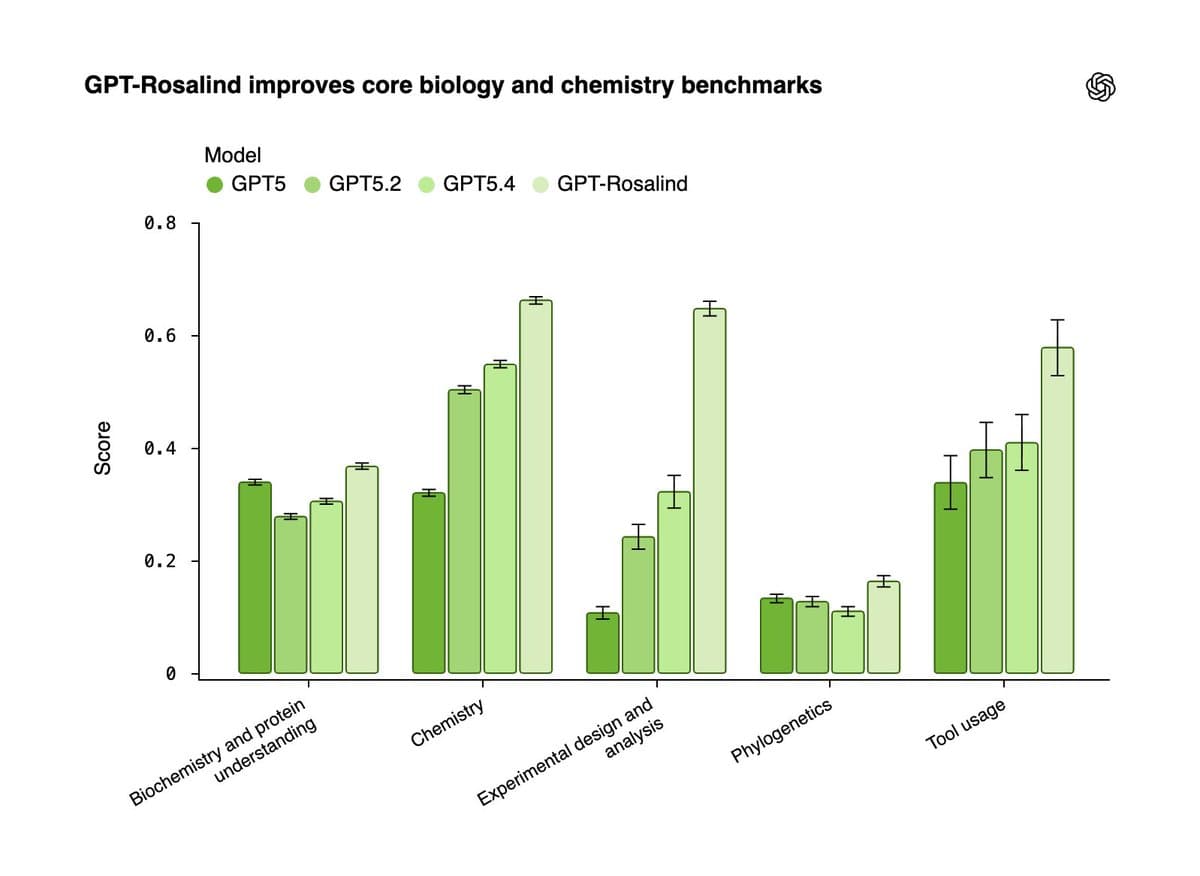
- OpenAI's benchmark card shows Rosalind leading GPT-5, GPT-5.2, and GPT-5.4 across five internal biology and chemistry benchmark buckets, and OpenAI's blog post also cites external evals including BixBench, LABBench2, and a Dyno Therapeutics study.
- Kevin Weil's thread says OpenAI is also releasing a Life Sciences plugin for Codex to everyone, and the plugin repo is positioned in the launch materials as a bridge to more than 50 scientific tools and data sources.
You can read the full launch post, request preview access through OpenAI's form, and browse the Life Sciences Codex plugin on GitHub. There is also a long podcast discussion on YouTube where OpenAI frames the product as useful for research workflows now and more autonomous lab systems later.
Trusted-access preview
OpenAI is selling Rosalind as a deployment model as much as a model. Kevin Weil calls it OpenAI's first frontier model built for scientific research, and OpenAI's access form says the preview is limited to eligible institutions reviewed for beneficial use, safety controls, and readiness.
The availability story is narrow on day one. OpenAI's thread names Amgen, Moderna, the Allen Institute, and Thermo Fisher Scientific as initial qualified customers, while Physical AI News reports that OpenAI described the early rollout as aimed at enterprise and institutional research users rather than broad self-serve access.
Benchmarks and workflow focus
OpenAI is not pitching Rosalind as a protein-folding lab in a box. the official benchmark image frames it around five workflow buckets: biochemistry and protein understanding, chemistry, experimental design and analysis, phylogenetics, and tool usage.
OpenAI's announcement adds three concrete eval references:
- BixBench for research task performance
- LABBench2, where OpenAI says Rosalind beats GPT-5.4 on 6 of 11 tasks
- A Dyno Therapeutics study, where OpenAI says best-of-10 runs topped the 95th percentile of human experts on RNA prediction
That profile lines up with kimmonismus's summary, which describes Rosalind less as a structural biology engine and more as a reasoning and orchestration layer for messy scientific workflows.
Codex plugin and tool connections
The more interesting shipping detail may be the plugin. Kevin Weil's thread says the Life Sciences plugin works with OpenAI's mainline models as well as GPT-Rosalind, and OpenAI's post says it helps scientists connect models to more than 50 scientific tools and data sources.
The openai/plugins repository describes these as Codex plugin examples built around a required manifest plus optional skills, agents, commands, hooks, and MCP surfaces. That makes the Rosalind launch feel half model release, half packaging job for scientific software that already lives outside the model.
Partner list is broader than the first four logos
The official launch copy highlights four named customers, but Greg Brockman's partner screenshot shows a wider orbit: Amgen, Novo Nordisk, Thermo Fisher Scientific, Moderna, Oracle Health and Life Sciences, NVIDIA, the Allen Institute, Benchling, and UCSF School of Pharmacy.
That same screenshot includes an Amgen quote from Sean Bruich saying the collaboration is aimed at applying OpenAI's tools to high-precision life sciences work. OpenAI's podcast post adds one more future-facing detail, saying the discussion covers better research workflows today and more autonomous labs over time.