
Meta reports Muse Spark solutions to six open mathematics problems
Meta published six research collaborations reporting solutions to open mathematics problems with Muse Spark. Mathematicians guided the work through its regular chat interface, independently reviewed results, and marked human contributions.
TL;DR
- Meta published six mathematics papers with Muse Spark, listed in a launch post; its official announcement describes five as answers to previously open questions.
- Researchers used Muse Spark 1.1 and 1.2 in Thinking Mode through ordinary chat, without a custom research scaffold, according to Meta's account.
- AI-generated search code found a group-theory counterexample; mathematicians verified it and completed the proof, as Meta reported.
- The papers distinguish human-drafted and AI-assisted passages, with researchers owning the final manuscript, as documented in the AI-use statement.
One group-theory counterexample has a concrete GAP identifier: SmallGroup(384, 20127). The Gaussian-fitting theorem locates a sharp phase transition while leaving the critical regime unresolved.
Thinking Mode and separate reviewers
The collaborations followed four principles in Meta's announcement:
- Mathematicians guided the research and developed arguments with Muse Spark.
- A second group of mathematicians reviewed the work.
- Each paper marked passages primarily drafted by humans or AI.
- Papers credited earlier research and acknowledged independently developed solutions.
GAP search and a 384-element counterexample
A semiabelian group with 384 elements, SmallGroup(384, 20127), disproves M. Kida's conjecture that every finite semiabelian group is monomial. Muse Spark generated the GAP search program; the researchers verified the result and completed the argument.
Generated search code plus a checkable counterexample is the batch's most tangible engineering win.
Gaussian ellipsoid fitting
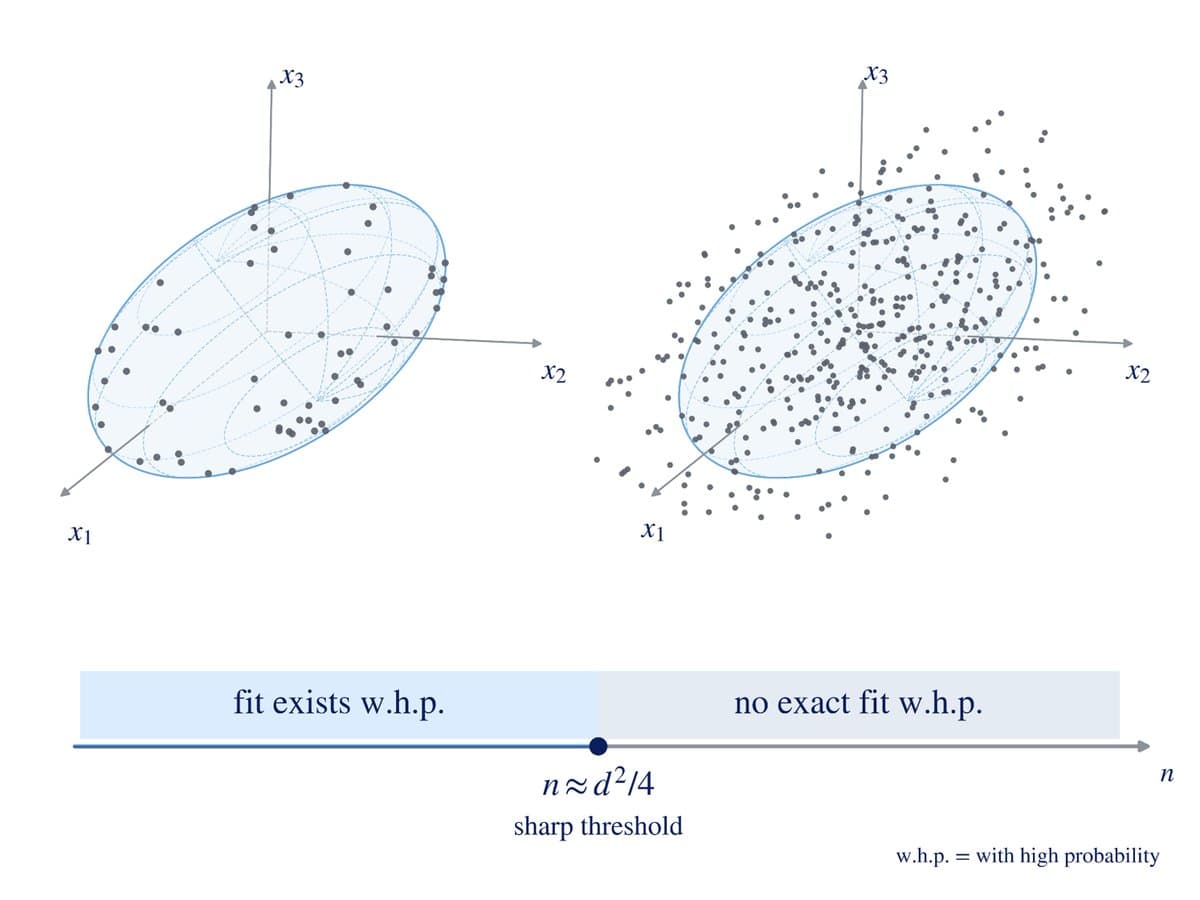
The probability paper asks whether independent Gaussian vectors xᵢ ~ N(0, I_d) admit a positive semidefinite matrix S satisfying xᵢᵀ S xᵢ = d for every point.
Its asymptotic threshold is n ≈ d²/4:
- If
limsup n(d)/d² < 1/4, a fitting matrix exists with probability tending to one, and can be positive definite. - If
liminf n(d)/d² > 1/4, no fitting matrix exists with probability tending to one. - If
n(d)/d² → 1/4, the paper makes no claim.
Finite-time wave collapse
In dimensions two and higher, radial negative-energy solutions must blow up in finite time under the conditions studied in the differential-equations paper. The model is the mass-critical biharmonic nonlinear Schrödinger equation.
The result settles a question left open in 2015 and confirms a prediction from 2002 simulations, according to Meta's research post. The researcher selected the problem and key proof ideas; Muse Spark helped with calculations, candidate arguments and revisions.
Binary polynomial relaxations
For completed length-three alpha-cycles, a cycle-based relaxation of binary polynomial optimization has an exactness criterion in the optimization paper:
- Exact: Each pairwise overlap of the three maximal edges, excluding the third edge, contains exactly one vertex.
- Gap: Any of those pairwise-only regions contains more than one vertex.
Muse Spark helped reformulate the problem using probabilities, identify a counterexample and develop a proof strategy. The researchers checked the arguments and corrected gaps.
p-adic strings and height pairings
For curves over a p-adic local field with semistable reduction, the arithmetic-physics paper identifies a string-theory boundary two-point function with the Néron local height pairing on degree-zero divisors. This extends a connection previously known for the Tate curve.
Muse Spark generated candidate proofs and drafted three core technical sections, which researchers checked, corrected and refined, according to Meta's account.
Solvable evolution algebras
A three-dimensional counterexample in the evolution-algebra paper passes the proposed solvability test but is not solvable, disproving the García-Martínez and Pérez-Rodríguez conjecture.
Muse Spark generated the example and proposed alternative characterizations using idempotent subspaces. The researchers checked and refined the mathematics, moving beyond a counterexample to replacement classification rules.
Concurrent solutions
Other teams had independently announced solutions to some of the same problems, Meta noted in its research post:
- Gaussian fitting: Three concurrent works appeared in August 2026. Misiakiewicz and Wen proved the Gaussian threshold; De la Cerda, Potechin, Tulsiani and Xu established it up to a vanishing multiplicative factor; Koehler and Sohn proved a broader universality result containing the Gaussian case.
- Group theory: The AI agent Nilradical reported a different counterexample to Kida's conjecture on September 16, 2026.
- Evolution algebras: Hu and Wen independently reported counterexamples to the same conjecture.
Meta says these results and its collaborations were developed independently, using different approaches where described.
Prompts and release norms
Mathematicians published September 29 release recommendations after collecting more than 600 responses. Their three overarching principles were:
- Prompt release of significant mathematical results.
- Lab support, including funding, for human understanding when substantial output arrives without it.
- Community-led development of that understanding, outside lab direction.
For outputs not yet understood by their prompters, the document also requests:
- Model names, prompts and summarized reasoning.
- Runtime and estimated computation cost.
- Formalization artifacts or a clearly stated formalization status.
- For batches of results, problem-selection details and the number of comparably difficult problems attempted unsuccessfully.
The document asks labs to stop testing advanced mathematical problems on proprietary models inaccessible to the scientific community. BlackHC argued in the discussion that the route to an insight should not matter when knowledge is the objective, and suggested in a follow-up that the dispute involved credit assignment.