
OpenCode 1.4.11 adds workspace support for git worktrees and remote environments
OpenCode 1.4.11 beta lets sessions run inside git worktrees or remote environments, with a remote server that keeps sessions alive and resyncs locally after reconnects. Use it if you run multi-session agent work across machines or plugin-defined runtimes.
TL;DR
- OpenCode 1.4.11 adds beta workspace support, and jlongster's launch post says those workspaces can run either as git worktrees or inside remote environments.
- The headline behavior in jlongster's launch post is session coordination across environments: sessions stay grouped in one place, a remote OpenCode server keeps them running, and local sync keeps data available on your machine.
- The implementation detail from jlongster's architecture follow-up is the useful bit: OpenCode runs a full server in the remote environment, then reconnects and resyncs locally even after hours of disconnection.
- Extensibility is already part of the design, because jlongster's plugin post says plugins can define new workspace types, and the linked workspace adaptor gist sketches the adaptor interface behind it.
- The caveat is also explicit, because jlongster's beta warning calls the feature experimental and says breakage is especially likely when using remote environments.
You can watch the demo video in jlongster's launch post, read the workspace adaptor gist, and browse the older Hacker News thread where OpenCode users were already talking about remote access via opencode serve, plugins, telemetry, and sandboxing. There is also an early ecosystem hook here, because jlongster's plugin post says Daytona is building an official plugin and that he used a preview version.
Workspaces
The new beta groups multi-session agent work under a workspace abstraction instead of treating each run as an isolated local session. In jlongster's launch post, jlongster lists four pieces of that model:
- run sessions in git worktrees
- run sessions in remote environments
- keep sessions coordinated in one place
- let plugins add more workspace types
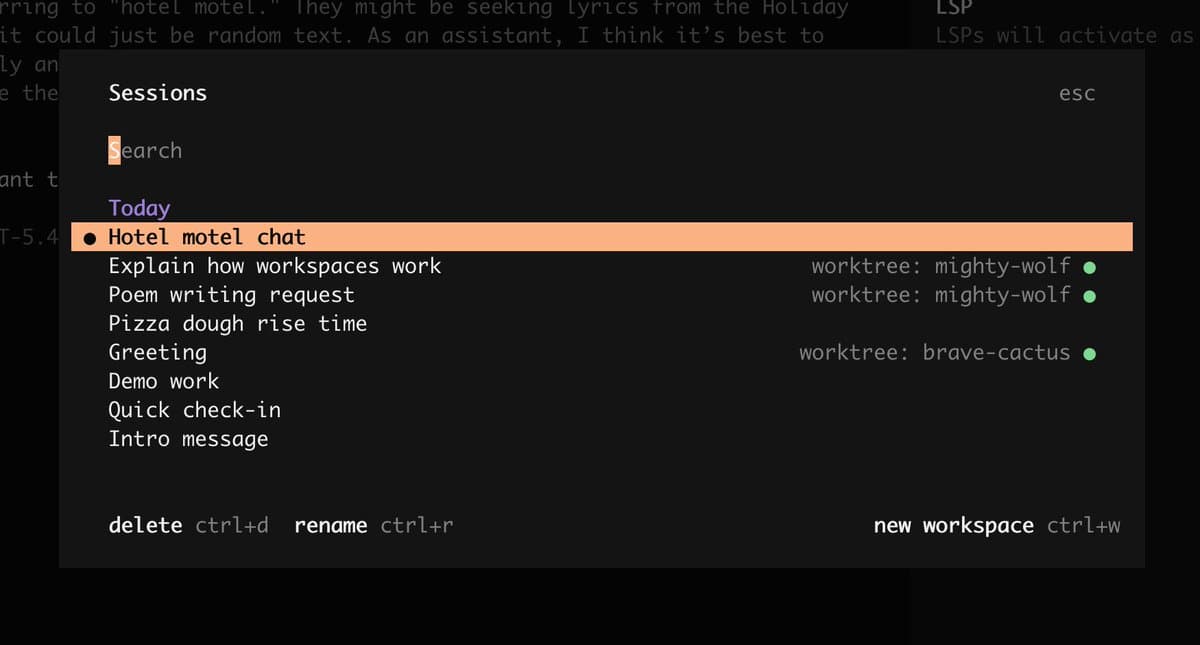
The UI in jlongster's beta warning shows why this shipped as a workspace feature rather than a remote shell feature. The interface is organizing active environments and sessions together, not just forwarding commands into another box.
Remote sync
jlongster's architecture follow-up gives the clearest architecture sketch in the evidence pool. OpenCode is not proxying a thin terminal client into a remote repo. It is running a full OpenCode server remotely, then syncing state back to the local server.
That thread breaks the flow into three mechanics:
- a full OpenCode server runs inside the remote environment, so existing features still work there
- the local server connects to the remote server and syncs changes back locally
- reconnection is resumable, so the local server can reconnect hours later and resync
The durability claim is stronger than simple remote execution. According to jlongster's architecture follow-up, if the remote environment dies you can restore the session from local state, and if your computer dies the remote environment keeps running.
Workspace plugins
The plugin angle makes this more than built-in worktree support. In jlongster's plugin post, jlongster says Daytona is working on an official plugin, and links instructions for building your own workspace type.
The linked workspace adaptor gist fills in the contract:
- enable the feature with
OPENCODE_EXPERIMENTAL_WORKSPACES=true - register a workspace type with
experimental_workspace.register - implement adaptor methods for
configure,create,remove, andtarget - return either a local directory or a remote URL as the workspace target
- persist whatever extra workspace metadata your runtime needs
That design pushes OpenCode toward a control plane for agent runtimes. Git worktrees are the built-in example, but the interface is already shaped for sandboxes and hosted dev environments.
Remote workflows were already in the product
Discussion around OpenCode – Open source AI coding agent
Thread discussion highlights: - everlier on remote/mobile workflows: You can start a service via `opencode serve`, it can be accessed from anywhere... It’s a really good way to work with your agents remotely, goes really well with TailScale. - anonym29 on telemetry and proxying: OpenCode is sending telemetry to their own servers, even when you're using your own locally hosted models... there are no environment variables, flags, or other configuration options to disable this behavior. - khimaros on plugins and extensions: ...built a plugin to enable a very minimal OpenClaw alternative as a self modifying hook system over IPC as a plugin for OpenCode...
The interesting context is that remote use was already a live community pattern before 1.4.11. In the HN discussion summary, one commenter described opencode serve as a way to access agents remotely, while another described building a plugin over IPC, and a separate comment described sandboxing OpenCode with bubblewrap.
OpenCode's own product page also frames the tool as more than a terminal wrapper, with OpenCode's site highlighting multi-session support, shareable sessions, plugin hooks, and support for many model backends including local models. The new workspace layer is landing on top of that existing remote and extensibility story, not starting from zero.
Experimental edges
The release came with two concrete warnings. First, jlongster's beta warning says the whole feature is experimental. Second, that same post says remote environments are the likeliest place for breakage.
The older Hacker News thread also surfaced adjacent operational concerns around telemetry and sandboxing, which matter more once sessions can outlive a laptop and move across environments. Those concerns are not new to 1.4.11, but the workspace rollout makes them more central than they were in a purely local workflow.