
Qwen3.6-Plus launches with 1M context and Code Arena #8 ranking
Alibaba launched Qwen3.6-Plus with a 1M default context window, stronger coding and multimodal performance, and rollout across chat, API, and routing partners. Benchmarks and partner availability make it a new high-end option for agentic coding and web tasks.
TL;DR
- Alibaba Qwen's launch thread introduced Qwen3.6-Plus as a hosted flagship with default 1M context, stronger agentic coding, upgraded multimodal reasoning, and chat plus API access from day one.
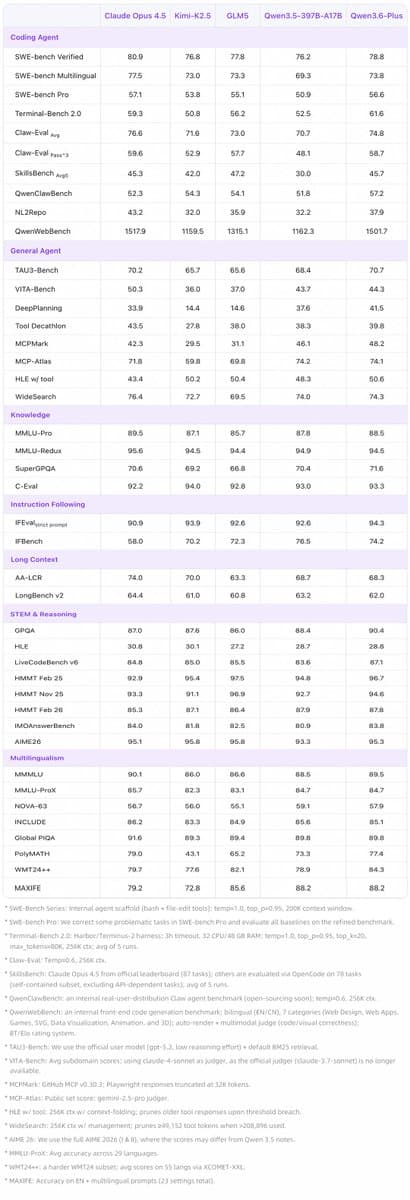
- In Qwen's LM benchmark table, Qwen3.6-Plus posted 61.6 on Terminal-Bench 2.0, 56.6 on SWE-bench Pro, 78.8 on SWE-bench Verified, and 57.2 on QwenClawBench, while bridgemindai's comparison highlighted that Terminal-Bench result as a win over Claude Opus 4.5.
- Qwen's VLM benchmark table shows the same release pushing multimodal scores to 91.2 on OmniDocBench 1.5, 85.4 on RealWorldQA, 87.8 on Video-MME with subtitles, and 68.2 on ScreenSpot Pro.
- Arena's ranking post put Qwen 3.6 Plus Preview at #8 overall in Code Arena and #2 lab on the React leaderboard, a result Alibaba amplified in its follow-up post as evidence that the model's webdev agent loop is getting competitive.
- Distribution moved fast: OpenRouter made the model free with no prompt or completion retention during the launch window, Vercel added it to AI Gateway the same day, and Alibaba's Fireworks announcement said inference plus fine-tuning support is next.
The official blog post ties the whole launch to “real-world agents,” while the OpenRouter model page adds one extra technical detail, a hybrid linear-attention plus sparse-MoE architecture. The Vercel changelog is already pitching it for repo-level refactors and long-horizon tasks, and the main HN thread immediately fixated on a different question, whether a lab known for open weights can turn a hosted-only flagship into a serious Claude and ChatGPT competitor.
Agentic coding benchmarks
Qwen's main claim is simple: this release is aimed at coding agents, not just code completion.
The strongest numbers are concentrated in terminal use, repo-scale tasks, and internal agent evals:
- Terminal-Bench 2.0: 61.6
- SWE-bench Pro: 56.6
- SWE-bench Verified: 78.8
- SWE-bench Multilingual: 73.8
- Claw-Eval Pass^3: 58.7
- QwenClawBench: 57.2
- QwenWebBench: 1501.7 Elo
- NL2Repo: 37.9
According to Qwen's own table, that mix puts Qwen3.6-Plus ahead of Claude Opus 4.5 on Terminal-Bench 2.0, SkillsBench average, and QwenClawBench, while Claude stays ahead on SWE-bench Verified, SWE-bench Multilingual, SWE-bench Pro, and NL2Repo. That split matters because it makes the launch look less like a clean frontier sweep and more like a serious bid for the terminal-and-tool-use lane.
Multimodal and visual agent results
The other half of the launch is vision. Qwen is not framing 3.6-Plus as a text-only coding model.
The visual benchmark spread is broad enough to matter for agent work:
- OmniDocBench 1.5: 91.2
- RealWorldQA: 85.4
- Video-MME with subtitles: 87.8
- AI2D_TEST: 94.4
- RefCOCO average: 93.5
- ScreenSpot Pro: 68.2
- OSWorld-Verified: 62.5
The VLM table shows especially strong document, OCR, and general image reasoning scores, while the visual-agent numbers are more mixed. Screen interaction and OSWorld-style control improved, but they did not land in obvious category-leading territory from this table alone.
Code Arena and webdev signals
Independent leaderboard signals landed within hours of the release.
Arena ranked Qwen 3.6 Plus Preview at #8 overall in its agentic webdev board, with a 1454 preliminary score, and put Alibaba at #2 lab on the React leaderboard. Arena's wording matters here: the board is meant to reflect multi-step reasoning, tool use, and multi-file app work, not single-file benchmark puzzles.
That lines up with the rest of Qwen's evidence pack. Its LM table includes a 1501.7 Elo on QwenWebBench, and OpenRouter's announcement summarized the release as “1M context, multimodal, agentic,” which is basically the same positioning in one line.
1M context and rollout
Alibaba launched the model across its own surfaces first, then immediately fanned it out through routing and platform partners.
The official launch exposed three entry points on day one: Qwen Chat, the Alibaba Cloud Model Studio API, and the official blog post. Later the same day, OpenRouter listed the model as free with 1,000,000 context and said prompts and completions would not be retained during that period, while the OpenRouter model page described the backend as hybrid linear attention plus sparse mixture-of-experts routing.
The partner rollout filled in different parts of the stack. Vercel's changelog positioned it for frontend work, repository-level problem solving, tool calling, and long-horizon planning under the alibaba/qwen3.6-plus model ID. Alibaba's Fireworks announcement added that inference and fine-tuning support are coming soon, which makes this look less like a one-platform release and more like a fast distribution push.
Demo prompts and open-source follow-ons
Qwen also spent launch day showing the model on flashy generation tasks, not just benchmark charts.
One shared prompt asked for “a 3D snow mountain scene” with a Japanese-style temple in a Breath of the Wild aesthetic, and another asked for a monochrome portfolio site with oversized serif type, a custom cursor, perspective-shifting images, and parallax text. A 3D scene demo from the launch-day thread is the cleaner example because it compresses the model's multimodal story into one artifact.
The final interesting detail is buried in the launch note itself: Alibaba Qwen said “more Qwen3.6 models” are coming and will be open-sourced. That gives the day-one hosted flagship an unusual coda, because the company is selling a closed high-end endpoint while promising that smaller members of the same family will still feed the open-weight pipeline.