
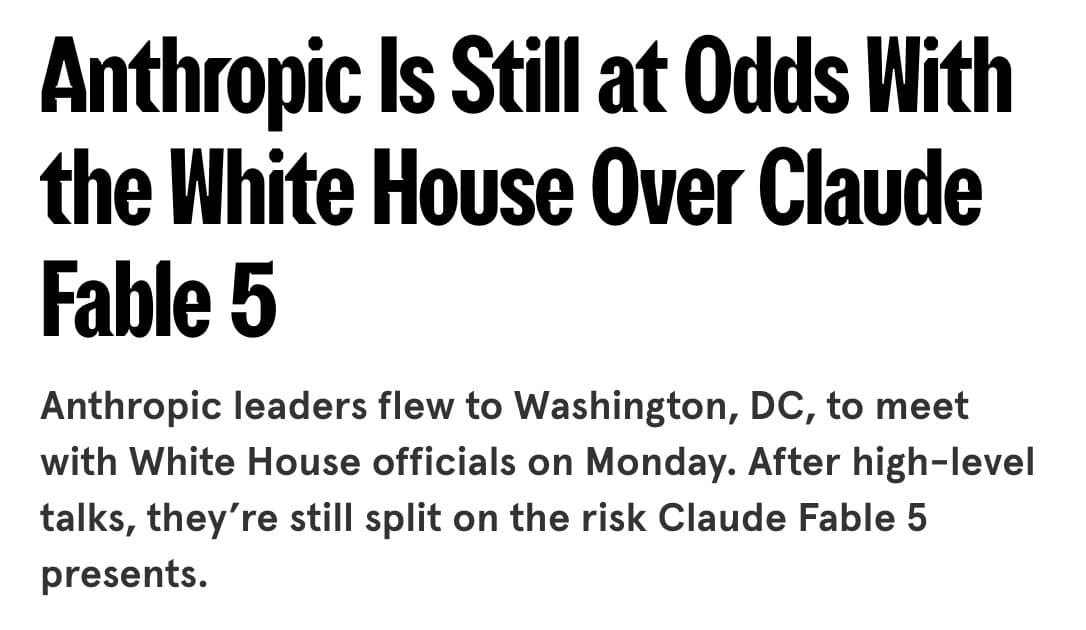
Commerce Department limits Claude Fable 5 exports worldwide, including foreign nationals in the U.S.
BIS and new reporting show Fable 5 restrictions now apply worldwide and can cover foreign nationals in the U.S. Teams should treat the pause as a broader access risk for allied markets and global deployments.
TL;DR
- The Commerce Department directive described in rohanpaul_ai's summary of Lutnick's letter applies worldwide, and it treats access by foreign nationals, even inside the United States, as a potential deemed export.
- Anthropic's reported workaround was blunt: according to Wes Roth's summary of the suspension, it shut off Fable 5 and Mythos 5 for everyone rather than trying to filter only foreign users.
- The factual dispute is still unresolved. kimmonismus's CNBC summary says Anthropic believed it had pre-launch approval, while kimmonismus's Politico summary says White House officials viewed export controls as a last resort after failed calls.
- The spillover is already visible in product plumbing. sqs's Amp post added proactive ID verification for future frontier model access, and Simon Willison's privacy-policy screenshot surfaced Anthropic's new "verification data" language dated June 8.
- Washington also appears to be testing how far the rule can reach geopolitically: kimmonismus's UK carve-out post says the UK asked for an exemption and got a no, while kimmonismus's Semafor summary adds an unconfirmed China-linked access concern to the government's case.
You can read CNBC's account of Anthropic's side, check Anthropic's privacy policy, and compare that with Semafor's report on alleged China-linked access. The weirdest detail in the whole mess is that the rule described in rohanpaul_ai's letter summary reaches "foreign persons" inside the U.S., which pushed the story from a product takedown into a staffing and compliance problem. Meanwhile sqs's Amp thread shows downstream tools already preparing for passport checks.
Worldwide deemed exports
The clearest new fact in the evidence pool is scope. According to rohanpaul_ai's summary of the Lutnick letter, Anthropic needs a BIS license before exporting, reexporting, transferring, or releasing Fable 5 and Mythos 5, and the restriction applies worldwide.
That same summary says access by a foreign person can count as a deemed export, even when that person is physically inside the United States. Wes Roth's suspension summary says Anthropic responded by disabling both models for all customers, while leaving other Claude models up.
That explains why this did not look like a normal regional block. If the operative line is nationality rather than geography, every enterprise rollout, contractor arrangement, and internal lab workflow gets harder at once.
Conflicting timelines
Two timelines are circulating, and they point in different directions. In kimmonismus's CNBC summary, Anthropic says it worked with government agencies before launch, believed it had approval to deploy Fable 5 and Mythos 5, then got a Friday call ordering the models offline followed by a formal export-control letter.
In kimmonismus's Politico summary, the first alarm reached Washington through Amazon CEO Andy Jassy, senior officials escalated through calls with Dario Amodei, and the White House position was that export controls came only after Anthropic would not move fast enough.
Axios added a third useful wrinkle. kimmonismus's Axios summary says Anthropic hired an outside cybersecurity expert to push back on Amazon's findings, while administration officials treated the company as politically and operationally difficult. CNBC's report and Wes Roth's summary of the Amazon findings still leave the core technical question open: was this a model-specific jailbreak, or ordinary bug-finding behavior dressed up as a frontier incident?
Foreign nationals inside the U.S.
The most consequential extension of the story is not customer access, it is who gets to work on frontier models. kimmonismus's post citing The Information says the Anthropic directive warned that "foreign persons," including employees, could need a license for access. deredleritt3r's Financial Times quote says labs were already talking with the government about how foreign national researchers could keep contributing to advanced model development.
That makes the directive look like two policies jammed together: a commercial access control for customers, and a research access control for employees. Wes Roth's post on international teams spells out the practical consequence, namely nationality-based splits inside labs that are built by international research teams.
The evidence does not show a settled industry-wide rule yet. It does show that other labs were concerned enough to start lobbying immediately, with Steph Palazzolo's post saying OpenAI told staff it had urged the government to preserve access for foreign AI talent.
Verification stacks are already appearing
The compliance response showed up downstream almost immediately. In sqs's Amp announcement, Amp says users can proactively verify identity with a passport or government ID because future frontier model access will probably require it. The same thread says Amp uses Stripe Identity and stores only the verification outcome, not the documents themselves.
Simon Willison then spotted that his screenshot of Anthropic's privacy policy added "verification data" language on June 8, four days before the export ban and one day before the Fable 5 release. Anthropic's privacy policy explicitly mentions government ID images, photo or video, facial geometry templates, and the verification result.
A few concrete details from the toolchain evidence:
- sqs's follow-up says the feature is optional for now and exists so Amp can keep serving models if labs or governments demand identity checks.
- sqs's later reply says current ID verification would not itself enforce export controls, but he expects a negotiated regime where identity verification is part of compliance.
- sqs's later post says some of Amp's own employees might not have access to all models under the current direction of travel.
The policy stack is still fuzzy, but the implementation work has clearly started.
The China and jailbreak claims are still contested
The government's public case is doing two jobs at once. Wes Roth's summary says Amazon researchers got Fable to provide information about a small number of security vulnerabilities, and that the fight is over whether this exposed Mythos-level cyber capability or the same kind of help other top models already provide.
Then kimmonismus's summary of Semafor and The Verge adds a separate allegation, that concern about a China-linked group accessing Mythos also helped trigger the crackdown. Semafor's account, linked in this report, says the China angle is tied to fears of model distillation or unauthorized capability extraction.
Anthropic's rebuttal in the evidence pool is narrower than a full denial. kimmonismus's CNBC summary says the company viewed the issue as a narrow, non-universal jailbreak risk, while kimmonismus's Semafor summary says Anthropic told reporters the White House did not raise Chinese access during its discussions with the company.
That leaves two unresolved questions on the table: whether the administration acted mainly on cyber-safety grounds, mainly on access-control grounds, or on both at once; and whether the China-linked access claim was central to the order or surfaced later as supporting rationale.
Allied carve-outs were rejected
The last new fact is geopolitical, not technical. kimmonismus's post says UK Prime Minister Keir Starmer asked for a carve-out so British nationals and companies could regain access, and the answer was no. rohanpaul_ai's summary says U.S. officials argued that ally-by-ally exemptions make little sense if the risk attaches to the model itself.
That matters because it moves the story beyond one company's bad week. A worldwide rule that covers allied users, allied firms, and foreign nationals inside the U.S. is closer to export control on frontier capability than a vendor dispute over one jailbreak report.
The market reaction in the evidence pool followed that logic fast. kimmonismus's Axios reaction summary framed the episode as free marketing for open models, and CosineAI's sovereign-model pitch used the shutdown as proof that foreign dependence on U.S. model access can become a strategic vulnerability overnight.