
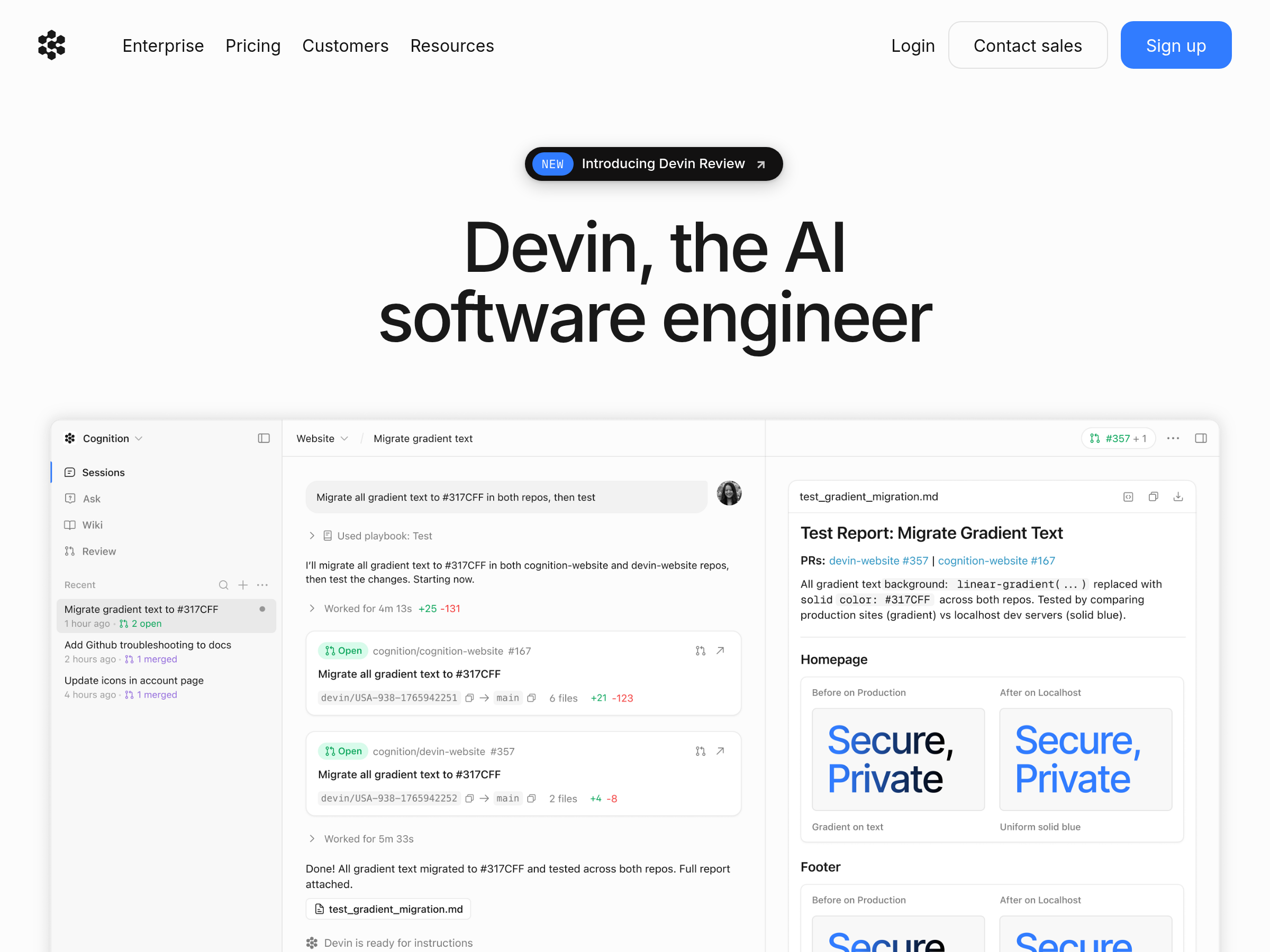
Devin
The AI software engineer.
Autonomous AI software-engineering agent that can plan, implement, test, and help maintain software through a cloud workspace and integrations.
Recent stories
Cognition’s Memory and Dreaming features build a memory graph across Devin sessions and revise stale records overnight. The open-source system is designed to work across harnesses and environments.
Cognition says Devin can launch native macOS environments, run Xcode and iOS simulators, and test Apple apps in the cloud. The company demonstrated prompt-driven workflows for iOS, iPadOS, and macOS apps.
Cursor said cloud agents rose from 1 in 10 merged PRs in December to 56% today. Its setup gives agents cloud computers and tooling to repair their own environments.
Kyle Jeong open-sourced a Devin Fusion-style orchestrator with sidekick agents for subtasks. Peter Steinberger used Codex with 12 subagents, worktrees, dev gateways, and autonomous PRs to test OpenClaw.
Cognition said Devin Fusion now uses Fable 5 and saw lower cost per task than Opus 4.8. Practitioners cited Fable-led delegation patterns that cut token use, with caveats on serial debugging.
Devin exposed routers such as Fusion, claiming frontier performance at 35% lower cost, while Databricks argued for smart routing in agent harnesses. New charts put Grok 4.5 and Muse Spark 1.1 near the coding-cost frontier.
Cognition says SWE-1.7 was trained with RL on a Kimi K2.7 base and now runs in Devin at 1,000 tok/s. It reports 42.3% on FrontierCode at $1.97 per task and released revised grading rules.
Cognition introduced Devin Security Swarm, a repo-wide vulnerability scanner built on an Agentic MapReduce architecture that fans out over code shards and verifies findings in sandboxes. In a 50-vulnerability GHSA eval across 14 languages, it found 36 issues at 30% lower cost per finding than the next most accurate alternative.
Cognition launched Devin Fusion, a hybrid coding harness that reroutes work mid-task and says it cuts Fable-class cost by 35%. Use it when upfront routing misses late complexity; the router can re-evaluate after investigation starts.
Codex usage moved further into phone-first workflows, with iOS dictation loops, background voice capture, and app updates like searchable settings and restored state. The comparisons still flag rough spots in multi-thread UX, Windows support, and cases where CLI tabs or cloud agents are easier to manage.
Vendors pushed routing and spend controls closer to the default app layer, including OpenRouter's cache-hit pricing telemetry and Devin's adaptive routing. The discussion frames model choice more as a budget-control problem than a pure quality setting.
Cognition said it will fund Devin usage up to $10 million when measured engineering value falls below cost, and published a technical writeup estimating productive engineering hours per session. It matters because the company is shifting agent pricing from tokens to claimed output and extending coding evaluation toward much longer task horizons.
Cognition added a desktop control surface that can run Devin, Codex, Claude, and other ACP-compatible agents across local and cloud contexts. The app turns Devin from a single hosted agent into a broader orchestration surface.
Cognition added native Windows VMs to Devin so it can build, run, and test Windows applications with MSBuild, IIS, PowerShell, and SQL Server. The rollout lets Devin handle enterprise codebases where Linux sandboxes are not enough.
Cognition launched Devin Auto-Triage to watch issues across Slack, Linear, GitHub, schedules, webhooks, and observability tools. Teams can use it as an always-on investigation flow that returns context, next steps, or a PR.
Raindrop launched Triage, a Slack-based agent that finds traces, summarizes recurring failures, runs recurring briefs, and opens experiments from production conversations. Teams using Claude Code, Cursor, or Devin can plug it into agent ops to shorten debugging loops.
Cognition launched Devin for Terminal, a local CLI agent that can hand active sessions to the cloud with `/handoff` and switch across frontier models. It gives teams a hybrid local/remote workflow without forcing them into a separate cloud IDE from the start.
Windsurf 2.0 launched with Devin embedded into the product, combining local agents with cloud agents that can continue across codebases after you close the laptop. The IDE now acts as a handoff layer between interactive edits and long-running remote execution.