
ARQ publishes storyboard-first workflow for 20- to 30-second AI film generations
ARQ breaks longer films into 20- to 30-second generations, planning shots and A-roll/B-roll before generation. The workflow uses still references, Blender gray-boxing, Fable 5.1 prompts, Seedance 2.5, and a final CapCut edit.
TL;DR
- ARQ made its three-minute film with Seedance 2.5 in CapCut, Blender, Midjourney, and NB pro, according to starks_arq's prompt release, after first describing the project as a 1080p CapCut and Seedance production in starks_arq's original film post.
- Each script passage became one 20- to 30-second generation, following starks_arq's pacing note, rather than an attempt to synthesize the whole film at once.
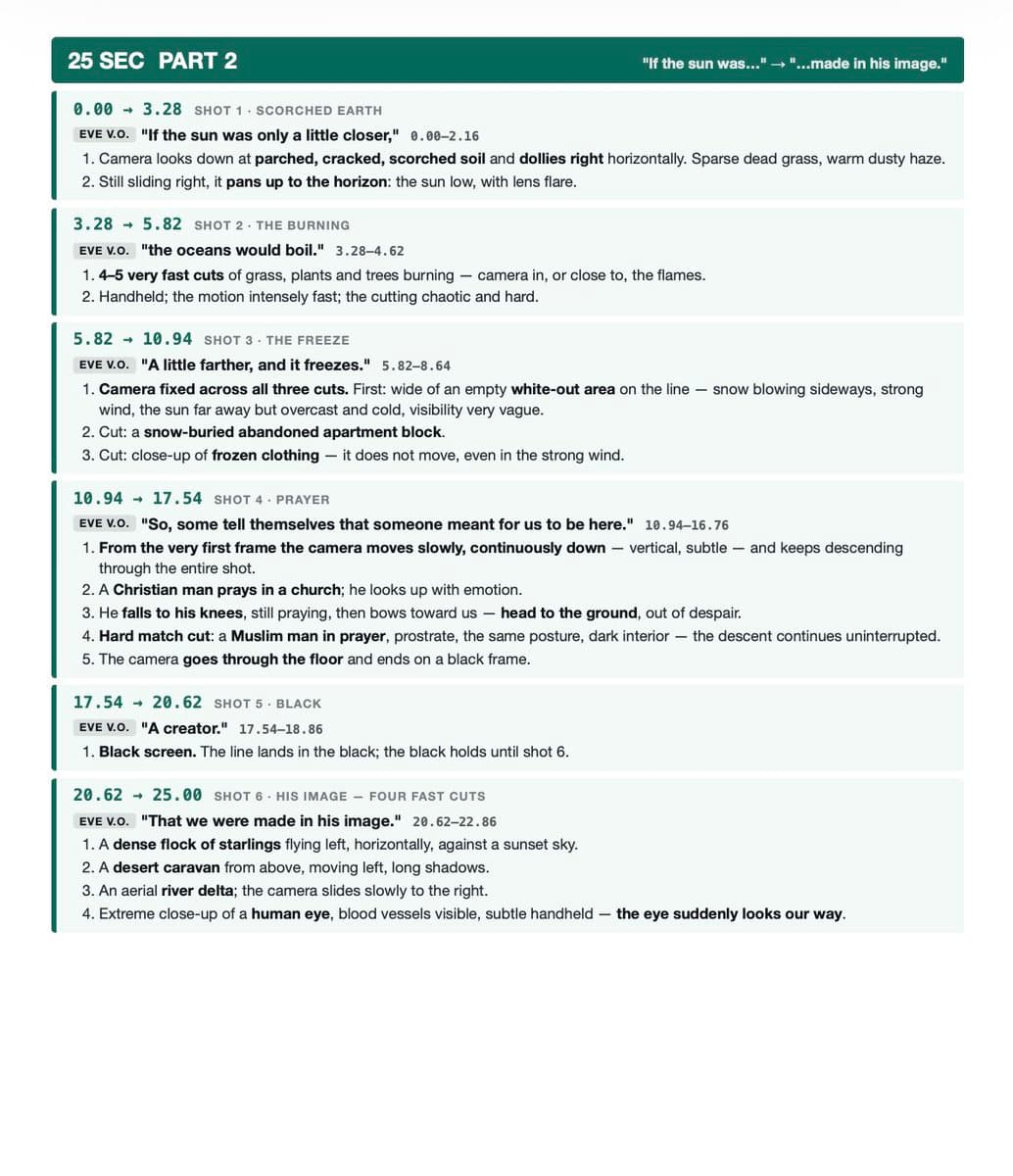
- A shot map specified camera angle, movement, lighting, lens, and action before Fable 5.1 turned it into timestamped, asset-aware prompts, as starks_arq's prompt-template note details.
- ARQ locked character, environment, and camera intent with stills and Blender gray-box MP4s, a method described in starks_arq's reference-image note and starks_arq's Blender note.
- The team carried a dialogue across generations by briefly starting the next clip on the preceding clip's last frame, then removing that half-second in the edit, per starks_arq's continuity fix.
CapCut’s Seedance 2.5 feature page says white-model footage can direct movement, spatial placement, multi-character interaction, and scene blocking. Dreamina’s R2V guide separates motion, style, image, audio, and storyboard references, the same inputs ARQ turns into a miniature film pipeline.
20- to 30-second units
ARQ began with a script written years earlier by easys_arq, according to starks_arq's script note. It divided that text into consecutive 20- to 30-second passages, with each passage assigned to a single generation.
Each passage received a shot map:
- Angles
- Camera movement
- Lighting
- Lens
- Actions
Fable 5.1 received that map plus an uploaded template. Its output had to contain:
- Timestamped beats
- Assets
- Constraints
A-roll and B-roll
The storyboard separated a stable A-roll world from B-roll cutaways. In starks_arq's layer plan, the A-roll keeps Eve and Spectrum in front of The Creation of Adam, while the B-roll moves through environments that reinforce their dialogue and preserve the end reveal that Eve is addressing an AI.
Before video runs, the team generated reference stills for character designs, environments, and B-roll plates. Those stills and the prepared prompts then went into the canvas one part at a time, starks_arq's reference-image note says.
Timestamped reruns
A failed take did not send ARQ back to the beginning of a 30-second unit. Its timestamped prompt structure identified the failing second, then the team changed only the relevant line and reran it while preserving what already worked.
The correction loop was:
- Find the timestamp where the footage diverged.
- Edit the matching prompt line in CapCut.
- Rerun the affected passage.
Blender blocking
ARQ used Blender when prose could not lock a precise move. For the NEO robot shot and final dialogue, it built simple gray-box MP4s and supplied them as video references, preserving the intended camera path and composition.
That combination was already part of an earlier starks_arq Blender and Seedance post. In a separate previs test, GlennHasABeard's previs post had Claude generate and repair a Blender Python script, render 720 frames headlessly in 2.9 minutes, and cut between ten named cameras at specified frames.
The final edit
ARQ’s CapCut pass covered minor cuts, smooth transitions, sound design, color grading, and a grain overlay.
Selection remains part of the generation loop. techhalla's workflow starts with a Seedream 5 Pro still, animates it in Seedance 2.5, generates additional scenes, then selects the strongest clips for the final cut.
Artedeingenio’s music-video post credits a similarly modular stack, Midjourney for the painterly look, Seedance 2.5 for animation, Suno for the song, and CapCut for final editing. An Artedeingenio F1 post frames fast-paced dynamic editing as central to its racing piece, while an Artedeingenio follow-up says its process breakdown was due later that day.
Frame handoffs
The dialogue between Eve and the cube could not fit cleanly in one 30-second run. ARQ joined the generations with a disguised frame handoff:
- Extract the ending frame of the previous generation.
- Start the next generation with that frame for 0.5 seconds, then cut to another angle and continue the action.
- Remove the 0.5-second bridge during the edit.
The prompt pack
The released prompt collection names the full production stack: Seedance 2.5 through CapCut, Blender, Midjourney, and NB pro.
The Spectrum prompt PDF is offered for reuse, and starks_arq directed a commenter to the comments in a follow-up reply.